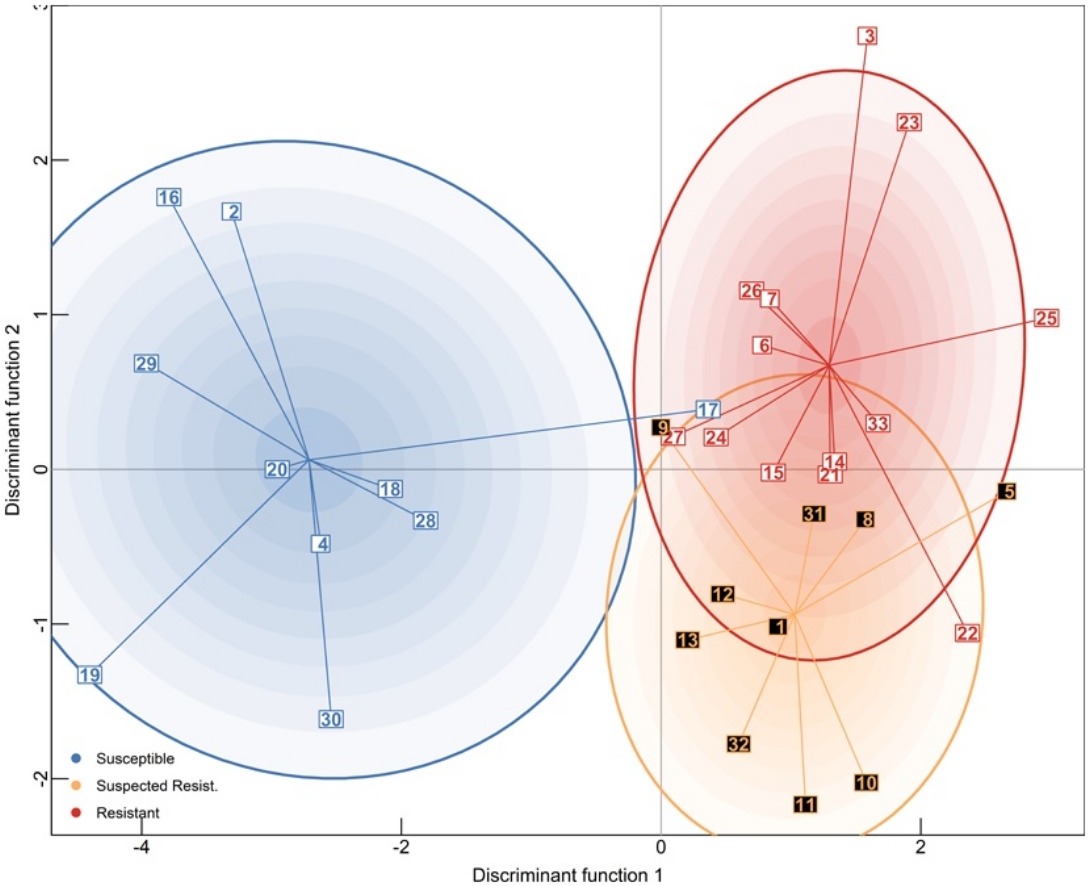
Microscopy is the gold standard for malaria epidemiology, but laboratory and point-of-care (POC) tests detecting parasite antigen, DNA, and human antibodies against malaria have expanded this capacity. The island nation of Haiti is endemic for Plasmodium falciparum (Pf) malaria, though at a low national prevalence and heterogenous geospatial distribution. In 2015 and 2016, serosurveys were …
CTEGD names travel fund for Daniel G. Colley
Dr. Dan Colley with students (photo credit: Andrew Tucker) One day Daniel Colley raised his hand to volunteer, setting in motion five decades of scientific adventures. It was 1969, and Colley’s postdoctoral adviser, ByronWaksman, a renowned immunologist at Yale University School of Medicine, had stepped into the laboratory and asked if anyone wanted to go …
Nationwide Remapping of Schistosoma mansoni Infection in Rwanda Using Circulating Cathodic Antigen Rapid Test: Taking Steps Toward Elimination
Eugene Ruberanziza, Udo Wittmann, Aimable Mbituyumuremyi, Alphonse Mutabazi, Carl H. Campbell Jr, Daniel G. Colley, Fiona M. Fleming, Giuseppina Ortu, Govert J. van Dam, Irenee Umulisa, Jamie Tallant, Michee Kabera, Muhammed Semakula, Paul L. A. M. Corstjens, Tharcisse Munyaneza, Warren Lancaster, Jean Bosco Mbonigaba and Michelle N. Clements. Am J Trop Med Hyg. 2020 May 18. doi: 10.4269/ajtmh.19-0866.
A terminal α3-galactose modification regulates an E3 ubiquitin ligase subunit in Toxoplasma gondii
Skp1, a subunit of E3 Skp1/Cullin-1/F-box protein ubiquitin ligases, is modified by a prolyl hydroxylase that mediates O2-regulation of the social amoeba Dictyostelium and the parasite Toxoplasma gondii. The full effect of hydroxylation requires modification of the hydroxyproline by a pentasaccharide that, in Dictyostelium, influences Skp1 structure to favor assembly of Skp1/F-box protein subcomplexes. In Toxoplasma, the presence of a contrasting …
Antimalarial Diterpenoids From Vitex Rotundifolia: Isolation, Structure Elucidation, and in Vitro Antiplasmodial Activity
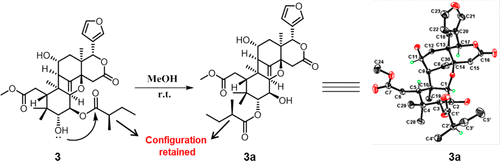
Vitex rotundifolia is an important medicinal plant frequently employed in traditional medicines for the treatment of various ailments. Although this plant species has been under exploration for its constituents by various research groups including our own group, no reports were found regarding the antimalarial potential of this plant or of its purified phytochemicals. Phytochemical investigation …
Supplemental Articles: Operational Research on Controlling and Eliminating Schistosomiasis (SCORE)
These articles are available online ahead of print and summarize much of the work of the Schistosomiasis Consortium for Operational Research and Evaluation (SCORE). The articles will be published as a supplement to the July issue of The American Journal of Tropical Medicine and Hygiene. Schistosomiasis Consortium for Operational Research and Evaluation: Mission Accomplished The …
Directing Traffic: Chaperone-mediated protein transport in malaria parasites
The ability of eukaryotic parasites from the phylum Apicomplexa to cause devastating diseases is predicated upon their ability to maintain faithful and precise protein trafficking mechanisms. Their parasitic life cycle depends on the trafficking of effector proteins to the infected host cell, transport of proteins to several critical organelles required for survival, as well as …
Ynes Ortega receives grant to study Cyclospora presence in the U.S.
Historically, Cyclospora infection in the United States has been associated with imported fresh produce. However, in 2018, the U.S. saw two significant outbreaks associated with vegetables grown in the United States. “We had more than 2,000 non-travel associates cyclosporiasis cases,” said Ynes Ortega, member of the Center for Tropical and Emerging Global Diseases and associate …
UGA researchers join team of 100+ scientists to develop genetic tools for marine protists
Docampo is Barbara and Sanford Orkin/GRA Eminent Scholar in Emerging Diseases and Cellular Biology and professor in the Franklin College of Arts and Sciences. (Photo by Billy Howard) Roberto Docampo and colleagues at the University of Georgia’s Center for Tropical and Emerging Global Diseases have joined with 53 other lab groups to develop tools to …