
VAMP3 vesicles support host protein recruitment and Plasmodium liver stage development
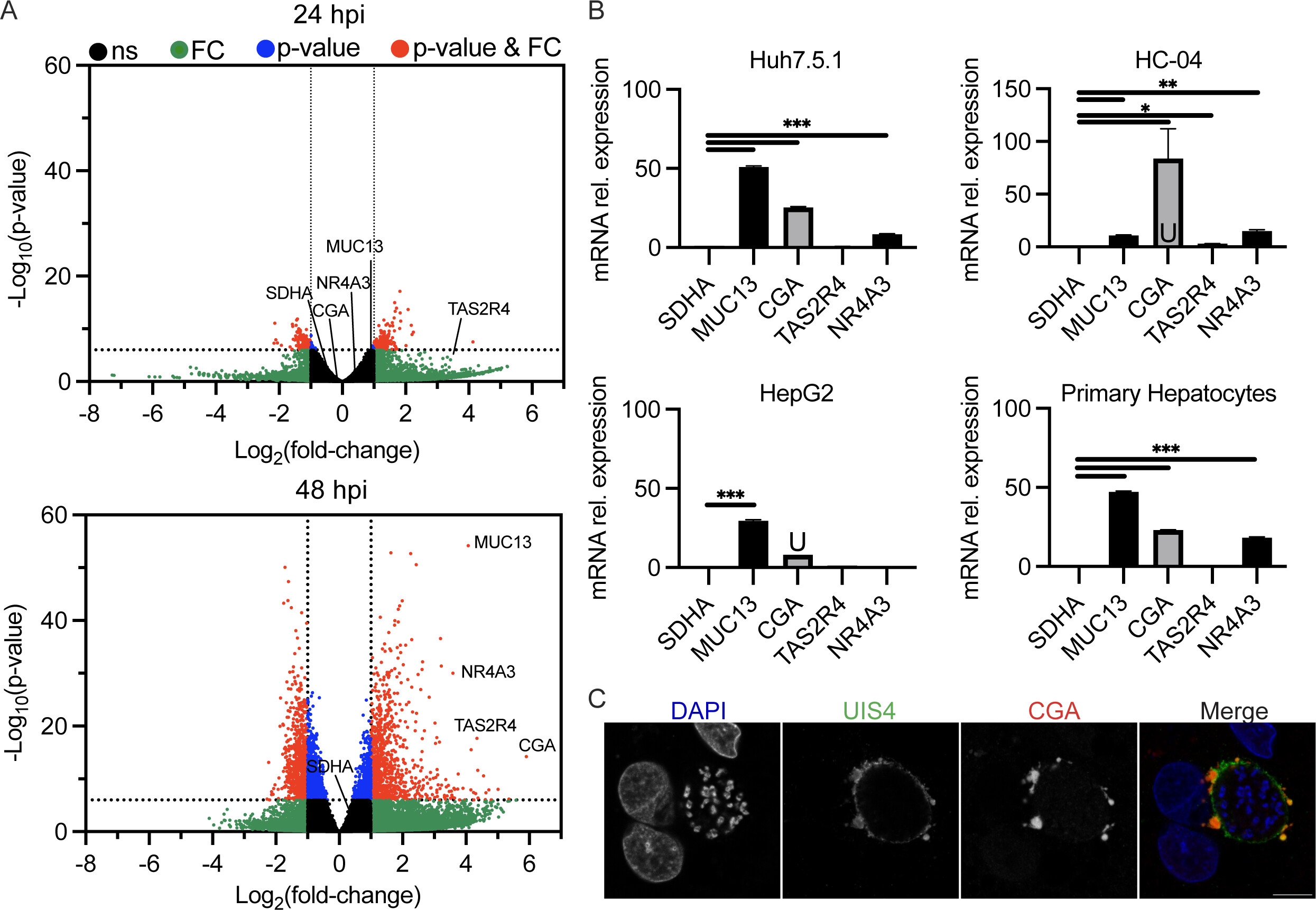
CGA is highly upregulated during liver stage P. berghei infection. (
Plasmodium remodels the host liver cell as an obligatory step in malaria infection. Although several host proteins are recruited to the parasitophorous vacuole membrane (PVM) after invasion, the mechanisms underlying this acquisition remain unknown. Here, we validated the upregulation and recruitment of the host protein CGA during liver stage Plasmodium berghei infection. We then depleted a panel of host trafficking proteins to investigate their role in CGA recruitment to the P. berghei PVM. This highlighted the significance of protein exocytosis for host protein acquisition and identified vesicle-associated membrane protein 3 (VAMP3), a SNARE family protein, as critical for CGA recruitment and parasite growth. A phenotypic study revealed that VAMP3 depletion decreased P. berghei survival after invasion, which correlated with enhanced LC3 recruitment. VAMP3 recruitment to the PVM was observed in the rodent-infective P. berghei and the human-infective Plasmodium falciparum, suggesting host vesicle redirection may be a conserved mechanism during the parasite’s liver stage. Expansion microscopy revealed VAMP3 vesicles near and overlapping with the PVM, suggesting fusion events might occur. This proposal was tested using the chemical probe N-ethylmaleimide (NEM), which prevents SNARE recycling. VAMP3 accumulates on the PVM after NEM treatment, consistent with host vesicle fusion to the PVM. Overall, we uncover factors that facilitate Plasmodium’s acquisition of host proteins and provide evidence that the PVM undergoes fusion with host SNARE machinery.
Importance: Plasmodium remodels the host liver cell as an essential step in malaria infection, yet the mechanisms by which host proteins are acquired at the parasitophorous vacuole membrane (PVM) remain unclear. Here, we show that the host protein CGA is upregulated in the Plasmodium berghei liver stage and recruited to the PVM by host exocytosis machinery. Specifically, the SNARE protein vesicle-associated membrane protein 3 (VAMP3) is linked to CGA acquisition and is shown to be recruited to the PVM in both rodent- and human-infective malaria. Functional VAMP3 is critical for P. berghei growth and correlates with its survival. Imaging and chemical inhibition studies provide evidence that supports host vesicle fusion with the PVM for the first time. Overall, these findings reveal that host SNARE machinery facilitates Plasmodium acquisition of host proteins.
Michael E Chirgwin, Chelsea Gan, Karla P Godinez-Macias, Kaitlyn Choe, Justine C Shiau, Jaeson Calla, Dennis E Kyle, Elizabeth A Winzeler, Emily R Derbyshire. mBio. 2026 Aug 12;17(8):e0143026. doi: 10.1128/mbio.01430-26.