Generic selectors
Exact matches only
Search in title
Search in content
Post Type Selectors

Tag: Roberto Docampo

Mitochondrial Pyruvate Carrier Subunits Are Essential for Pyruvate-Driven Respiration, Infectivity, and Intracellular Replication of Trypanosoma cruzi

Pyruvate is the final metabolite of glycolysis and can be converted into acetyl coenzyme A (acetyl-CoA) in mitochondria, where it is used as the substrate for the tricarboxylic acid cycle. Pyruvate availability in mitochondria depends on its active transport through the heterocomplex formed by the mitochondrial pyruvate carriers 1 and 2 (MPC1/MPC2). We report here studies on MPC1/MPC2 of Trypanosoma cruzi, the etiologic agent of Chagas disease. Endogenous tagging of T. cruzi MPC1 (TcMPC1) and TcMPC2 with 3×c-Myc showed that both encoded proteins colocalize with MitoTracker to the mitochondria of epimastigotes. Individual knockout (KO) of TcMPC1 and TcMPC2 genes using CRISPR/Cas9 was confirmed by PCR and Southern blot analyses. Digitonin-permeabilized TcMPC1-KO and TcMPC2-KO epimastigotes showed reduced O2 consumption rates when pyruvate, but not succinate, was used as the mitochondrial substrate, while α-ketoglutarate increased their O2 consumption rates due to an increase in α-ketoglutarate dehydrogenase activity. Defective mitochondrial pyruvate import resulted in decreased Ca2+ uptake. The inhibitors UK5099 and malonate impaired pyruvate-driven oxygen consumption in permeabilized control cells. Inhibition of succinate dehydrogenase by malonate indicated that pyruvate needs to be converted into succinate to increase respiration. TcMPC1-KO and TcMPC2-KO epimastigotes showed little growth differences in standard or low-glucose culture medium. However, the ability of trypomastigotes to infect tissue culture cells and replicate as intracellular amastigotes was decreased in TcMPC-KOs. Overall, T. cruzi MPC1 and MPC2 are essential for cellular respiration in the presence of pyruvate, invasion of host cells, and replication of amastigotes.

IMPORTANCE Trypanosoma cruzi is the causative agent of Chagas disease. Pyruvate is the end product of glycolysis, and its transport into the mitochondrion is mediated by the mitochondrial pyruvate carrier (MPC) subunits. Using the CRISPR/Cas9 technique, we generated individual T. cruzi MPC1 (TcMPC1) and TcMPC2 knockouts and demonstrated that they are essential for pyruvate-driven respiration. Interestingly, although glycolysis was reported as not an important source of energy for the infective stages, MPC was essential for normal host cell invasion and intracellular replication.

Raquel S. NegreirosNoelia LanderMiguel A. ChiurilloAnibal E. VercesiRoberto Docampo.

Ca2+ entry at the plasma membrane and uptake by acidic stores is regulated by the activity of the V‐H+‐ATPase in Toxoplasma gondii

Ca2+ is a universal intracellular signal that regulates many cellular functions. In Toxoplasma gondii, the controlled influx of extracellular and intracellular Ca2+ into the cytosol initiates a signaling cascade that promotes pathogenic processes like tissue destruction and dissemination. In this work we studied the role of proton transport in cytosolic Ca2+ homeostasis and the initiation of Ca2+ signaling. We used a T. gondii mutant of the V-ATPase, a pump previously shown to transport protons to the extracellular medium, control intracellular pH and membrane potential and we show that proton gradients are important for maintaining resting cytosolic Ca2+ at physiological levels and for Ca2+ influx. Proton transport was also important for Ca2+ storage by acidic stores and, unexpectedly, the endoplasmic reticulum. Proton transport impacted the amount of polyphosphate (polyP), a phosphate polymer that binds Ca2+ and concentrate in acidocalcisomes. This was supported by the co-localization of the vacuolar transporter chaperone 4 (VTC4), the catalytic subunit of the VTC complex that synthesizes polyP, with the V-ATPase in acidocalcisomes. Our work show that proton transport regulate plasma membrane Ca2+ transport and control acidocalcisome polyP and Ca2+ content impacting Ca2+ signaling and downstream stimulation of motility and egress in T. gondii.

Andrew J Stasic, Eric J Dykes, Ciro D Cordeiro, Stephen A Vella, Mojtaba S Fazli, Shannon Quinn, Roberto Docampo, Silvia N J Moreno. Mol Microbiol. 2021 Apr 1. doi: 10.1111/mmi.14722

Deletion of a Golgi protein in Trypanosoma cruzi reveals a critical role for Mn2+ in protein glycosylation needed for host cell invasion and intracellular replication

Trypanosoma cruzi is a protist parasite and the causative agent of American trypanosomiasis or Chagas disease. The parasite life cycle in its mammalian host includes an intracellular stage, and glycosylated proteins play a key role in host-parasite interaction facilitating adhesion, invasion and immune evasion. Here, we report that a Golgi-localized Mn2+-Ca2+/H+ exchanger of T. cruzi (TcGDT1) is required for efficient protein glycosylation, host cell invasion, and intracellular replication. The Golgi localization was determined by immunofluorescence and electron microscopy assays. TcGDT1 was able to complement the growth defect of Saccharomyces cerevisiae null mutants of its ortholog ScGDT1 but ablation of TcGDT1 by CRISPR/Cas9 did not affect the growth of the insect stage of the parasite. The defect in protein glycosylation was rescued by Mn2+ supplementation to the growth medium, underscoring the importance of this transition metal for Golgi glycosylation of proteins.

Ramakrishnan S, Unger LM, Baptista RP, Cruz-Bustos T, Docampo R (2021) Deletion of a Golgi protein in Trypanosoma cruzi reveals a critical role for Mn2+ in protein glycosylation needed for host cell invasion and intracellular replication. PLoS Pathog 17(3): e1009399. https://doi.org/10.1371/journal.ppat.1009399

The Inositol Pyrophosphate Biosynthetic Pathway of Trypanosoma cruzi

Inositol phosphates (IPs) are phosphorylated derivatives of myo-inositol involved in the regulation of several cellular processes through their interaction with specific proteins. Their synthesis relies on the activity of specific kinases that use ATP as phosphate donor. Here, we combined reverse genetics and liquid chromatography coupled to mass spectrometry (LC-MS) to dissect the inositol phosphate biosynthetic pathway and its metabolic intermediates in the main life cycle stages (epimastigotes, cell-derived trypomastigotes, and amastigotes) of Trypanosoma cruzi, the etiologic agent of Chagas disease. We found evidence of the presence of highly phosphorylated IPs, like inositol hexakisphosphate (IP6), inositol heptakisphosphate (IP7), and inositol octakisphosphate (IP8), that were not detected before by HPLC analyses of the products of radiolabeled exogenous inositol. The kinases involved in their synthesis (inositol polyphosphate multikinase (TcIPMK), inositol 5-phosphate kinase (TcIP5K), and inositol 6-phosphate kinase (TcIP6K)) were also identified. TcIPMK is dispensable in epimastigotes, important for the synthesis of polyphosphate, and critical for the virulence of the infective stages. TcIP5K is essential for normal epimastigote growth, while TcIP6K mutants displayed defects in epimastigote motility and growth. Our results demonstrate the relevance of highly phosphorylated IPs in the life cycle of T. cruzi.

Brian S Mantilla, Leticia D Do Amaral, Henning J Jessen, Roberto Docampo. ACS Chem Biol. 2021 Jan 7. doi: 10.1021/acschembio.0c00759

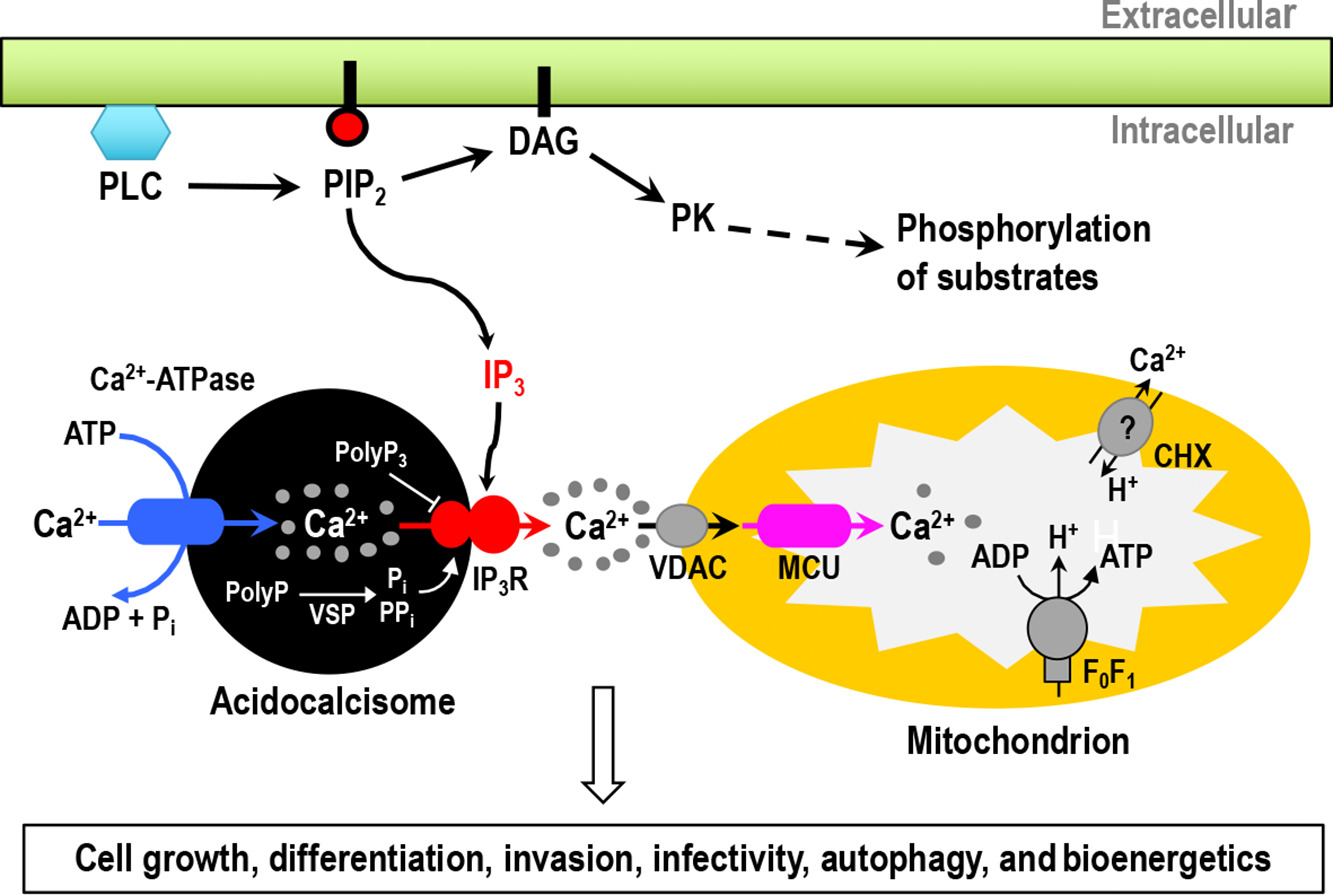
The IP 3 receptor and Ca 2+ signaling in trypanosomes

Trypanosoma cruzi, and the T. brucei group of parasites cause neglected diseases that affect millions of people around the world. These unicellular microorganisms have complex life cycles involving an insect vector and a mammalian host. Both groups of pathogens possess an inositol 1,4,5-trisphosphate (IP3)/diacylglycerol (DAG) signaling pathway, and an IP3 receptor, but with lineage-specific adaptations that make them different from their mammalian counterparts. The phospholipase C (PLC), which hydrolyzes phosphatidyl inositol 4,5-bisphosphate (PIP2) to IP3 is N-terminally myristoylated and palmitoylated. Acidocalcisomes, which are lysosome-related organelles rich in polyphosphate, are the main intracellular Ca2+ stores. The inositol 1,4,5-trisphosphate receptor (IP3R) localizes to acidocalcisomes instead of the endoplasmic reticulum. The trypanosome IP3R is stimulated by luminal phosphate and pyrophosphate, which are hydrolysis products of polyphosphate (polyP), and inhibited by tripolyphosphate (polyP3), which is the most abundant polyP in acidocalcisomes. Ca2+ signaling is important for host cell invasion and differentiation and to maintain cellular bioenergetics.

Roberto Docampo, Guozhong Huang. Biochim Biophys Acta Mol Cell Res. 2021 Jan 6;118947. doi: 10.1016/j.bbamcr.2021.118947

Affinity‐based proteomics reveals novel targets of inositol pyrophosphate (5‐IP7)‐dependent phosphorylation and binding in Trypanosoma cruzi replicative stages

Diphosphoinositol-5-pentakisphosphate (5-PP-IP5 ), also known as inositol heptakisphosphate (5-IP7 ), has been described as a high-energy phosphate metabolite that participates in the regulation of multiple cellular processes through protein binding or serine pyrophosphorylation, a post-translational modification involving a β-phosphoryl transfer. In this study, utilizing an immobilized 5-IP7 affinity reagent, we performed pull-down experiments coupled with mass spectrometry identification, and bioinformatic analysis, to reveal 5-IP7 -regulated processes in the two proliferative stages of the unicellular parasite Trypanosoma cruzi. Our protein screen clearly defined two cohorts of putative targets either in the presence of magnesium ions or in metal-free conditions. We endogenously tagged four protein candidates and immunopurified them to assess whether 5-IP7 -driven phosphorylation is conserved in T. cruzi. Among the most interesting targets, we identified a choline/o-acetyltransferase domain-containing phosphoprotein that undergoes 5-IP7 -mediated phosphorylation events at a polyserine tract (Ser578-580 ). We also identified a novel SPX domain-containing phosphoribosyl transferase [EC 2.7.6.1] herein termed as TcPRPPS4. Our data revealed new possible functional roles of 5-IP7 in this divergent eukaryote, and provided potential new targets for chemotherapy.

Brian S Mantilla, Karunakaran Kalesh, Nathaniel W Brown Jr, Dorothea Fiedler, Roberto Docampo. Mol Microbiol. 2020 Dec 22. doi: 10.1111/mmi.14672.

Different Sensitivity of Control and MICU1- and MICU2-Ablated Trypanosoma cruzi Mitochondrial Calcium Uniporter Complex to Ruthenium-Based Inhibitors

The mitochondrial Ca2+ uptake in trypanosomatids shares biochemical characteristics with that of animals. However, the composition of the mitochondrial Ca2+ uniporter complex (MCUC) in these parasites is quite peculiar, suggesting lineage-specific adaptations. In this work, we compared the inhibitory activity of ruthenium red (RuRed) and Ru360, the most commonly used MCUC inhibitors, with that of the recently described inhibitor Ru265, on Trypanosoma cruzi, the agent of Chagas disease. Ru265 was more potent than Ru360 and RuRed in inhibiting mitochondrial Ca2+ transport in permeabilized cells. When dose-response effects were investigated, an increase in sensitivity for Ru360 and Ru265 was observed in TcMICU1-KO and TcMICU2-KO cells as compared with control cells. In the presence of RuRed, a significant increase in sensitivity was observed only in TcMICU2-KO cells. However, application of Ru265 to intact cells did not affect growth and respiration of epimastigotes, mitochondrial Ca2+ uptake in Rhod-2-labeled intact cells, or attachment to host cells and infection by trypomastigotes, suggesting a low permeability for this compound in trypanosomes.

Mayara S Bertolini, Roberto Docampo. Int J Mol Sci. 2020 Dec 7;21(23):E9316. doi: 10.3390/ijms21239316.

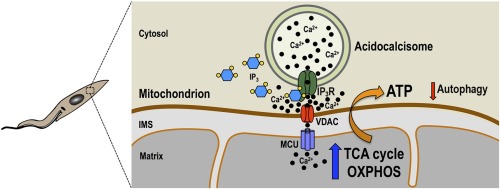
IP3 receptor-mediated Ca2+ release from acidocalcisomes regulates mitochondrial bioenergetics and prevents autophagy in Trypanosoma cruzi

In contrast to animal cells, the inositol 1,4,5-trisphosphate receptor of Trypanosoma cruzi (TcIP3R) localizes to acidocalcisomes instead of the endoplasmic reticulum. Here, we present evidence that TcIP3R is a Ca2+ release channel gated by IP3 when expressed in DT40 cells knockout for all vertebrate IP3 receptors, and is required for Ca2+ uptake by T. cruzi mitochondria, regulating pyruvate dehydrogenase dephosphorylation and mitochondrial O2 consumption, and preventing autophagy. Localization studies revealed its co-localization with an acidocalcisome marker in all life cycle stages of the parasite. Ablation of TcIP3R by CRISPR/Cas9 genome editing caused: a) a reduction in O2 consumption rate and citrate synthase activity; b) decreased mitochondrial Ca2+ transport without affecting the membrane potential; c) increased ammonia production and AMP/ATP ratio; d) stimulation of autophagosome formation, and e) marked defects in growth of culture forms (epimastigotes) and invasion of host cells by infective stages (trypomastigotes). Moreover, TcIP3R overexpressing parasites showed decreased metacyclogenesis, trypomastigote host cell invasion and intracellular amastigote replication. In conclusion, the results suggest a modulatory activity of TcIP3R-mediated acidocalcisome Ca2+ release on cell bioenergetics in T. cruzi.

Miguel A. Chiurillo, Noelia Lander, Anibal E. Vercesi, Roberto Docampo, 2020. Cell Calcium; 92:102284, https://doi.org/10.1016/j.ceca.2020.102284.

Lathosterol Oxidase (Sterol C-5 Desaturase) Deletion Confers Resistance to Amphotericin B and Sensitivity to Acidic Stress in Leishmania Major

Lathosterol oxidase (LSO) catalyzes the formation of the C-5–C-6 double bond in the synthesis of various types of sterols in mammals, fungi, plants, and protozoa. In Leishmania parasites, mutations in LSO or other sterol biosynthetic genes are associated with amphotericin B resistance. To investigate the biological roles of sterol C-5–C-6 desaturation, we generated an LSO-null mutant line (lso) in Leishmania major, the causative agent for cutaneous leishmaniasis. lso parasites lacked the ergostane-based sterols commonly found in wild-type L. major and instead accumulated equivalent sterol species without the C-5–C-6 double bond. These mutant parasites were replicative in culture and displayed heightened resistance to amphotericin B. However, they survived poorly after reaching the maximal density and were highly vulnerable to the membrane-disrupting detergent Triton X-100. In addition, lso mutants showed defects in regulating intracellular pH and were hypersensitive to acidic conditions. They also had potential alterations in the carbohydrate composition of lipophosphoglycan, a membrane-bound virulence factor in Leishmania. All these defects in lso were corrected upon the restoration of LSO expression. Together, these findings suggest that the C-5–C-6 double bond is vital for the structure of the sterol core, and while the loss of LSO can lead to amphotericin B resistance, it also makes Leishmania parasites vulnerable to biologically relevant stress.

IMPORTANCE Sterols are essential membrane components in eukaryotes, and sterol synthesis inhibitors can have potent effects against pathogenic fungi and trypanosomatids. Understanding the roles of sterols will facilitate the development of new drugs and counter drug resistance. LSO is required for the formation of the C-5–C-6 double bond in the sterol core structure in mammals, fungi, protozoans, plants, and algae. Functions of this C-5–C-6 double bond are not well understood. In this study, we generated and characterized a lathosterol oxidase-null mutant in Leishmania major. Our data suggest that LSO is vital for the structure and membrane-stabilizing functions of leishmanial sterols. In addition, our results imply that while mutations in lathosterol oxidase can confer resistance to amphotericin B, an important antifungal and antiprotozoal agent, the alteration in sterol structure leads to significant defects in stress response that could be exploited for drug development.

Yu Ning, Cheryl Frankfater, Fong-Fu Hsu, Rodrigo P Soares, Camila A Cardoso, Paula M Nogueira, Noelia Marina Lander, Roberto Docampo, Kai Zhang. mSphere. 2020 Jul 1;5(4):e00380-20. doi: 10.1128/mSphere.00380-20.