
Generic selectors
Exact matches only
Search in title
Search in content
Post Type Selectors

Tag: Michael Strand

Insulin-like peptide 3 stimulates hemocytes to proliferate in anautogenous and facultatively autogenous mosquitoes

Most mosquito species are anautogenous, which means they must blood feed on a vertebrate host to produce eggs, while a few are autogenous and can produce eggs without blood feeding. Egg formation is best understood in the anautogenous mosquito Aedes aegypti, where insulin-like peptides (ILPs), ovary ecdysteroidogenic hormone (OEH) and 20-hydroxyecdysone (20E) interact to regulate …

Insulin-like peptide 3 stimulates hemocytes to proliferate in anautogenous and facultatively autogenous mosquitoes

Most mosquito species are anautogenous, which means they must blood feed on a vertebrate host to produce eggs, while a few are autogenous and can produce eggs without blood feeding. Egg formation is best understood in the anautogenous mosquito Aedes aegypti where insulin-like peptides (ILPs), ovary ecdysteroidogenic hormone (OEH) and 20-hydroxyecdysone (20E) interact to regulate …

The complete genome of Chelonus insularis reveals dynamic arrangement of genome components in parasitoid wasps that produce bracoviruses

Bracoviruses (BVs) are endogenized nudiviruses in parasitoid wasps of the microgastroid complex (family Braconidae). Microgastroid wasps have coopted nudivirus genes to produce replication-defective virions that females use to transfer virulence genes to parasitized hosts. The microgastroid complex further consists of six subfamilies and ∼50,000 species but current understanding of BV gene inventories and organization primarily …

Bracoviruses, ichnoviruses, and virus-like particles from parasitoid wasps retain many features of their virus ancestors

Animal genomes commonly contain genes or sequences that have been acquired from different types of viruses. The vast majority of these endogenous virus elements (EVEs) are inactive or consist of only a small number of components that show no evidence of cooption for new functions or interaction. Unlike most EVEs, bracoviruses (BVs), ichnoviruses (IVs) and …

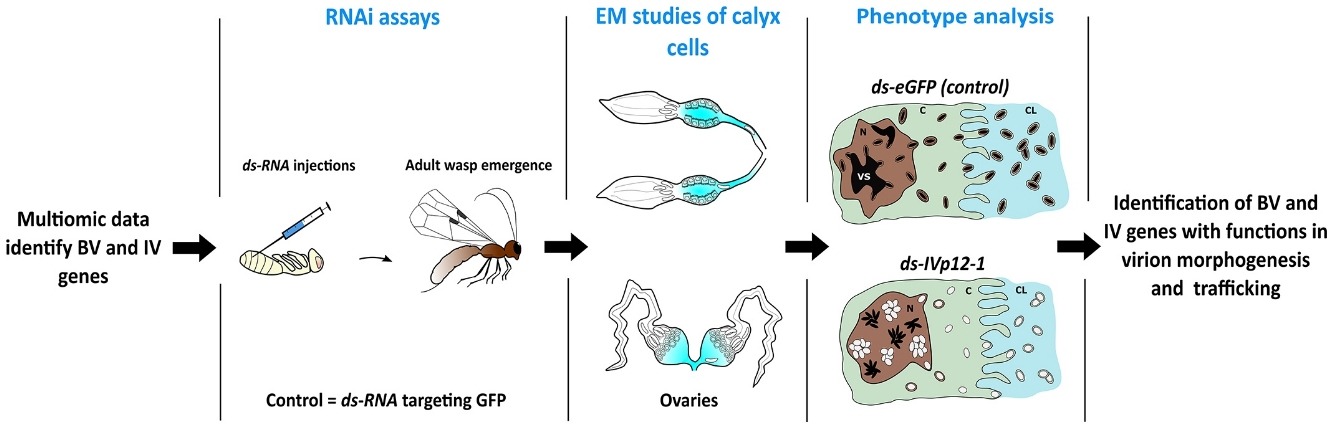
Identifying bracovirus and ichnovirus genes involved in virion morphogenesis

Bracoviruses (BVs) and ichnoviruses (IVs) evolved from different endogenized viruses but through convergence have been coopted by parasitoids in the families Braconidae and Ichneumonidae for similar functions in parasitizing hosts. Experimentally studying the role of endogenized viral genes in virion morphogenesis remains a key challenge in the study of BVs and IVs. Here we summarize …

Trainee Spotlight: Benjamin Phipps

Benjamin Phipps is an NIH T32 trainee in Michael Strand's laboratory. Originally from Woodland, California, Benjamin earned his bachelor’s degrees in Spanish and biology and a minor in chemistry from the University of North Texas in May 2019. While at UNT, he studied the influence of mixed vehicle emissions on regulation of the renin-angiotensin system with …

Evolutionary genomics of APSE: a tailed phage that lysogenically converts the bacterium Hamiltonella defensa into a heritable protective symbiont of aphids

Background: Most phages infect free-living bacteria but a few have been identified that infect heritable symbionts of insects or other eukaryotes. Heritable symbionts are usually specialized and isolated from other bacteria with little known about the origins of associated phages. Hamiltonella defensa is a heritable bacterial symbiont of aphids that is usually infected by a tailed, …

Diet-Microbiota Interactions Alter Mosquito Development

Gut microbes and diet can both strongly affect the biology of multicellular animals, but it is often difficult to disentangle microbiota-diet interactions due to the complex microbial communities many animals harbor and the nutritionally variable diets they consume. While theoretical and empirical studies indicate that greater microbiota diversity is beneficial for many animal hosts, there …

Toll9 from Bombyx mori functions as a pattern recognition receptor that shares features with Toll-like receptor 4 from mammals

Toll/Toll-like receptors (TLRs) are key regulators of the innate immune system in both invertebrates and vertebrates. However, while mammalian TLRs directly recognize pathogen-associated molecular patterns, the insect Toll pathway is thought to be primarily activated by binding Spätzle cytokines that are processed from inactive precursors in response to microbial infection. Phylogenetic and structural data generated …