Generic selectors
Exact matches only
Search in title
Search in content
Post Type Selectors

Tag: malaria

Field Relevant Variation in Ambient Temperature Modifies Density-Dependent Establishment of Plasmodium falciparum Gametocytes in Mosquitoes

The relationship between Plasmodium falciparum gametocyte density and infections in mosquitoes is central to understanding the rates of transmission with important implications for control. Here, we determined whether field relevant variation in environmental temperature could also modulate this relationship. Anopheles stephensi were challenged with three densities of P. falciparum gametocytes spanning a ~10-fold gradient, and housed under diurnal/daily temperature range (“DTR”) of 9°C (+5°C and -4°C) around means of 20, 24, and 28°C. Vector competence was quantified as the proportion of mosquitoes infected with oocysts in the midguts (oocyst rates) or infectious with sporozoites in the salivary glands (sporozoite rates) at peak periods of infection for each temperature to account for the differences in development rates. In addition, oocyst intensities were also recorded from infected midguts and the overall study replicated across three separate parasite cultures and mosquito cohorts. While vector competence was similar at 20 DTR 9°C and 24 DTR 9°C, oocyst and sporozoite rates were also comparable, with evidence, surprisingly, for higher vector competence in mosquitoes challenged with intermediate gametocyte densities. For the same gametocyte densities however, severe reductions in the sporozoite rates was accompanied by a significant decline in overall vector competence at 28 DTR 9°C, with gametocyte density per se showing a positive and linear effect at this temperature. Unlike vector competence, oocyst intensities decreased with increasing temperatures with a predominantly positive and linear association with gametocyte density, especially at 28 DTR 9°C. Oocyst intensities across individual infected midguts suggested temperature-specific differences in mosquito susceptibility/resistance: at 20 DTR 9°C and 24 DTR 9°C, dispersion (aggregation) increased in a density-dependent manner but not at 28 DTR 9°C where the distributions were consistently random. Limitations notwithstanding, our results suggest that variation in temperature could modify seasonal dynamics of infectious reservoirs with implications for the design and deployment of transmission-blocking vaccines/drugs.

Ashutosh K. Pathak, Justine C. Shiau, Matthew B. Thomas and Courtney C. Murdock, Front Microbiol. 2019 Nov 15;10:2651. doi: 10.3389/fmicb.2019.02651. eCollection 2019.

Anibamine and Its Analogues: Potent Antiplasmodial Agents from Aniba citrifolia

In our continuing search for novel natural products with antiplasmodial activity, an extract of Aniba citrifolia was found to have good activity, with an IC50 value less than 1.25 μg/mL. After bioassay-directed fractionation, the known indolizinium alkaloid anibamine (1) and the new indolizinium alkaloid anibamine B (2) were isolated as the major bioactive constituents, with antiplasmodial IC50 values of 0.170 and 0.244 μM against the drug-resistant Dd2 strain of Plasmodium falciparum. The new coumarin anibomarin A (3), the new norneolignan anibignan A (5), and six known neolignans (712) were also obtained. The structures of all the isolated compounds were determined based on analyses of 1D and 2D NMR spectroscopic and mass spectrometric data, and the absolute configuration of anibignan A (5) was assigned from its ECD spectrum. Evaluation of a library of 28 anibamine analogues (1340) indicated that quaternary charged analogues had IC50 values as low as 58 nM, while uncharged analogues were inactive or significantly less active. Assessment of the potential effects of anibamine and its analogues on the intraerythrocytic stages and morphological development of P. falciparum revealed substantial activity against ring stages for compounds with two C-10 side chains, while those with only one C-10 side chain exhibited substantial activity against trophozoite stages, suggesting different mechanisms of action.

Yongle Du, Ana Lisa Valenciano, Yumin Dai, Yi Zheng, Feng Zhang, Yan Zhang, Jason Clement, Michael Goetz, David G. I. Kingston, Maria B. Cassera. 2019. J Nat Prod. doi: 10.1021/acs.jnatprod.9b00724.

Metabolic dependency of chorismate in Plasmodium falciparum suggests an alternative source for the ubiquinone biosynthesis precursor

The shikimate pathway, a metabolic pathway absent in humans, is responsible for the production of chorismate, a branch point metabolite. In the malaria parasite, chorismate is postulated to be a direct precursor in the synthesis of p-aminobenzoic acid (folate biosynthesis), p-hydroxybenzoic acid (ubiquinone biosynthesis), menaquinone, and aromatic amino acids. While the potential value of the shikimate pathway as a drug target is debatable, the metabolic dependency of chorismate in P. falciparum remains unclear. Current evidence suggests that the main role of chorismate is folate biosynthesis despite ubiquinone biosynthesis being active and essential in the malaria parasite. Our goal in the present work was to expand our knowledge of the ubiquinone head group biosynthesis and its potential metabolic dependency on chorismate in P. falciparum. We systematically assessed the development of both asexual and sexual stages of P. falciparum in a defined medium in the absence of an exogenous supply of chorismate end-products and present biochemical evidence suggesting that the benzoquinone ring of ubiquinones in this parasite may be synthesized through a yet unidentified route.

Ana Lisa Valenciano, Maria L. Fernández-Murga, Emilio F. Merino, Nicole R. Holderman, Grant J. Butschek, Karl J. Shaffer, Peter C. Tyler & Maria Belen Cassera. 2019. Sci Rep.;9(1):13936. doi: 10.1038/s41598-019-50319-5.

Clinically silent relapsing malaria may still pose a threat

The immune system can control a relapsing form of malaria enough to avoid clinical signs of disease, but it doesn’t eliminate transmissible parasites from the body that may still be infectious to mosquitoes. That’s the conclusion of a study on a nonhuman primate model of Plasmodium vivax infection, which has implications relevant to malaria elimination strategies.

Keep reading about the MaPHIC study at Technology.org

The ER chaperone PfGRP170 is essential for asexual development and is linked to stress response in malaria parasites

The vast majority of malaria mortality is attributed to one parasite species: Plasmodium falciparum. Asexual replication of the parasite within the red blood cell is responsible for the pathology of the disease. In Plasmodium, the endoplasmic reticulum (ER) is a central hub for protein folding and trafficking as well as stress response pathways. In this study, we tested the role of an uncharacterized ER protein, PfGRP170, in regulating these key functions by generating conditional mutants. Our data show that PfGRP170 localizes to the ER and is essential for asexual growth, specifically required for proper development of schizonts. PfGRP170 is essential for surviving heat shock, suggesting a critical role in cellular stress response. The data demonstrate that PfGRP170 interacts with the Plasmodium orthologue of the ER chaperone, BiP. Finally, we found that loss of PfGRP170 function leads to the activation of the Plasmodium eIF2α kinase, PK4, suggesting a specific role for this protein in this parasite stress response pathway.

Heather M. Kudyba, David W. Cobb, Manuel A. Fierro, Anat Florentin, Dragan Ljolje, Balwan Singh, Naomi W. Lucchi, Vasant Muralidharan. 2019. Cell Microbiol.:e13042. doi: 10.1111/cmi.13042

Distinct amino acid and lipid perturbations characterize acute versus chronic malaria

Chronic malaria is a major public health problem and significant challenge for disease eradication efforts. Despite its importance, the biological factors underpinning chronic malaria are not fully understood. Recent studies have shown that host metabolic state can influence malaria pathogenesis and transmission, but its role in chronicity is not known. Here, with the goal of identifying distinct modifications in the metabolite profiles of acute versus chronic malaria, metabolomics was performed on plasma from Plasmodium-infected humans and nonhuman primates with a range of parasitemias and clinical signs. In rhesus macaques infected with Plasmodium coatneyi, significant alterations in amines, carnitines, and lipids were detected during a high parasitemic acute phase and many of these reverted to baseline levels once a low parasitemic chronic phase was established. Plasmodium gene expression, studied in parallel in the macaques, revealed transcriptional changes in amine, fatty acid, lipid and energy metabolism genes, as well as variant antigen genes. Furthermore, a common set of amines, carnitines, and lipids distinguished acute from chronic malaria in plasma from human Plasmodium falciparum cases. In summary, distinct host-parasite metabolic environments have been uncovered that characterize acute versus chronic malaria, providing insights into the underlying host-parasite biology of malaria disease progression.

Regina Joice Cordy, Rapatbhorn Patrapuvich, Loukia N. Lili, Monica Cabrera-Mora, Jung-Ting Chien, Gregory K. Tharp, Manoj Khadka, Esmeralda V.S. Meyer, Stacey A. Lapp, Chester J. Joyner, AnaPatricia Garcia, Sophia Banton, ViLinh Tran, Viravarn Luvira, Siriwan Rungin, Teerawat Saeseu, Nattawan Rachaphaew, Suman B. Pakala, Jeremy D. DeBarry, MaHPIC Consortium, Jessica C. Kissinger, Eric A. Ortlund, Steven E. Bosinger, John W. Barnwell, Dean P. Jones, Karan Uppal, Shuzhao Li, Jetsumon Sattabongkot, Alberto Moreno, and Mary R. Galinski. 2019. JCI Insight.; 4(9). pii: 125156. doi: 10.1172/jci.insight.125156.

Field evaluation of malaria malachite green loop-mediated isothermal amplification in health posts in Roraima state, Brazil

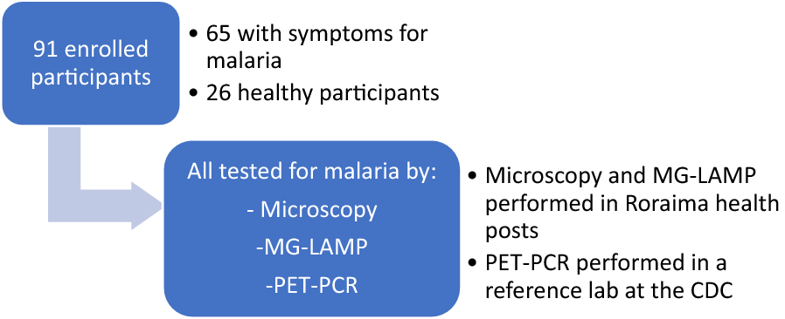
enrolled patietns and sample processing
Fig. 1 Summary of enrolled patients and sample processing

BACKGROUND:

Microscopic detection of malaria parasites is the standard method for clinical diagnosis of malaria in Brazil. However, malaria epidemiological surveillance studies specifically aimed at the detection of low-density infection and asymptomatic cases will require more sensitive and field-usable tools. The diagnostic accuracy of the colorimetric malachite green, loop-mediated, isothermal amplification (MG-LAMP) assay was evaluated in remote health posts in Roraima state, Brazil.

METHODS:

Study participants were prospectively enrolled from health posts (healthcare-seeking patients) and from nearby villages (healthy participants) in three different study sites. The MG-LAMP assay and microscopy were performed in the health posts. Two independent readers scored the MG-LAMP tests as positive (blue/green) or negative (clear). Sensitivity and specificity of local microscopy and MG-LAMP were calculated using results of PET-PCR as a reference.

RESULTS:

A total of 91 participants were enrolled. There was 100% agreement between the two MG-LAMP readers (Kappa = 1). The overall sensitivity and specificity of MG-LAMP were 90.0% (95% confidence interval (CI) 76.34-97.21%) and 94% (95% CI 83.76-98.77%), respectively. The sensitivity and specificity of local microscopy were 83% (95% CI 67.22-92.66%) and 100% (95% CI 93.02-100.00%), respectively. PET-PCR detected six mixed infections (infection with both Plasmodium falciparum and Plasmodium vivax); two of these were also detected by MG-LAMP and one by microscopy. Microscopy did not detect any Plasmodium infection in the 26 healthy participants; MG-LAMP detected Plasmodium in five of these and PET-PCR assay detected infection in three. Overall, performing the MG-LAMP in this setting did not present any particular challenges.

CONCLUSION:

MG-LAMP is a sensitive and specific assay that may be useful for the detection of malaria parasites in remote healthcare settings. These findings suggest that it is possible to implement simple molecular tests in facilities with limited resources.

Heather M. Kudyba, Jaime Louzada, Dragan Ljolje, Karl A. Kudyba, Vasant Muralidharan, Joseli Oliveira-Ferreira, and Naomi W. Lucchi. 2019. Malar J. 2019 Mar 25;18(1):98. doi: 10.1186/s12936-019-2722-1.

Lysyl-tRNA synthetase as a drug target in malaria and cryptosporidiosis

Malaria and cryptosporidiosis, caused by apicomplexan parasites, remain major drivers of global child mortality. New drugs for the treatment of malaria and cryptosporidiosis, in particular, are of high priority; however, there are few chemically validated targets. The natural product cladosporin is active against blood- and liver-stage Plasmodium falciparum and Cryptosporidium parvum in cell-culture studies. Target deconvolution in P. falciparum has shown that cladosporin inhibits lysyl-tRNA synthetase (PfKRS1). Here, we report the identification of a series of selective inhibitors of apicomplexan KRSs. Following a biochemical screen, a small-molecule hit was identified and then optimized by using a structure-based approach, supported by structures of both PfKRS1 and C. parvum KRS (CpKRS). In vivo proof of concept was established in an SCID mouse model of malaria, after oral administration (ED90 = 1.5 mg/kg, once a day for 4 d). Furthermore, we successfully identified an opportunity for pathogen hopping based on the structural homology between PfKRS1 and CpKRS. This series of compounds inhibit CpKRS and C. parvum and Cryptosporidium hominis in culture, and our lead compound shows oral efficacy in two cryptosporidiosis mouse models. X-ray crystallography and molecular dynamics simulations have provided a model to rationalize the selectivity of our compounds for PfKRS1 and CpKRS vs. (human) HsKRS. Our work validates apicomplexan KRSs as promising targets for the development of drugs for malaria and cryptosporidiosis.


Beatriz Baragaña, Barbara Forte, Ryan Choi, Stephen Nakazawa Hewitt, Juan A. Bueren-Calabuig, João Pedro Pisco, Caroline Peet, David M. Dranow, David A. Robinson, Chimed Jansen, Neil R. Norcross, Sumiti Vinayak, Mark Anderson, Carrie F. Brooks, Caitlin A. Cooper, Sebastian Damerow, Michael Delves, Karen Dowers, James Duffy, Thomas E. Edwards, Irene Hallyburton, Benjamin G. Horst, Matthew A. Hulverson, Liam Ferguson, María Belén Jiménez-Díaz, Rajiv S. Jumani, Donald D. Lorimer, Melissa S. Love, Steven Maher, Holly Matthews, Case W. McNamara, Peter Miller, Sandra O’Neill, Kayode K. Ojo, Maria Osuna-Cabello, Erika Pinto, John Post, Jennifer Riley, Matthias Rottmann, Laura M. Sanz, Paul Scullion, Arvind Sharma, Sharon M. Shepherd, Yoko Shishikura, Frederick R. C. Simeons, Erin E. Stebbins, Laste Stojanovski, Ursula Straschil, Fabio K. Tamaki, Jevgenia Tamjar, Leah S. Torrie, Amélie Vantaux, Benoît Witkowski, Sergio Wittlin, Manickam Yogavel, Fabio Zuccotto, Iñigo Angulo-Barturen, Robert Sinden, Jake Baum, Francisco-Javier Gamo, Pascal Mäser, Dennis E. Kyle, Elizabeth A. Winzeler, Peter J. Myler, Paul G. Wyatt, David Floyd, David Matthews, Amit Sharma, Boris Striepen, Christopher D. Huston, David W. Gray, Alan H. Fairlamb, Andrei V. Pisliakov, Chris Walpole, Kevin D. Read, Wesley C. Van Voorhis, and Ian H. Gilbert. 2019. PNAS, https://doi.org/10.1073/pnas.1814685116

Targeted Inhibition of Plasmodium falciparum Calcium-Dependent Protein Kinase 1 with a Constrained J Domain-Derived Disruptor Peptide

graphical abstract

To explore the possibility of constrained peptides to target Plasmodium-infected cells, we designed a J domain mimetic derived from Plasmodium falciparum calcium-dependent protein kinase 1 ( PfCDPK1) as a strategy to disrupt J domain binding and inhibit PfCDPK1 activity. The J domain disruptor (JDD) peptide was conformationally constrained using a hydrocarbon staple and was found to selectively permeate segmented schizonts and colocalize with intracellular merozoites in late-stage parasites. In vitro analyses demonstrated that JDD could effectively inhibit the catalytic activity of recombinant PfCDPK1 in the low micromolar range. Treatment of late-stage parasites with JDD resulted in a significant decrease in parasite viability mediated by a blockage of merozoite invasion, consistent with a primary effect of PfCDPK1 inhibition. To the best of our knowledge, this marks the first use of stapled peptides designed to specifically target a Plasmodium falciparum protein and demonstrates that stapled peptides may serve as useful tools for exploring potential antimalarial agents.

Briana R. Flaherty, Tienhuei G. Ho, Sven H. Schmidt, Friedrich W. Herberg, David S. Peterson, and Eileen J. Kennedy. 2019. ACS Infectious Diseases. DOI: 10.1021/acsinfecdis.8b0034