Generic selectors
Exact matches only
Search in title
Search in content
Post Type Selectors

Tag: malaria

Combination of Serological, Antigen Detection, and DNA Data for Plasmodium Falciparum Provides Robust Geospatial Estimates for Malaria Transmission in Haiti

Microscopy is the gold standard for malaria epidemiology, but laboratory and point-of-care (POC) tests detecting parasite antigen, DNA, and human antibodies against malaria have expanded this capacity. The island nation of Haiti is endemic for Plasmodium falciparum (Pf) malaria, though at a low national prevalence and heterogenous geospatial distribution. In 2015 and 2016, serosurveys were performed of children (ages 6-7 years) sampled in schools in Saut d’Eau commune (n = 1,230) and Grand Anse department (n = 1,664) of Haiti. Children received malaria antigen rapid diagnostic test and provided a filter paper blood sample for further laboratory analysis of the Pf histidine-rich protein 2 (HRP2) antigen, Pf DNA, and anti-Pf IgG antibodies. Prevalence of Pf infection ranged from 0.0-16.7% in 53 Saut d’Eau schools, and 0.0-23.8% in 56 Grand Anse schools. Anti-Pf antibody carriage exceeded 80% of students in some schools from both study sites. Geospatial prediction ellipses were created to indicate clustering of positive tests within the survey areas and overlay of all prediction ellipses for the different types of data revealed regions with high likelihood of active and ongoing Pf malaria transmission. The geospatial utilization of different types of Pf data can provide high confidence for spatial epidemiology of the parasite.

Adan Oviedo, Alaine Knipes, Caitlin Worrell, LeAnne M Fox, Luccene Desir, Carl Fayette, Alain Javel, Franck Monestime, Kimberly Mace, Michelle A Chang, Venkatachalam Udhayakumar, Jean F Lemoine, Kimberly Won, Patrick J Lammie, Eric Rogier. Scientific Reports volume 10, Article number: 8443 (2020). https://doi.org/10.1038/s41598-020-65419-w
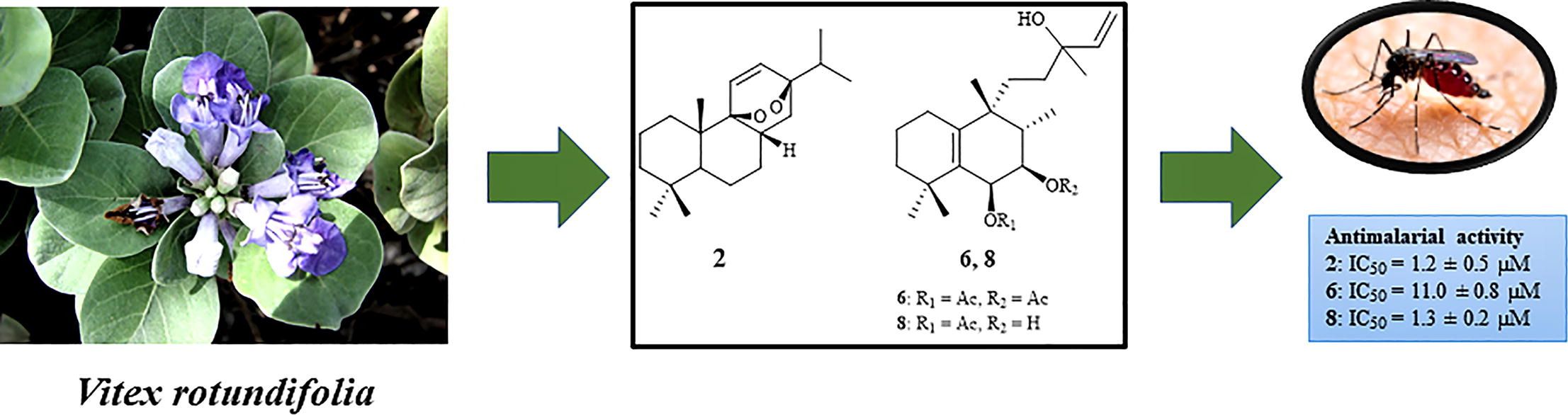
Antimalarial Diterpenoids From Vitex Rotundifolia: Isolation, Structure Elucidation, and in Vitro Antiplasmodial Activity

Vitex rotundifolia is an important medicinal plant frequently employed in traditional medicines for the treatment of various ailments. Although this plant species has been under exploration for its constituents by various research groups including our own group, no reports were found regarding the antimalarial potential of this plant or of its purified phytochemicals. Phytochemical investigation of this plant yielded three new (1-3) and five known (4-8) diterpenoids. These compounds were purified by modern chromatographic techniques and their structures were determined by advanced spectroscopic techniques such as nuclear magnetic resonance (NMR) and high-resolution mass spectrometry (HRMS). The in vitro antiplasmodial activities were encouraging, as compounds 2, 6, and 8 were found to have significant IC50 values of 1.2, 1.3 and 11.0 µM, respectively against Plasmodium falciparum.

You Ah Kim, Abdul Latif, Chang-Suk Kong, Youngwan Seo, Seema R Dalal, Maria B Cassera, David G I Kingston. Bioorg Chem. 2020 May 12;100:103925. doi: 10.1016/j.bioorg.2020.103925.

Directing Traffic: Chaperone-mediated protein transport in malaria parasites

The ability of eukaryotic parasites from the phylum Apicomplexa to cause devastating diseases is predicated upon their ability to maintain faithful and precise protein trafficking mechanisms. Their parasitic life cycle depends on the trafficking of effector proteins to the infected host cell, transport of proteins to several critical organelles required for survival, as well as transport of parasite and host proteins to the digestive organelles to generate the building blocks for parasite growth. Several recent studies have shed light on the molecular mechanisms parasites utilize to transform the infected host cells, transport proteins to essential metabolic organelles, and for biogenesis of organelles required for continuation of their life cycle. Here, we review key pathways of protein transport originating and branching from the endoplasmic reticulum, focusing on the essential roles of chaperones in these processes. Further, we highlight key gaps in our knowledge that prevents us from building a holistic view of protein trafficking in these deadly human pathogens.

Anat Florentin, David W. Cobb, Heather M. Kudyba, Vasant Muralidharan. Cell Microbiol. 2020 May 9:e13215. doi: 10.1111/cmi.13215.

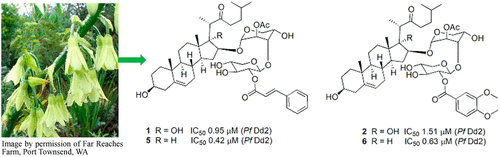
Galtonosides A-E: Antiproliferative and Antiplasmodial Cholestane Glycosides from Galtonia regalis

An extract of Galtonia regalis from the Natural Products Discovery Institute showed moderate antiplasmodial activity, with an IC50 value less than 1.25 μg/mL. The two known cholestane glycosides 1 and 2 and the five new cholestane glycosides galtonosides A–E (37) were isolated after bioassay-directed fractionation. The structures of the new compounds were determined by interpretation of their NMR and mass spectra. Among these compounds, galtonoside B (4) displayed the most potent antiplasmodial activity, with an IC50 value of 0.214 μM against the drug-resistant Dd2 strain of Plasmodium falciparum.

Yongle Du, Brooke A. Martin, Ana Lisa Valenciano, Jason A. Clement, Michael Goetz, Maria B. Cassera, David G. I. Kingston. J Nat Prod. 2020 Mar 31. doi: 10.1021/acs.jnatprod.9b01064.

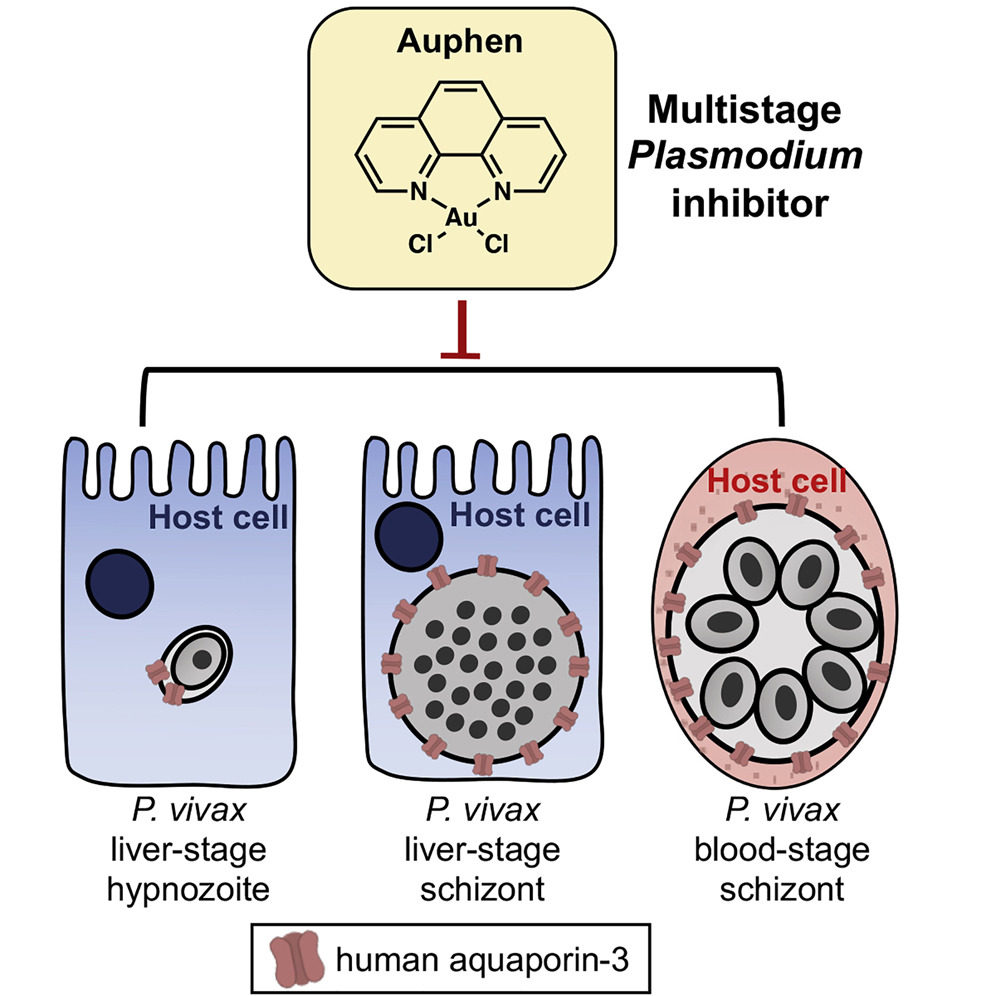
Plasmodium vivax Liver and Blood Stages Recruit the Druggable Host Membrane Channel Aquaporin-3

Plasmodium vivax infects hepatocytes to form schizonts that cause blood infection, or dormant hypnozoites that can persist for months in the liver before leading to relapsing blood infections. The molecular processes that drive Pvivax schizont and hypnozoite survival remain largely unknown, but they likely involve a rich network of host-pathogen interactions, including those occurring at the host-parasite interface, the parasitophorous vacuole membrane (PVM). Using a recently developed Pvivax liver-stage model system we demonstrate that host aquaporin-3 (AQP3) localizes to the PVM of schizonts and hypnozoites within 5 days after invasion. This recruitment is also observed in Pvivax-infected reticulocytes. Chemical treatment with the AQP3 inhibitor auphen reduces Pvivax liver hypnozoite and schizont burden, and inhibits Pvivax asexual blood-stage growth. These findings reveal a role for AQP3 in Pvivax liver and blood stages and suggest that the protein may be targeted for therapeutic treatment.

Dora Posfai, Steven P. Maher, Camille Roesch, Amélie Vantaux, Kayla Sylvester, Julie Péneau, Jean Popovici, Dennis E. Kyle, Benoît Witkowski, Emily R. Derbyshire. Cell Chem Biol. 2020 Mar 24. pii: S2451-9456(20)30083-0. doi: 10.1016/j.chembiol.2020.03.009.

Acute Plasmodium Infection Promotes Interferon-Gamma-Dependent Resistance to Ebola Virus Infection

During the 2013-2016 Ebola virus (EBOV) epidemic, a significant number of patients admitted to Ebola treatment units were co-infected with Plasmodium falciparum, a predominant agent of malaria. However, there is no consensus on how malaria impacts EBOV infection. The effect of acute Plasmodium infection on EBOV challenge was investigated using mouse-adapted EBOV and a biosafety level 2 (BSL-2) model virus. We demonstrate that acute Plasmodium infection protects from lethal viral challenge, dependent upon interferon gamma (IFN-γ) elicited as a result of parasite infection. Plasmodium-infected mice lacking the IFN-γ receptor are not protected. Ex vivo incubation of naive human or mouse macrophages with sera from acutely parasitemic rodents or macaques programs a proinflammatory phenotype dependent on IFN-γ and renders cells resistant to EBOV infection. We conclude that acute Plasmodium infection can safeguard against EBOV by the production of protective IFN-γ. These findings have implications for anti-malaria therapies administered during episodic EBOV outbreaks in Africa.

Kai J Rogers, Olena Shtanko, Rahul Vijay, Laura N Mallinger, Chester J Joyner, Mary R Galinski, Noah S Butler, Wendy Maury. Cell Rep. 2020 Mar 24;30(12):4041-4051.e4. doi: 10.1016/j.celrep.2020.02.104.

Battling Malaria

UGA is developing new drugs to fight a lethal parasite. Dennis Kyle discusses what his lab is doing to fight malaria in this brief (2:30) video.


HELP BATTLE DEADLY DISEASES

Donate to the Center for Tropical and Emerging Global Diseases

[button size=’large’ style=” text=’Give Now’ icon=” icon_color=’BA0C2F’ link=’https://gail.uga.edu/commit?cat=campus&subcat=research&des=91700000′ target=’_self’ color=” hover_color=” border_color=” hover_border_color=” background_color=” hover_background_color=” font_style=” font_weight=” text_align=” margin=”]

An Endoplasmic Reticulum CREC Family Protein Regulates the Egress Proteolytic Cascade in Malaria Parasites

The endoplasmic reticulum (ER) is thought to play an essential role during egress of malaria parasites because the ER is assumed to be required for biogenesis and secretion of egress-related organelles. However, no proteins localized to the parasite ER have been shown to play a role in egress of malaria parasites. In this study, we generated conditional mutants of the Plasmodium falciparum endoplasmic reticulum-resident calcium-binding protein (PfERC), a member of the CREC family. Knockdown of the PfERC gene showed that this gene is essential for asexual growth of P. falciparum Analysis of the intraerythrocytic life cycle revealed that PfERC is essential for parasite egress but is not required for protein trafficking or calcium storage. We found that PfERC knockdown prevents the rupture of the parasitophorous vacuole membrane. This is because PfERC knockdown inhibited the proteolytic maturation of the subtilisin-like serine protease SUB1. Using double mutant parasites, we showed that PfERC is required for the proteolytic maturation of the essential aspartic protease plasmepsin X, which is required for SUB1 cleavage. Further, we showed that processing of substrates downstream of the proteolytic cascade is inhibited by PfERC knockdown. Thus, these data establish that the ER-resident CREC family protein PfERC is a key early regulator of the egress proteolytic cascade of malaria parasites.

IMPORTANCE The divergent eukaryotic parasites that cause malaria grow and divide within a vacuole inside a host cell, which they have to break open once they finish cell division. The egress of daughter parasites requires the activation of a proteolytic cascade, and a subtilisin-like protease initiates a proteolytic cascade to break down the membranes blocking egress. It is assumed that the parasite endoplasmic reticulum plays a role in this process, but the proteins in this organelle required for egress remain unknown. We have identified an early ER-resident regulator essential for the maturation of the recently discovered aspartic protease in the egress proteolytic cascade, plasmepsin X, which is required for maturation of the subtilisin-like protease. Conditional loss of PfERC results in the formation of immature and inactive egress proteases that are unable to breakdown the vacuolar membrane barring release of daughter parasites.

Manuel A. Fierro, Beejan Asady, Carrie F. Brooks, David W. Cobb, Alejandra Villegas, Silvia N. J. Moreno, Vasant Muralidharan. mBio. 2020 Feb 25;11(1). pii: e03078-19. doi: 10.1128/mBio.03078-19.

An adaptable soft-mold embossing process for fabricating optically-accessible, microfeature-based culture systems and application toward liver stage antimalarial compound testing

Advanced cell culture methods for modeling organ-level structure have been demonstrated to replicate in vivo conditions more accurately than traditional in vitro cell culture. Given that the liver is particularly important to human health, several advanced culture methods have been developed to experiment with liver disease states, including infection with Plasmodium parasites, the causative agent of malaria. These models have demonstrated that intrahepatic parasites require functionally stable hepatocytes to thrive and robust characterization of the parasite populations’ response to investigational therapies is dependent on high-content and high-resolution imaging (HC/RI). We previously reported abiotic confinement extends the functional longevity of primary hepatocytes in a microfluidic platform and set out to instill confinement in a microtiter plate platform while maintaining optical accessibility for HC/RI; with an end-goal of producing an improved P. vivax liver stage culture model. We developed a novel fabrication process in which a PDMS soft mold embosses hepatocyte-confining microfeatures into polystyrene, resulting in microfeature-based hepatocyte confinement (μHEP) slides and plates. Our process was optimized to form both microfeatures and culture wells in a single embossing step, resulting in a 100 μm-thick bottom ideal for HC/RI, and was found inexpensively amendable to microfeature design changes. Microfeatures improved intrahepatic parasite infection rates and μHEP systems were used to reconfirm the activity of reference antimalarials in phenotypic dose-response assays. RNAseq of hepatocytes in μHEP systems demonstrated microfeatures sustain hepatic differentiation and function, suggesting broader utility for preclinical hepatic assays; while our tailorable embossing process could be repurposed for developing additional organ models.

Steven P. Maher, Amy J. Conway, Alison Roth, Swamy R. Adapa, Phillip Cualing, Chiara Andolina, James Hsiao, Jessica Turgeon, Victor Chaumeau, Myles Johnson, Chris Palmiotti, Naresh Singh, Samantha J. Barnes, Raahil Patel, Virginia Van Grod, Robert Carter, H.-C. Steve Sun, Jetsumon Sattabongkot, Brice Campo, François Nosten, Wajeeh M. Saadi, John H. Adams, Rays H. Y. Jiang, and Dennis E. Kyle. Lab Chip. 2020 Feb 14. doi: 10.1039/c9lc00921c

Optimal 10-Aminoartemisinins With Potent Transmission-Blocking Capabilities for New Artemisinin Combination Therapies–Activities Against Blood Stage P. falciparum Including PfKI3 C580Y Mutants and Liver Stage P. berghei Parasites

We have demonstrated previously that amino-artemisinins including artemiside and artemisone in which an amino group replaces the oxygen-bearing substituents attached to C-10 of the current clinical artemisinin derivatives dihydroartemisinin (DHA), artemether and artesunate, display potent activities in vitro against the asexual blood stages of Plasmodium falciparum (Pf). In particular, the compounds are active against late blood stage Pf gametocytes, and are strongly synergistic in combination with the redox active drug methylene blue. In order to fortify the eventual selection of optimum amino-artemisinins for development into new triple combination therapies also active against artemisinin-resistant Pf mutants, we have prepared new amino-artemisinins based on the easily accessible and inexpensive DHA-piperazine. The latter was converted into alkyl- and aryl sulfonamides, ureas and amides. These derivatives were screened together with the comparator drugs DHA and the hitherto most active amino-artemisinins artemiside and artemisone against asexual and sexual blood stages of Pf and liver stage P. berghei (Pb) sporozoites. Several of the new amino-artemisinins bearing aryl-urea and -amide groups are potently active against both asexual, and late blood stage gametocytes (IC50 0.4-1.0 nM). Although the activities are superior to those of artemiside (IC50 1.5 nM) and artemisone (IC50 42.4 nM), the latter are more active against the liver stage Pb sporozoites (IC50 artemisone 28 nM). In addition, early results indicate these compounds tend not to display reduced susceptibility against parasites bearing the Pf Kelch 13 propeller domain C580Y mutation characteristic of artemisinin-resistant Pf. Thus, the advent of the amino-artemisinins including artemiside and artemisone will enable the development of new combination therapies that by virtue of the amino-artemisinin component itself will possess intrinsic transmission-blocking capabilities and may be effective against artemisinin resistant falciparum malaria.

Ho Ning Wong, Vivian Padín-Irizarry, Mariëtte E. van der Watt, Janette Reader, Wilna Liebenberg, Lubbe Wiesner, Peter Smith, Korina Eribez, Elizabeth A. Winzeler, Dennis E. Kyle, Lyn-Marie Birkholtz, Dina Coertzen, and Richard K. Haynes. Front Chem. 2020 Jan 10;7:901. doi: 10.3389/fchem.2019.00901. eCollection 2019.