
Memory regulatory T cells reprogram into protective TFH cell-like effectors in recurrent malaria
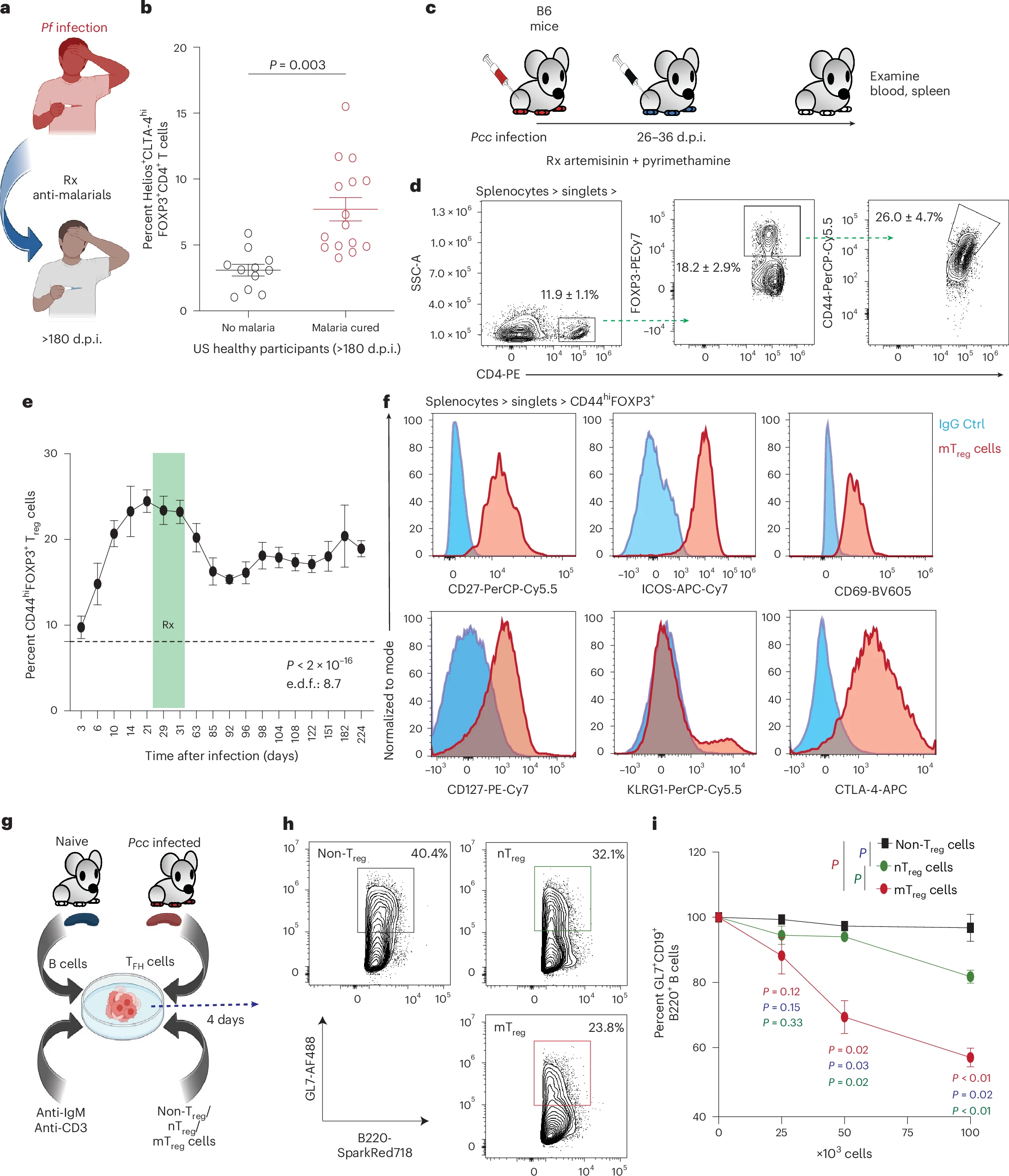
Long-term persistence of mTreg cells following Plasmodium infection in humans and mice
Although people living in malaria-endemic areas experience repeated infections with Plasmodium, the role of regulatory T (Treg) cells in recurrent malaria remains poorly understood. During a primary infection with Plasmodium, Treg cells suppress protective immunity by inhibiting germinal center (GC) reactions, thereby impeding the control of parasitemia. In contrast, memory Treg (mTreg) cells remaining after the clearance of initial Plasmodium infection acquire protective functions after recall. Longitudinal studies in humans and mice show that mTreg cells undergo antigen-driven expansion and inflammation-induced epigenetic reprogramming during reinfection to transition from FOXP3+ immunosuppressive cells to BCL6+ follicular T helper (TFH) cell-like effectors. These mTreg cell-derived TFH-like cells enhance GC responses and the generation of antibodies specific to Plasmodium, ultimately facilitating Plasmodium control. Precluding such mTreg-to-TFH cell differentiation abolished protection. Our findings reveal a previously unrecognized adaptive plasticity in canonical mTreg cells that enables a context-dependent functional switch from immunoregulatory to protective effectors during recurrent infections.
Nana Appiah Essel Charles-Chess, Anthony A Ruberto, Carson Bowers, Clyde Schmidt-Silva, Nyamekye Obeng-Adjei, Matthew R Hansen, Disha B R Prasad, Alex Rosenberg, Boubacar Traore, Kimberly D Klonowski, Peter D Crompton, Samarchith P Kurup. Nat Immunol. 2026 Jun 22. doi: 10.1038/s41590-026-02537-z.