Generic selectors
Exact matches only
Search in title
Search in content
Post Type Selectors

Author: Donna Huber

Jessica Kissinger elected ASTMH Fellow

Jessica Kissinger (Photo by Peter Frey) University of Georgia geneticist Jessica Kissinger has been elected a 2020 American Society of Tropical Medicine and Hygiene Fellow. Kissinger is a Distinguished Research Professor in the Department of Genetics, part of the Franklin College of Arts and Sciences. She also holds appointments in the Institute of Bioinformatics and Center for Tropical and Emerging Global Diseases. …

Towards a comprehensive research and development plan to support the control, elimination and eradication of neglected tropical diseases

To maximise the likelihood of success, global health programmes need repeated, honest appraisal of their own weaknesses, with research undertaken to address any identified gaps. There is still much to be learned to optimise work against neglected tropical diseases. To facilitate that learning, a comprehensive research and development plan is required. Here, we discuss how …

The nucleocytosolic O-fucosyltransferase Spindly affects protein expression and virulence in Toxoplasma gondii

Once considered unusual, nucleocytoplasmic glycosylation is now recognized as a conserved feature of eukaryotes. While in animals O-GlcNAc transferase (OGT) modifies thousands of intracellular proteins, the human pathogen Toxoplasma gondii transfers a different sugar, fucose, to proteins involved in transcription, mRNA processing and signaling. Knockout experiments showed that TgSPY, an ortholog of plant SPINDLY and paralog of host OGT, …

Outbreak News Today Interviews Rick Tarleton

Recently, Dr. Rick Tarleton was interviewed by Outbreak News Today about his recently published study in Science Translational Medicine. [button size='large' style='' text='Listen Now' icon='' icon_color='BA0C2F' link='http://outbreaknewstoday.com/chagas-disease-treatment-research-with-rick-tarleton-phd-81114/' target='_self' color='' hover_color='' border_color='' hover_border_color='' background_color='' hover_background_color='' font_style='' font_weight='' text_align='' margin='']

Diagnostics and the neglected tropical diseases roadmap: setting the agenda for 2030

Accurate and reliable diagnostic tools are an essential requirement for neglected tropical diseases (NTDs) programmes. However, the NTD community has historically underinvested in the development and improvement of diagnostic tools, potentially undermining the successes achieved over the last 2 decades. Recognizing this, the WHO, in its newly released draft roadmap for NTD 2021-2030, has identified …

Trainee Spotlight: Megna Tiwari

  Megna Tiwari is a second-year Ph.D. trainee in the laboratory of Diego Huet. She is originally from Newport Beach, California and completed her undergraduate degree in Cell, Molecular and Developmental Biology at the University of California, Riverside (UCR). While at UCR, she worked as an undergraduate researcher in the fungal genomics lab of Dr. …

Stronger treatments could cure Chagas disease

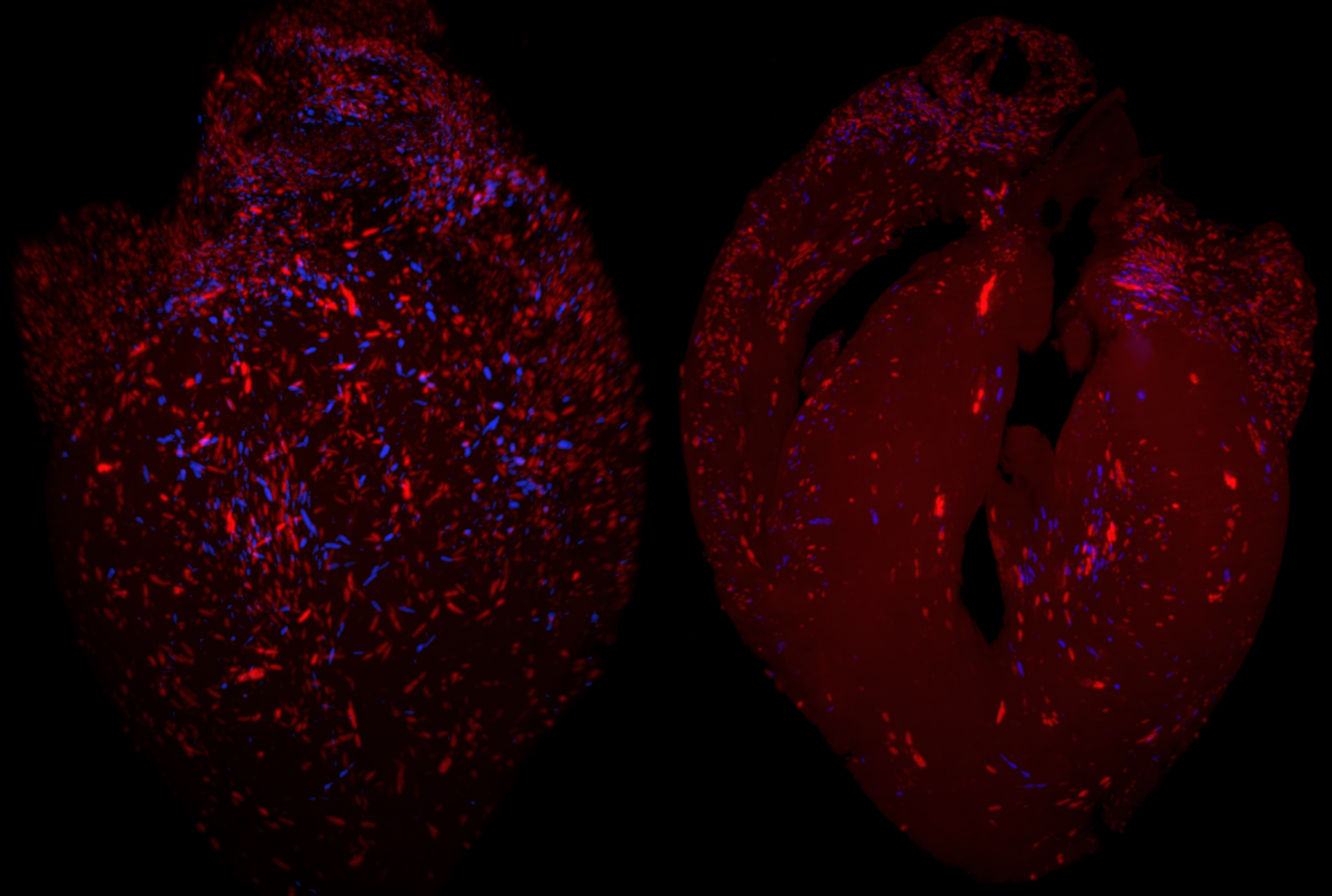
3D (left) and single slice (right) light sheet microscopy imaging of the heart of a mouse infected with two strains (red and blue) of Trypanosoma cruzi. (Image credit: Fernando Sanchez-Valdez) Research shows stronger but less frequent drug doses could be key Researchers in the University of Georgia’s Center for Tropical and Emerging Global Diseases have found …

A modified drug regimen clears active and dormant trypanosomes in mouse models of Chagas disease

A major contributor to treatment failure in Chagas disease, caused by infection with the protozoan parasite Trypanosoma cruzi, is that current treatment regimens do not address the drug insensitivity of transiently dormant T. cruzi amastigotes. Here, we demonstrated that use of a currently available drug in a modified treatment regimen of higher individual doses, given less frequently over …

Signaling pathways involved in environmental sensing in Trypanosoma cruzi

Trypanosoma cruzi is a unicellular parasite and the etiologic agent of Chagas disease. The parasite has a digenetic life cycle alternating between mammalian and insect hosts, where it faces a variety of environmental conditions to which it must adapt in order to survive. The adaptation to these changes is mediated by signaling pathways that coordinate …

Glycomics, Glycoproteomics and Glycogenomics: an Inter-Taxa Evolutionary Perspective

Glycosylation is a highly diverse set of co- and post-translational modification of proteins. For mammalian glycoproteins, glycosylation is often site-, tissue- and species-specific, and diversified by microheterogeneity. Multitudinous biochemical, cellular, physiological and organismic effects of their glycans have been revealed, either intrinsic to the carrier proteins or mediated by endogenous reader proteins with carbohydrate recognition …