
Generic selectors
Exact matches only
Search in title
Search in content
Post Type Selectors

Tag: Don Harn

Monoclonal Antibodies Generated against Glycoconjugates Recognize Chemical Linkers
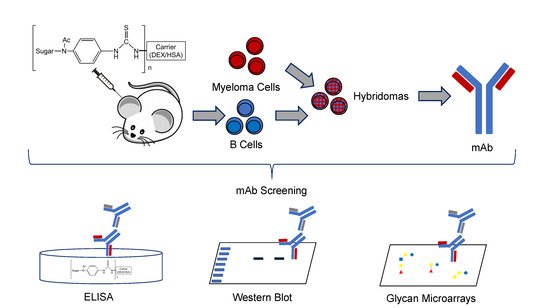
Monoclonal antibodies (mAbs) that recognize glycans are useful tools to assess carbohydrates’ structure and function. We sought to produce IgG mAbs to the human milk oligosaccharide (HMO), lacto-N-fucopentaose III (LNFPIII). LNFPIII contains the Lewisx antigen, which is found on the surface of schistosome parasites. mAbs binding the Lewisx antigen are well-reported in the literature, but mAbs recognizing HMO structures are rare. To generate mAbs, mice were immunized with LNFPIII-DEX (P3DEX) plus CpGs in VacSIM®, a novel vaccine/drug delivery platform. Mice were boosted with LNFPIII-HSA (P3HSA) plus CpGs in Incomplete Freund’s Adjuvant (IFA). Splenocytes from immunized mice were used to generate hybridomas and were screened against LNFPIII conjugates via enzyme-linked immunosorbent assay (ELISA). Three positive hybridomas were expanded, and one hybridoma, producing IgG and IgM antibodies, was cloned via flow cytometry. Clone F1P2H4D8D5 was selected because it produced IgG1 mAbs, but rescreening unexpectedly showed binding to both LNFPIII and lacto-N-neotetraose (LNnT) conjugates. To further assess the specificity of the mAb, we screened it on two glycan microarrays and found no significant binding. This finding suggests that the mAb binds to the acetylphenylenediamine (APD) linker-spacer structure of the conjugate. We present the results herein, suggesting that our new mAb could be a useful probe for conjugates using similar linker spacer structures.

Jessica Ramadhin, Vanessa Silva-Moraes, Thomas Norberg, Donald Harn. Antibodies 20209, 48. https://doi.org/10.3390/antib9030048

Neurochemical and neuroinflammatory perturbations in two Gulf War Illness models: Modulation by the immunotherapeutic LNFPIII

Gulf War Illness (GWI) manifests a multitude of symptoms, including neurological and immunological, and approximately a third of the 1990–1991 Gulf War (GW) veterans suffer from it. This study sought to characterize the acute neurochemical (monoamine) and neuroinflammatory profiles of two established GWI animal models and examine the potential modulatory effects of the novel immunotherapeutic Lacto-N-fucopentaose III (LNFPIII). In Model 1, male C57BL/6 J mice were treated for 10 days with pyridostigmine bromide (PB) and permethrin (PM). In Model 2, a separate cohort of mice were treated for 14 days with PB and N,N-Diethyl-methylbenzamide (DEET), plus corticosterone (CORT) via drinking water on days 8–14 and diisopropylfluorophosphate (DFP) on day 15. LNFPIII was administered concurrently with GWI chemicals treatments. Brain and spleen monoamines and hippocampal inflammatory marker expression were examined by, respectively, HPLC-ECD and qPCR, 6 h post treatment cessation. Serotonergic (5-HT) and dopaminergic (DA) dyshomeostasis caused by GWI chemicals was apparent in multiple brain regions, primarily in the nucleus accumbens (5-HT) and hippocampus (5-HT, DA) for both models. Splenic levels of 5-HT (both models) and norepinephrine (Model 2) were also disrupted by GWI chemicals. LNFPIII treatment prevented many of the GWI chemicals induced monoamine alterations. Hippocampal inflammatory cytokines were increased in both models, but the magnitude and spread of inflammation was greater in Model 2; LNFPIII was anti-inflammatory, more so in the apparently milder Model 1. Overall, in both models, GWI chemicals led to monoamine disbalance and neuroinflammation. LNFPIII co-treatment prevented many of these disruptions in both models, which is indicative of its promise as a potential GWI therapeutic.

J.M. Carpenter, H.E. Gordon, H.D. Ludwig, J.J. Wagner, D.A. Harn, T. Norberg, N.M. Filipov. Neurotoxicology. 2019 Dec 19;77:40-50. doi: 10.1016/j.neuro.2019.12.012

Field Testing Integrated Interventions for Schistosomiasis Elimination in the People’s Republic of China: Outcomes of a Multifactorial Cluster-Randomized Controlled Trial

Despite significant progress, China faces the challenge of re-emerging schistosomiasis transmission in currently controlled areas due, in part, to the presence of a range of animal reservoirs, notably water buffalo and cattle, which can harbor Schistosoma japonicuminfections. Environmental, ecological and social-demographic changes in China, shown to affect the distribution of oncomelanid snails, can also impact future schistosomiasis transmission. In light of their importance in the S. japonicum, lifecycle, vaccination has been proposed as a means to reduce the excretion of egg from cattle and buffalo, thereby interrupting transmission from these reservoir hosts to snails. A DNA-based vaccine (SjCTPI) our team developed showed encouraging efficacy against S. japonicum in Chinese water buffaloes. Here we report the results of a double-blind cluster randomized trial aimed at determining the impact of a combination of the SjCTPI bovine vaccine (given as a prime-boost regimen), human mass chemotherapy and snail control on the transmission of S. japonicum in 12 selected administrative villages around the Dongting Lake in Hunan province. The trial confirmed human praziquantel treatment is an effective intervention at the population level. Further, mollusciciding had an indirect ~50% efficacy in reducing human infection rates. Serology showed that the SjCTPI vaccine produced an effective antibody response in vaccinated bovines, resulting in a negative correlation with bovine egg counts observed at all post-vaccination time points. Despite these encouraging outcomes, the effect of the vaccine in preventing human infection was inconclusive. This was likely due to activities undertaken by the China National Schistosomiasis Control Program, notably the treatment, sacrifice or removal of bovines from trial villages, over which we had no control; as a result, the trial design was compromised, reducing power and contaminating outcome measures. This highlights the difficulties in undertaking field trials of this nature and magnitude, particularly over a long period, and emphasizes the importance of mathematical modeling in predicting the potential impact of control intervention measures. A transmission blocking vaccine targeting bovines for the prevention of S. japonicum with the required protective efficacy would be invaluable in tandem with other preventive intervention measures if the goal of eliminating schistosomiasis from China is to become a reality.

Gail M. Williams, Yue-Sheng Li, Darren J. Gray, Zheng-Yuan Zhao, Donald A. Harn, Lisa M. Shollenberger, Sheng-Ming Li, Xinglin Yu, Zeng Feng, Jia-Gang Guo, Jie Zhou, Yu-Lan Dong, Yuan Li, Biao Guo, Patrick Driguez, Marina Harvie, Hong You, Allen G. Ross and Donald P. McManus. Front Immunol. 2019 Apr 3;10:645. doi: 10.3389/fimmu.2019.006452019.

Diagnosis of Schistosoma mansoni infections: what are the choices in Brazilian low-endemic areas?

The population of Brazil is currently characterised by many individuals harbouring low-intensity Schistosoma mansoni infections. The Kato-Katz technique is the diagnostic method recommended by the World Health Organization (WHO) to assess these infections, but this method is not sensitive enough in the context of low egg excretion. In this regard, potential alternatives are being employed to overcome the limits of the Kato-Katz technique. In the present review, we evaluated the performance of parasitological and immunological approaches adopted in Brazilian areas. Currently, the diagnostic choices involve a combination of strategies, including the utilisation of antibody methods to screen individuals and then subsequent confirmation of positive cases by intensive parasitological investigations.


Vanessa Silva-Moraes, Lisa M Shollenberger, Liliane Maria Vidal Siqueira, William Castro-Borges, Donald A Harn, Rafaella Fortini Queiroz e Grenfell, Ana Lucia Teles Rabello, Paulo Marcos Zech Coelho. 2019. Mem Inst Oswaldo Cruz. 2019 Mar 28;114:e180478. doi: 10.1590/0074-02760180478.

Serological proteomic screening and evaluation of a recombinant egg antigen for the diagnosis of low-intensity Schistosoma mansoni infections in endemic area in Brazil

BACKGROUND:

Despite decades of use of control programs, schistosomiasis remains a global public health problem. To further reduce prevalence and intensity of infection, or to achieve the goal of elimination in low-endemic areas, there needs to be better diagnostic tools to detect low-intensity infections in low-endemic areas in Brazil. The rationale for development of new diagnostic tools is that the current standard test Kato-Katz (KK) is not sensitive enough to detect low-intensity infections in low-endemic areas. In order to develop new diagnostic tools, we employed a proteomics approach to identify biomarkers associated with schistosome-specific immune responses in hopes of developing sensitive and specific new methods for immunodiagnosis.


METHODS AND FINDINGS:

Immunoproteomic analyses were performed on egg extracts of Schistosoma mansoni using pooled sera from infected or non-infected individuals from a low-endemic area of Brazil. Cross reactivity with other soil-transmitted helminths (STH) was determined using pooled sera from individuals uniquely infected with different helminths. Using this approach, we identified 23 targets recognized by schistosome acute and chronic sera samples. To identify immunoreactive targets that were likely glycan epitopes, we compared these targets to the immunoreactivity of spots treated with sodium metaperiodate oxidation of egg extract. This treatment yielded 12/23 spots maintaining immunoreactivity, suggesting that they were protein epitopes. From these 12 spots, 11 spots cross-reacted with sera from individuals infected with other STH and 10 spots cross-reacted with the negative control group. Spot number 5 was exclusively immunoreactive with sera from S. mansoni-infected groups in native and deglycosylated conditions and corresponds to Major Egg Antigen (MEA). We expressed MEA as a recombinant protein and showed a similar recognition pattern to that of the native protein via western blot. IgG-ELISA gave a sensitivity of 87.10% and specificity of 89.09% represented by area under the ROC curve of 0.95. IgG-ELISA performed better than the conventional KK (2 slides), identifying 56/64 cases harboring 1-10 eggs per gram of feces that were undiagnosed by KK parasitological technique.


CONCLUSIONS:

The serological proteome approach was able to identify a new diagnostic candidate. The recombinant egg antigen provided good performance in IgG-ELISA to detect individuals with extreme low-intensity infections (1 egg per gram of feces). Therefore, the IgG-ELISA using this newly identified recombinant MEA can be a useful tool combined with other techniques in low-endemic areas to determine the true prevalence of schistosome infection that is underestimated by the KK method. Further, to overcome the complexity of ELISA in the field, a second generation of antibody-based rapid diagnostic tests (RDT) can be developed.


Vanessa Silva-Moraes, Lisa Marie Shollenberger, William Castro-Borges, Ana Lucia Teles Rabello, Donald A. Harn, Lia Carolina Soares Medeiros, Wander de Jesus Jeremias, Liliane Maria Vidal Siqueira, Caroline Stephane Salviano Pereira, Maria Luysa Camargos Pedrosa, Nathalie Bonatti Franco Almeida, Aureo Almeida, Jose Roberto Lambertucci, Nídia Francisca de Figueiredo Carneiro, Paulo Marcos Zech Coelho, Rafaella Fortini Queiroz Grenfell. 2019. PLOS Neglected Tropical Diseases.
https://doi.org/10.1371/journal.pntd.0006974