Generic selectors
Exact matches only
Search in title
Search in content
Post Type Selectors

Author: Donna Huber

Survival of Salmonella and Shiga Toxin-producing Escherichia coli and Changes in Indigenous Microbiota During Fermentation of Kombucha Made from Home-brewing Kits

Survival and growth of Salmonella and Shiga toxin-producing Escherichia coli (STEC) in kombucha prepared from four brands of commercially available kombucha kits intended for use by home brewers were investigated. Changes in microbiota responsible for fermentation were also determined. An initial population of Salmonella (6.77 log CFU/mL) decreased to below the detection limit (0.30 log …

Riboflavin instability is a key factor underlying the requirement of a gut microbiota for mosquito development

We previously determined that several diets used to rear Aedes aegypti and other mosquito species support the development of larvae with a gut microbiota but do not support the development of axenic larvae. In contrast, axenic larvae have been shown to develop when fed other diets. To understand the mechanisms underlying this dichotomy, we developed a defined …

Estimating true prevalence of Schistosoma mansoni from population summary measures based on the Kato-Katz diagnostic technique

Background: The prevalence of Schistosoma mansoni infection is usually assessed by the Kato-Katz diagnostic technique. However, Kato-Katz thick smears have low sensitivity, especially for light infections. Egg count models fitted on individual level data can adjust for the infection intensity-dependent sensitivity and estimate the 'true' prevalence in a population. However, application of these models is complex …

Mitochondrial Pyruvate Carrier Subunits Are Essential for Pyruvate-Driven Respiration, Infectivity, and Intracellular Replication of Trypanosoma cruzi

Pyruvate is the final metabolite of glycolysis and can be converted into acetyl coenzyme A (acetyl-CoA) in mitochondria, where it is used as the substrate for the tricarboxylic acid cycle. Pyruvate availability in mitochondria depends on its active transport through the heterocomplex formed by the mitochondrial pyruvate carriers 1 and 2 (MPC1/MPC2). We report here …

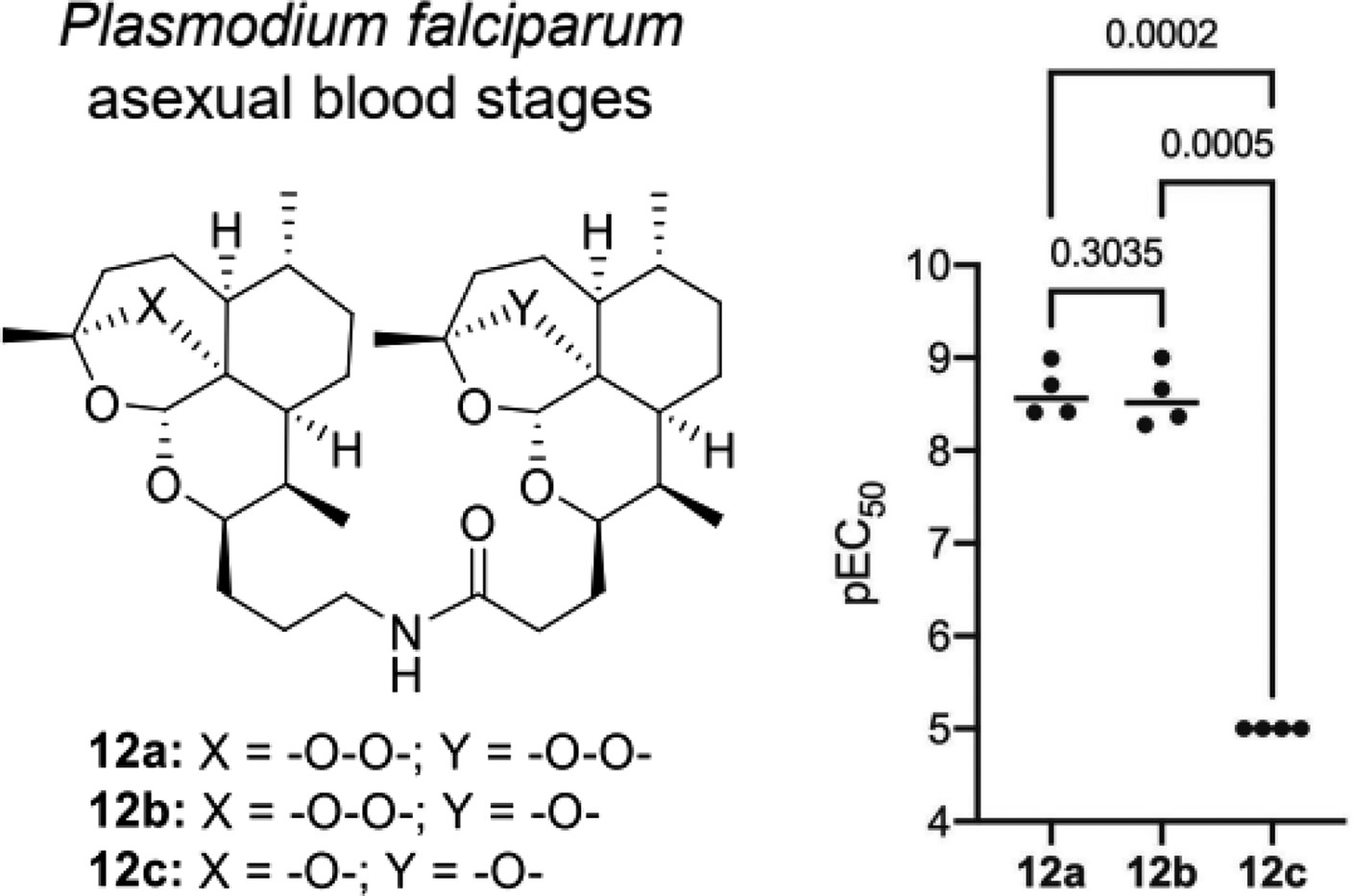
Synthesis of Mono- and Bisperoxide-Bridged Artemisinin Dimers to Elucidate the Contribution of Dimerization to Antimalarial Activity

During the past decade, artemisinin as an antimalarial has been in the spotlight, in part due to the Nobel Prize in Physiology or Medicine awarded to Tu Youyou. While many studies have been completed detailing the significant increase in activity resulting from the dimerization of natural product artemisinin, activity increases unaccounted for by the peroxide …

Ca2+ entry at the plasma membrane and uptake by acidic stores is regulated by the activity of the V‐H+‐ATPase in Toxoplasma gondii

Ca2+ is a universal intracellular signal that regulates many cellular functions. In Toxoplasma gondii, the controlled influx of extracellular and intracellular Ca2+ into the cytosol initiates a signaling cascade that promotes pathogenic processes like tissue destruction and dissemination. In this work we studied the role of proton transport in cytosolic Ca2+ homeostasis and the initiation of Ca2+ signaling. We …

High variation in immune responses and parasite phenotypes in naturally acquired Trypanosoma cruzi infection in a captive non-human primate breeding colony in Texas, USA

Trypanosoma cruzi, the causative agent of human Chagas disease, is endemic to the southern region of the United States where it routinely infects many host species. The indoor/outdoor housing configuration used in many non-human primate research and breeding facilities in the southern of the USA provides the opportunity for infection by T. cruzi and thus …

Naegleria fowleri: Protein structures to facilitate drug discovery for the deadly, pathogenic free-living amoeba

Naegleria fowleri is a pathogenic, thermophilic, free-living amoeba which causes primary amebic meningoencephalitis (PAM). Penetrating the olfactory mucosa, the brain-eating amoeba travels along the olfactory nerves, burrowing through the cribriform plate to its destination: the brain’s frontal lobes. The amoeba thrives in warm, freshwater environments, with peak infection rates in the summer months and has …