Generic selectors
Exact matches only
Search in title
Search in content
Post Type Selectors

Author: Donna Huber

The Toxoplasma Plant-Like Vacuolar Compartment (PLVAC)

Toxoplasma gondii belongs to the phylum Apicomplexa and is an important cause of congenital disease and infection in immunocompromised patients. T. gondii shares several characteristics with plants including a non-photosynthetic plastid termed apicoplast and a multi-vesicular organelle that was named the plant-like vacuole (PLV) or vacuolar compartment (VAC). The name plant-like vacuole was selected based …

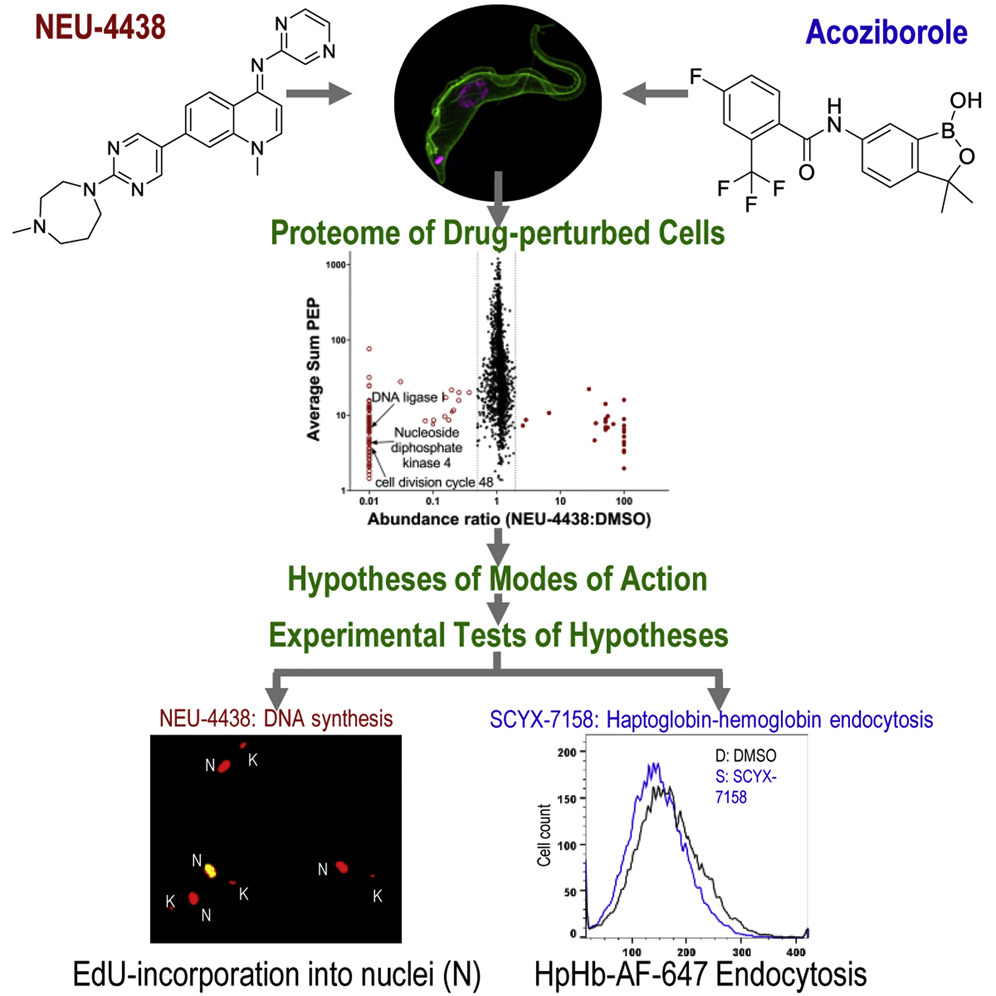
Hypothesis-generating proteome perturbation to identify NEU-4438 and acoziborole modes of action in the African Trypanosome

NEU-4438 is a lead for the development of drugs against Trypanosoma brucei, which causes human African trypanosomiasis. Optimized with phenotypic screening, targets of NEU-4438 are unknown. Herein, we present a cell perturbome workflow that compares NEU-4438's molecular modes of action to those of SCYX-7158 (acoziborole). Following a 6 h perturbation of trypanosomes, NEU-4438 and acoziborole reduced …

Liver-stage fate determination in Plasmodium vivax parasites: Characterization of schizont growth and hypnozoite fating from patient isolates

Plasmodium vivax, one species of parasite causing human malaria, forms a dormant liver stage, termed the hypnozoite, which activate weeks, months or years after the primary infection, causing relapse episodes. Relapses significantly contribute to the vivax malaria burden and are only killed with drugs of the 8-aminoquinoline class, which are contraindicated in many vulnerable populations. …

UGA researcher uncovers humans’ natural weapon against malaria

UGA’s Samarchith “Sam” Kurup, assistant professor of cellular biology, has been awarded a five-year National Institutes of Health grant to study the natural immune response to the Plasmodium parasite—which causes malaria—in liver cells. (photo credit: Lauren Corcino) Samarchith “Sam” Kurup grew up in India, and he’s always been aware of the impact of malaria. In …

MICU1 and MICU2 potentiation of Ca2+ uptake by the mitochondrial Ca2+ uniporter of Trypanosoma cruzi and its inhibition by Mg2

Trypanosome MCU cimplex organization The mitochondrial Ca2+ uptake, which is important to regulate bioenergetics, cell death and cytoplasmic Ca2+ signaling, is mediated via the calcium uniporter complex (MCUC). In animal cells the MCUC is regulated by the mitochondrial calcium uptake 1 and 2 dimer (MICU1/MICU2), which has been proposed to act as gatekeeper preventing mitochondrial Ca2+ overload at …

The Domestic Dog as a Laboratory Host for Brugia malayi

Of the three nematodes responsible for lymphatic filariasis in humans, only Brugia malayi is actively maintained in research settings owing to its viability in small animal hosts, principal among which is the domestic cat. While the microfilaremic feline host is necessary for propagation of parasites on any significant scale, this system is plagued by a number of …

The Heptaprenyl Diphosphate Synthase (Coq1) Is the Target of a Lipophilic Bisphosphonate That Protects Mice against Toxoplasma gondii Infection

Prenyldiphosphate synthases catalyze the reaction of allylic diphosphates with one or more isopentenyl diphosphate molecules to form compounds such as farnesyl diphosphate, used in, e.g., sterol biosynthesis and protein prenylation, as well as longer "polyprenyl" diphosphates, used in ubiquinone and menaquinone biosynthesis. Quinones play an essential role in electron transport and are associated with the …

Streamlining sporozoite isolation from mosquitoes by leveraging the dynamics of migration to the salivary glands

Background: Sporozoites isolated from the salivary glands of Plasmodium-infected mosquitoes are a prerequisite for several basic and pre-clinical applications. Although salivary glands are pooled to maximize sporozoite recovery, insufficient yields pose logistical and analytical hurdles; thus, predicting yields prior to isolation would be valuable. Preceding oocyst densities in the midgut is an obvious candidate. However, it …

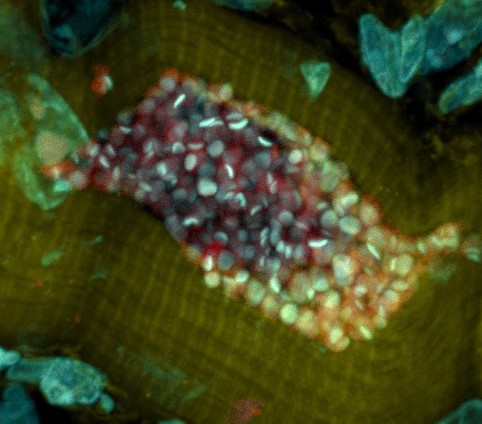
Researchers discover potential treatment for Chagas disease

The skeletal muscle of a mouse infected with Trypanosoma cruzi is shown under a microscope. (Submitted by Fernando Sanchez) The condition affects tens of millions across the Americas but lacks effective treatments Researchers from the University of Georgia have discovered a potential treatment for Chagas disease, marking the first medication with promise to successfully and …