Outbreak News Today Interviews Rick Tarleton
Recently, Dr. Rick Tarleton was interviewed by Outbreak News Today about his recently published study in Science Translational Medicine. [button size='large' style='' text='Listen Now' icon='' icon_color='BA0C2F' link='http://outbreaknewstoday.com/chagas-disease-treatment-research-with-rick-tarleton-phd-81114/' target='_self' color='' hover_color='' border_color='' hover_border_color='' background_color='' hover_background_color='' font_style='' font_weight='' text_align='' margin='']
Stronger treatments could cure Chagas disease
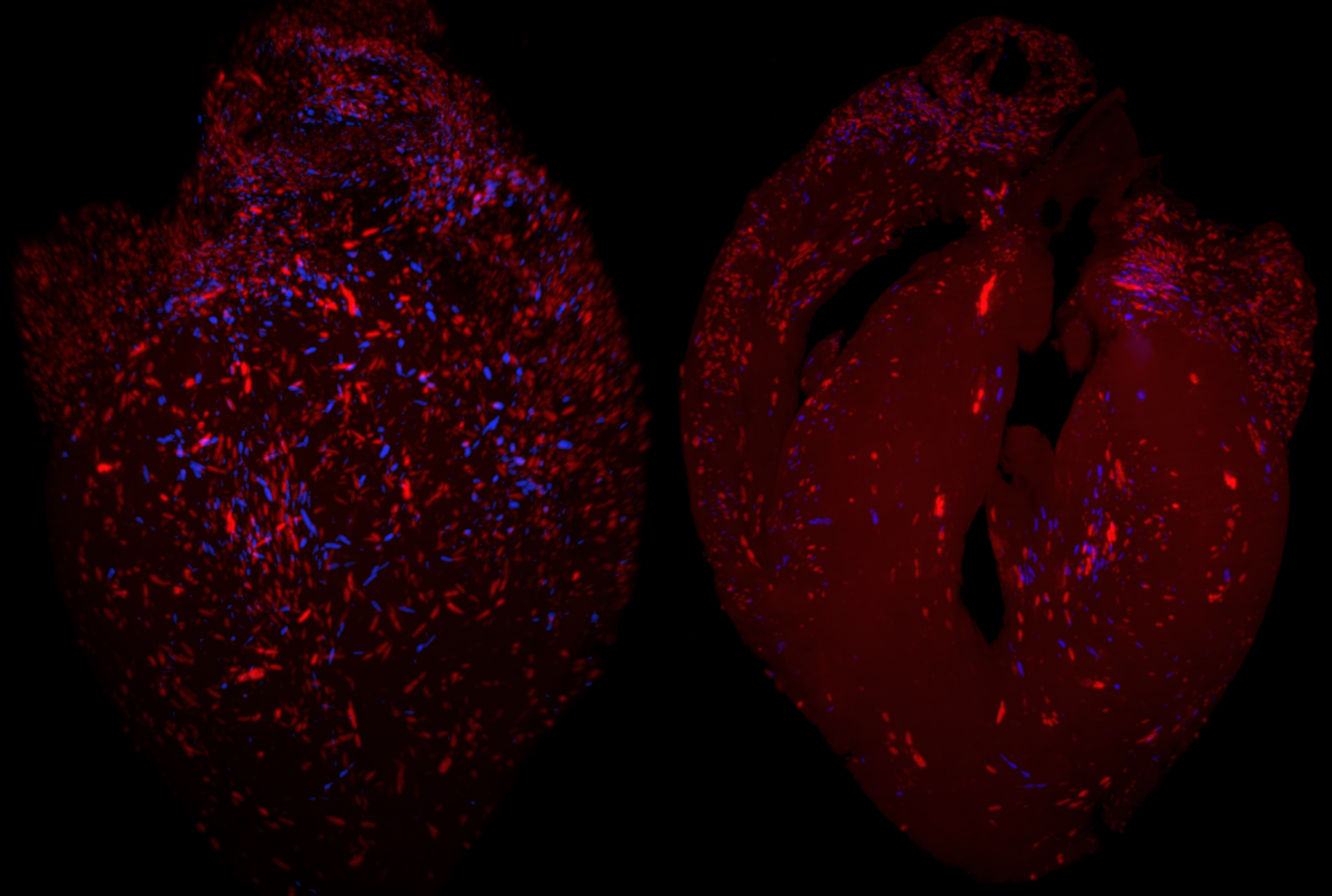
3D (left) and single slice (right) light sheet microscopy imaging of the heart of a mouse infected with two strains (red and blue) of Trypanosoma cruzi. (Image credit: Fernando Sanchez-Valdez) Research shows stronger but less frequent drug doses could be key Researchers in the University of Georgia’s Center for Tropical and Emerging Global Diseases have found …
A modified drug regimen clears active and dormant trypanosomes in mouse models of Chagas disease
A major contributor to treatment failure in Chagas disease, caused by infection with the protozoan parasite Trypanosoma cruzi, is that current treatment regimens do not address the drug insensitivity of transiently dormant T. cruzi amastigotes. Here, we demonstrated that use of a currently available drug in a modified treatment regimen of higher individual doses, given less frequently over …
Signaling pathways involved in environmental sensing in Trypanosoma cruzi
Trypanosoma cruzi is a unicellular parasite and the etiologic agent of Chagas disease. The parasite has a digenetic life cycle alternating between mammalian and insect hosts, where it faces a variety of environmental conditions to which it must adapt in order to survive. The adaptation to these changes is mediated by signaling pathways that coordinate …
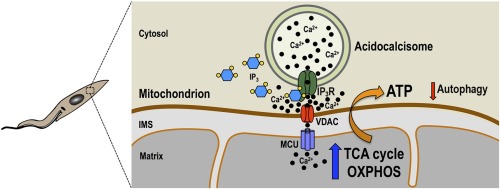
IP3 receptor-mediated Ca2+ release from acidocalcisomes regulates mitochondrial bioenergetics and prevents autophagy in Trypanosoma cruzi
In contrast to animal cells, the inositol 1,4,5-trisphosphate receptor of Trypanosoma cruzi (TcIP3R) localizes to acidocalcisomes instead of the endoplasmic reticulum. Here, we present evidence that TcIP3R is a Ca2+ release channel gated by IP3 when expressed in DT40 cells knockout for all vertebrate IP3 receptors, and is required for Ca2+ uptake by T. cruzi mitochondria, regulating pyruvate dehydrogenase …
Cutting Edge: Augmenting Muscle MHC Expression Enhances Systemic Pathogen Control at the Expense of T Cell Exhaustion
Myocytes express low levels of MHC class I (MHC I), perhaps influencing the ability of CD8+ T cells to efficiently detect and destroy pathogens that invade muscle. Trypanosoma cruzi infects many cell types but preferentially persists in muscle, and we asked if this tissue-dependent persistence was linked to MHC expression. Inducible enhancement of skeletal muscle MHC I in …
New Scheme of Intermittent Benznidazole Administration in Patients Chronically Infected With Trypanosoma cruzi: Clinical, Parasitological and Serological Assessment After Three Years of Follow-Up
Introduction. In a pilot study, we showed that intermittent administration of benznidazole in chronic Chagas disease patients resulted in a low rate of treatment suspension and therapeutic failure, as assessed by qPCR at the end of treatment. Herein, a three-year post-treatment follow-up study of the same cohort of patients is presented. Methods. The treatment scheme consisted …
CRISPR/Cas9 Technology Applied to the Study of Proteins Involved in Calcium Signaling in Trypanosoma cruzi
Chagas disease is a vector-borne tropical disease affecting millions of people worldwide, for which there is no vaccine or satisfactory treatment available. It is caused by the protozoan parasite Trypanosoma cruzi and considered endemic from North to South America. This parasite has unique metabolic and structural characteristics that make it an attractive organism for basic research. The …
A CRISPR/Cas9-riboswitch-Based Method for Downregulation of Gene Expression in Trypanosoma cruzi
Few genetic tools were available to work with Trypanosoma cruzi until the recent introduction of the CRISPR/Cas9 technique for gene knockout, gene knock-in, gene complementation, and endogenous gene tagging. Riboswitches are naturally occurring self-cleaving RNAs (ribozymes) that can be ligand-activated. Results from our laboratory recently demonstrated the usefulness of the glmS ribozyme from Bacillus subtilis, which has been shown to …