Generic selectors
Exact matches only
Search in title
Search in content
Post Type Selectors

Tag: parasitoid wasps

Large DNA Viruses That Parasitoid Wasps Transmit to Hosts

Many types of viruses have been identified in parasitoid wasps and other Hymenoptera. Parasitoid wasps also transmit several viruses to hosts through the piercing ovipositors that females use to lay eggs. Most viruses that are known to be transmitted by parasitoids have large double-stranded DNA genomes. We summarize the range of interactions that have evolved between parasitoid wasps and the viruses they transmit. Some viruses are mechanically transmitted to hosts, which can reduce the fitness of wasp offspring. Others have evolved into beneficial symbionts or reproductive parasites that replicate in wasps and hosts. Some large dsDNA viruses have also been co-opted into domesticated endogenized viruses that are vertically transmitted to offspring but still produce virions or virus-like particles that wasps use to parasitize hosts. We conclude by discussing future directions and why parasitoid wasps likely transmit many more viruses than are currently known.

Michael R Strand, Kelsey A Coffman, Gaelen R Burke. Annu Rev Entomol. 2025 Oct 7. doi: 10.1146/annurev-ento-121423-013425.

A symbiotic gene stimulates aggressive behavior favoring the survival of parasitized caterpillars

Animals often exhibit increased aggression in response to starvation, while parasites often manipulate host behavior. In contrast, underlying molecular mechanisms for these behavioral changes are mostly unknown. The diamondback moth, Plutella xylostella, is an agricultural pest that feeds on cruciferous plants as larvae, while Cotesia vestalis is a parasitoid wasp that parasitizes diamondback moth larvae. In this study, we determined that unparasitized diamondback moth larvae exhibit increased aggression and cannibalism when starved, while starved larvae parasitized by C. vestalis were more aggressive than unparasitized larvae. C. vestalis harbors a domesticated endogenized virus named Cotesia vestalis bracovirus (CvBV) that wasps inject into parasitized hosts. Starvation increased octopamine (OA) levels in the central nervous system (CNS) of diamondback moth larvae while a series of experiments identified a CvBV-encoded gene product named Assailant that further increased aggression in starved diamondback moth larvae. We determined that Assailant increases OA levels by activating tyramine beta-hydroxylase (PxTβh), which is a key enzyme in the OA biosynthesis pathway. Ectopic expression of assailant in Drosophila melanogaster likewise upregulated expression of DmTβh and OA, which increased aggressive behavior in male flies as measured by a well-established assay. While parasitized hosts are often thought to be at a competitive disadvantage to nonparasitized individuals, our results uncover how a parasitoid uses an endogenized virus to increase host aggression and enhance survival of offspring when competing against unparasitized hosts.

Zhiwei Wu, Xiaotong Wu, Zhizhi Wang, Xiqian Ye, Lan Pang, Yanping Wang, Yuenan Zhou, Ting Chen, Sicong Zhou, Zehua Wang, Yifeng Sheng, Qichao Zhang, Jiani Chen, Pu Tang, Xingxing Shen, Jianhua Huang, Jean-Michel Drezen, Michael R Strand, Xuexin Chen. Proc Natl Acad Sci U S A. 2025 May 6;122(18):e2422935122. doi: 10.1073/pnas.2422935122.

Identification of a viral gene essential for the genome replication of a domesticated endogenous virus in ichneumonid parasitoid wasps

Fig 6. RNAi knockdown of U16.
RNAi knockdown of U16.


Thousands of endoparasitoid wasp species in the families Braconidae and Ichneumonidae harbor “domesticated endogenous viruses” (DEVs) in their genomes. This study focuses on ichneumonid DEVs, named ichnoviruses (IVs). Large quantities of DNA-containing IV virions are produced in ovary calyx cells during the pupal and adult stages of female wasps. Females parasitize host insects by injecting eggs and virions into the body cavity. After injection, virions rapidly infect host cells which is followed by expression of IV genes that promote the successful development of wasp offspring. IV genomes consist of two components: proviral segment loci that serve as templates for circular dsDNAs that are packaged into capsids, and genes from an ancestral virus that produce virions. In this study, we generated a chromosome-scale genome assembly for Hyposotor didymator that harbors H. didymator ichnovirus (HdIV). We identified a total of 67 HdIV loci that are amplified in calyx cells during the wasp pupal stage. We then focused on an HdIV gene, U16, which is transcribed in calyx cells during the initial stages of replication. Sequence analysis indicated that U16 contains a conserved domain in primases from select other viruses. Knockdown of U16 by RNA interference inhibited virion morphogenesis in calyx cells. Genome-wide analysis indicated U16 knockdown also inhibited amplification of HdIV loci in calyx cells. Altogether, our results identified several previously unknown HdIV loci, demonstrated that all HdIV loci are amplified in calyx cells during the pupal stage, and showed that U16 is required for amplification and virion morphogenesis.

Ange Lorenzi, Fabrice Legeai, Véronique Jouan, Pierre-Alain Girard, Michael R Strand, Marc Ravallec, Magali Eychenne, Anthony Bretaudeau, Stéphanie Robin, Jeanne Rochefort, Mathilde Villegas, Gaelen R Burke, Rita Rebollo, Nicolas Nègre, Anne-Nathalie Volkoff. PLoS Pathog. 2024 Apr 25;20(4):e1011980. doi: 10.1371/journal.ppat.1011980.


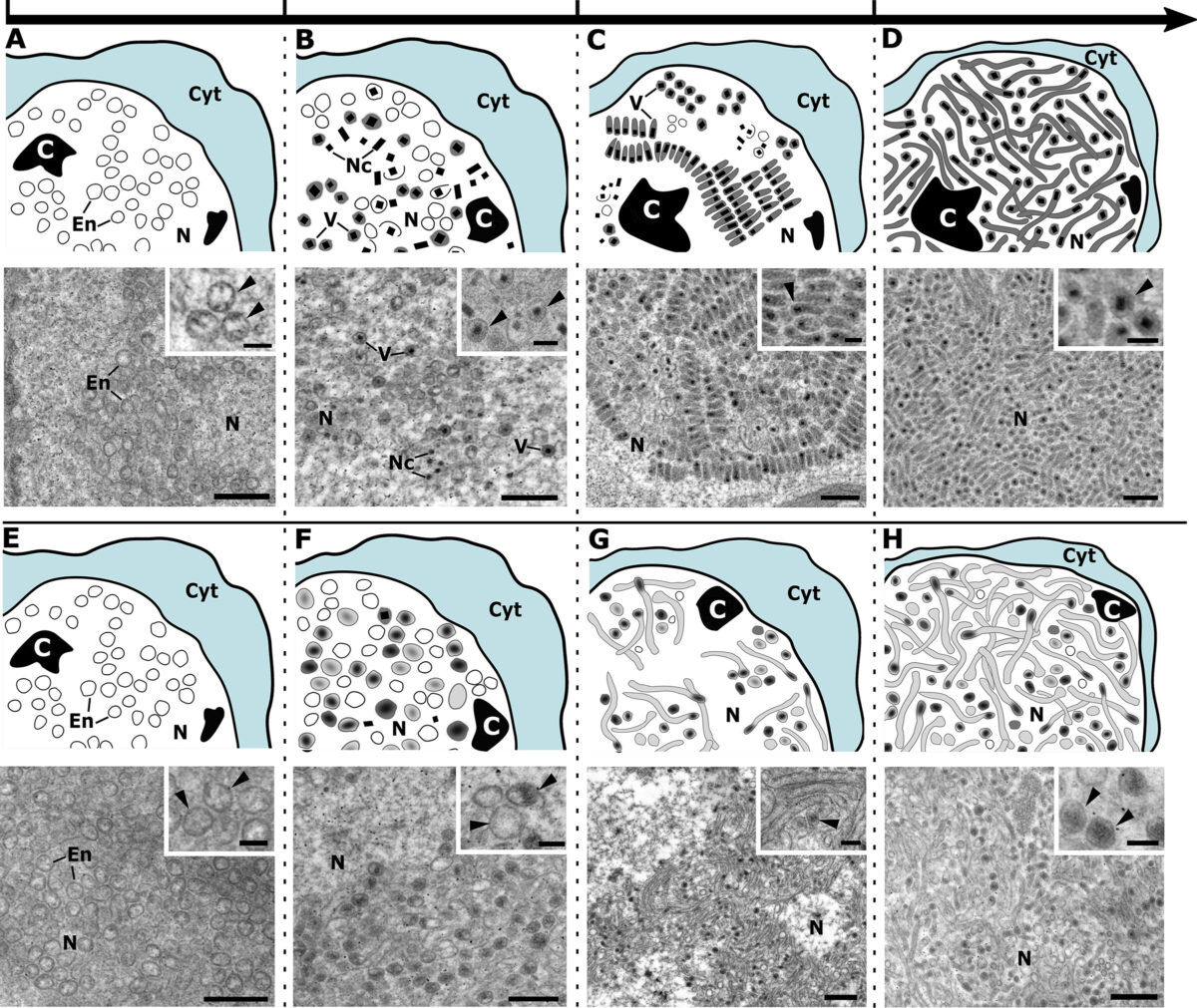
Functional characterization of Microplitis demolitor bracovirus genes that encode nucleocapsid

Fig 2 Virion morphogenesis (phases 1–4) in calyx cells from newly emerged adult females injected with ds-eGFP (control) (A–D) or ds-vp39 (E–H).


Bracoviruses (BVs) are endogenized nudiviruses in parasitoid wasps of the microgastroid complex (order Hymenoptera: Family Braconidae). BVs produce replication-defective virions that adult female wasps use to transfer DNAs encoding virulence genes to parasitized hosts. Some BV genes are shared with nudiviruses and baculoviruses with studies of the latter providing insights on function, whereas other genes are only known from nudiviruses or other BVs which provide no functional insights. A proteomic analysis of Microplitis demolitor bracovirus (MdBV) virions recently identified 16 genes encoding nucleocapsid components. In this study, we further characterized most of these genes. Some nucleocapsid genes exhibited early or intermediate expression profiles, while others exhibited late expression profiles. RNA interference (RNAi) assays together with transmission electron microscopy indicated vp39HzNVorf9-like2HzNVorf93-likeHzNVorf106-likeHzNVorf118-likeand 27b are required to produce capsids with a normal barrel-shaped morphology. RNAi knockdown of vlf-1avlf-1b-1vlf-1b-2int-1, and p6.9-1 did not alter the formation of barrel-shaped capsids but each reduced processing of amplified proviral segments and DNA packaging as evidenced by the formation of electron translucent capsids. All of the genes required for normal capsid assembly were also required for proviral segment processing and DNA packaging. Collectively, our results deorphanize several BV genes with previously unknown roles in virion morphogenesis.IMPORTANCEUnderstanding how bracoviruses (BVs) function in wasps is of broad interest in the study of virus evolution. This study characterizes most of the Microplitis demolitor bracovirus (MdBV) genes whose products are nucleocapsid components. Results indicate several genes unknown outside of nudiviruses and BVs are essential for normal capsid assembly. Results also indicate most MdBV tyrosine recombinase family members and the DNA binding protein p6.9-1 are required for DNA processing and packaging into nucleocapsids.

Ange Lorenzi, Michael J Arvin, Gaelen R Burke, Michael R Strand. J Virol. 2023 Oct 25:e0081723. doi: 10.1128/jvi.00817-23.

Bracoviruses, ichnoviruses, and virus-like particles from parasitoid wasps retain many features of their virus ancestors

Animal genomes commonly contain genes or sequences that have been acquired from different types of viruses. The vast majority of these endogenous virus elements (EVEs) are inactive or consist of only a small number of components that show no evidence of cooption for new functions or interaction. Unlike most EVEs, bracoviruses (BVs), ichnoviruses (IVs) and virus-like particles (VLPs) in parasitoid wasps have evolved through retention and interaction of many genes from virus ancestors. Here, we discuss current understanding of BV, IV and VLP evolution along with associated implications for what constitutes a virus. We suggest that BVs and IVs are domesticated endogenous viruses (DEVs) that differ in several important ways from other known EVEs.

Jean-Michel Drezen, Annie Bézier, Gaelen R Burke, Michael R Strand. Curr Opin Insect Sci. 2021 Dec 22;S2214-5745(21)00132-2. doi: 10.1016/j.cois.2021.12.003.