Generic selectors
Exact matches only
Search in title
Search in content
Post Type Selectors

Tag: mosquito

Insulin-like peptides and ovary ecdysteroidogenic hormone differentially stimulate physiological processes regulating egg formation in the mosquito Aedes aegypti
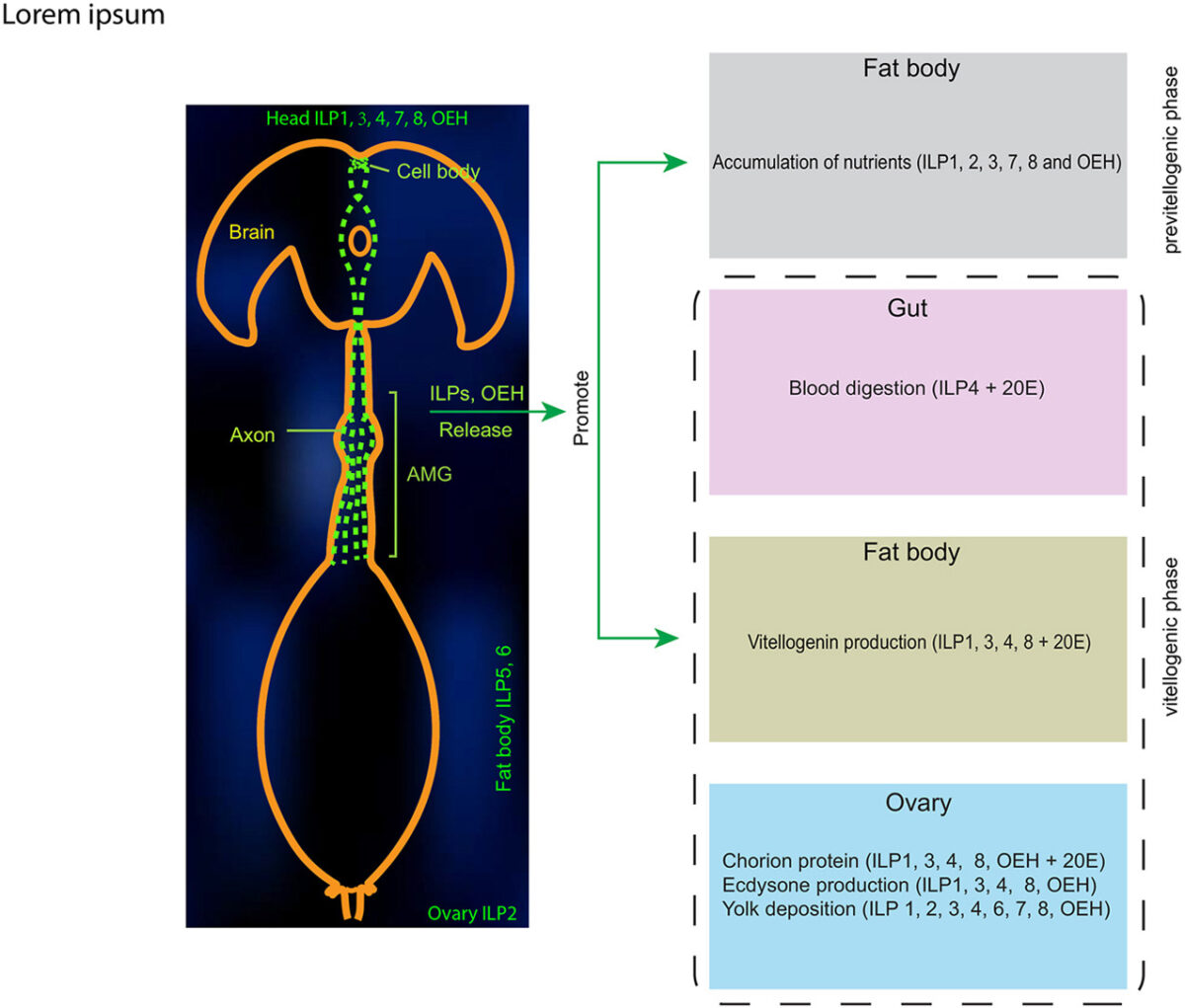
Mosquitoes including Aedes aegypti are human disease vectors because females must blood feed to produce and lay eggs. Blood feeding triggers insulin-insulin growth factor signaling (IIS) which regulates several physiological processes required for egg development. A. aegypti encodes 8 insulin-like peptides (ILPs) and one insulin-like receptor (IR) plus ovary ecdysteroidogenic hormone (OEH) that also activates …

Treatment of dogs with Bravecto® (fluralaner) reduces mosquito survival and fecundity

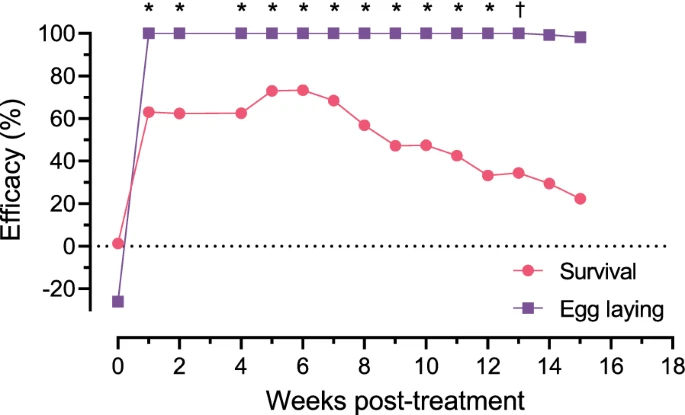
Background: Mosquitoes serve as the vector of canine heartworm (Dirofilaria immitis), which represents a significant and persistent threat to canine health. A reduction in the longevity and/or reproductive success of mosquitoes that take a blood meal from fluralaner-treated dogs may consequently reduce the local transmission of heartworm and prevent new infections. A novel secondary effect of …

Multiple endocrine factors regulate nutrient mobilization and storage in Aedes aegypti during a gonadotrophic cycle

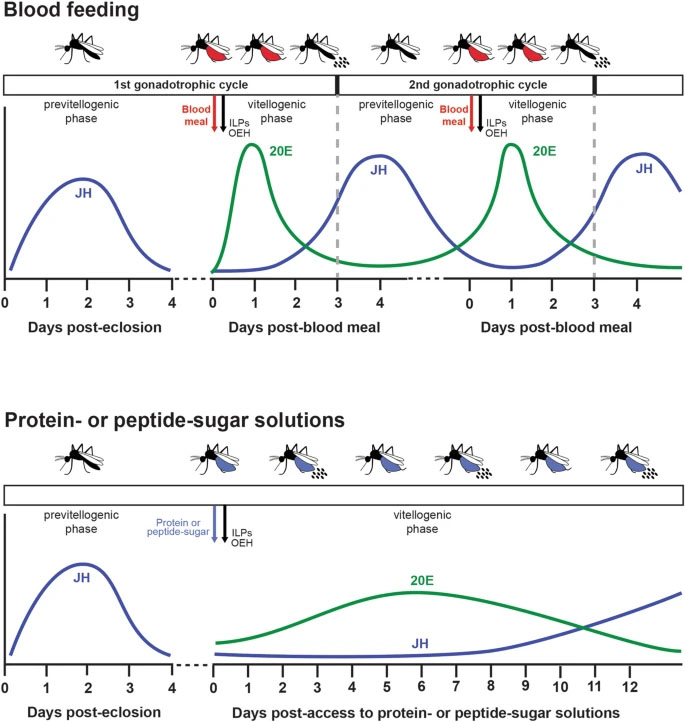
Anautogenous mosquitoes must blood feed on a vertebrate host to produce eggs. Each gonadotrophic cycle is subdivided into a sugar-feeding previtellogenic phase that produces primary follicles and a blood meal-activated vitellogenic phase in which large numbers of eggs synchronously mature and are laid. Multiple endocrine factors including juvenile hormone (JH), insulin-like peptides (ILPs), ovary ecdysteroidogenic …

Ad libitum consumption of protein- or peptide-sucrose solutions stimulates egg formation by prolonging the vitellogenic phase of oogenesis in anautogenous mosquitoes

Background: Anautogenous mosquitoes commonly consume nectars and other solutions containing sugar but are thought to only produce eggs in discrete gonadotrophic cycles after blood-feeding on a vertebrate host. However, some anautogenous species are known to produce eggs if amino acids in the form of protein are added to a sugar solution. Unclear is how different sources …

Anopheles gambiae strain (Ag55) cultured cells originated from Anopheles coluzzii and are phagocytic with hemocyte-like gene expression

Anopheles gambiae and Anopheles coluzzii are closely related species that are predominant vectors of malaria in Africa. Recently, A. gambiae form M was renamed A. coluzzii and we now conclude on the basis of a diagnostic PCR-restriction fragment length polymorphism assay that Ag55 cells were derived from A. coluzzii. We established an Ag55 cell transcriptome, …

Insulin-like peptide 3 stimulates hemocytes to proliferate in anautogenous and facultatively autogenous mosquitoes

Most mosquito species are anautogenous, which means they must blood feed on a vertebrate host to produce eggs, while a few are autogenous and can produce eggs without blood feeding. Egg formation is best understood in the anautogenous mosquito Aedes aegypti, where insulin-like peptides (ILPs), ovary ecdysteroidogenic hormone (OEH) and 20-hydroxyecdysone (20E) interact to regulate …

The Peptide Hormone CNMa Influences Egg Production in the Mosquito Aedes aegypti

Mosquito reproduction is regulated by a suite of hormones, many acting through membrane-bound receptor proteins. The Aedes aegypti G protein-coupled receptors AAEL024199 (AeCNMaR-1a) and AAEL018316 (AeCNMaR-1b) were identified as orthologs of the Drosophila melanogaster CNMa receptor (DmCNMaR). The receptor was duplicated early in the evolution of insects, and subsequently in Culicidae, into what we refer to as CNMaR-1a and …

Insulin-like peptide 3 stimulates hemocytes to proliferate in anautogenous and facultatively autogenous mosquitoes

Most mosquito species are anautogenous, which means they must blood feed on a vertebrate host to produce eggs, while a few are autogenous and can produce eggs without blood feeding. Egg formation is best understood in the anautogenous mosquito Aedes aegypti where insulin-like peptides (ILPs), ovary ecdysteroidogenic hormone (OEH) and 20-hydroxyecdysone (20E) interact to regulate …

Diet-Microbiota Interactions Alter Mosquito Development

Gut microbes and diet can both strongly affect the biology of multicellular animals, but it is often difficult to disentangle microbiota-diet interactions due to the complex microbial communities many animals harbor and the nutritionally variable diets they consume. While theoretical and empirical studies indicate that greater microbiota diversity is beneficial for many animal hosts, there …