
Generic selectors
Exact matches only
Search in title
Search in content
Post Type Selectors

Tag: Drew Etheridge

Protocol for laboratory rearing and infection tracking of Rhodnius prolixus using 3D-printable designs

Human infections by Trypanosoma cruzi propagate via its blood-feeding triatomine vector. Investigating parasite-vector interactions depends upon robust techniques to rear insects and analyze infections. Here, we present a protocol for laboratory rearing and infection tracking of Rhodnius prolixus. We describe steps for housing, feeding, and sorting strategies using 3D-printable designs. We also detail procedures for …

Lysosome and plasma membrane Piezo channels of Trypanosoma cruzi are essential for proliferation, differentiation and infectivity

Trypanosoma cruzi, the causative agent of Chagas disease, is a parasitic protist that affects millions of people worldwide. Currently there are no fully effective drugs or vaccines available. Contact of T. cruzi infective forms with their host cells or with the extracellular matrix increases their intracellular Ca2+ concentration suggesting a mechano-transduction process. We report here …

Stable colonization of the model kissing bug Rhodnius prolixus by Trypanosoma cruzi Y strain

Trypanosoma cruzi is a single-celled eukaryotic parasite responsible for Chagas disease, a major cause of morbidity and mortality in Central and South America. While the host-pathogen interactions of T. cruzi have been extensively studied in vertebrate models, investigations into its interactions within its insect host remain limited. To address this gap and establish a genetically …

A limitation lifted: A conditional knockdown system reveals essential roles for Polo-like kinase and Aurora kinase 1 in Trypanosoma cruzi cell division

While advances in genome editing technologies have simplified gene disruption in many organisms, the study of essential genes requires development of conditional disruption or knockdown systems that are not available in most organisms. Such is the case for Trypanosoma cruzi, a parasite that causes Chagas disease, a severely neglected tropical disease endemic to Latin America …

Trypanosoma cruzi heme responsive gene (TcHRG) plays a central role in orchestrating heme uptake in epimastigotes

Trypanosoma cruzi, a heme auxotrophic parasite, can control intracellular heme content by modulating heme responsive gene (TcHRG) expression when a free heme source is added to an axenic culture. Herein, we explored the role of TcHRG protein in regulating the uptake of heme derived from hemoglobin in epimastigotes. We demonstrate that the endogenous TcHRG (protein …

Massive invasion of organellar DNA drives nuclear genome evolution in Toxoplasma

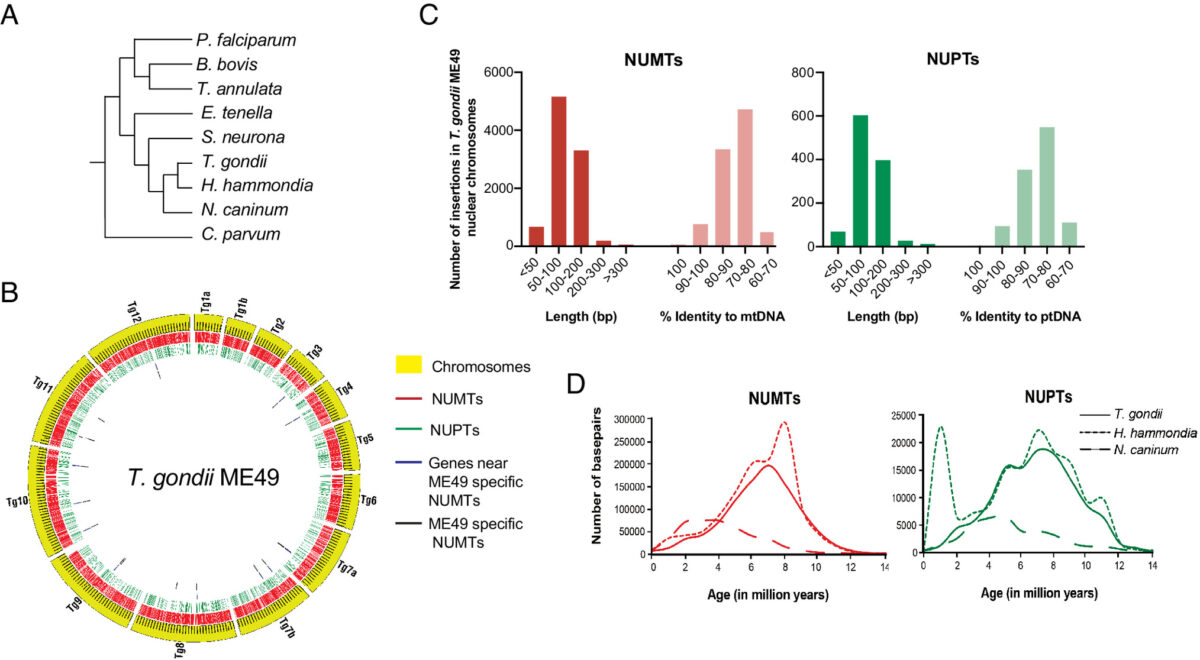
  Toxoplasma gondii is a zoonotic protist pathogen that infects up to one third of the human population. This apicomplexan parasite contains three genome sequences: nuclear (65 Mb); plastid organellar, ptDNA (35 kb); and mitochondrial organellar, mtDNA (5.9 kb of non-repetitive sequence). We find that the nuclear genome contains a significant amount of NUMTs (nuclear integrants …

Disruption of Toxoplasma gondii-Induced Host Cell DNA Replication Is Dependent on Contact Inhibition and Host Cell Type

The protozoan Toxoplasma gondii is a highly successful obligate intracellular parasite that, upon invasion of its host cell, releases an array of host-modulating protein effectors to counter host defenses and further its own replication and dissemination. Early studies investigating the impact of T. gondii infection on host cell function revealed that this parasite can force …

Protozoan phagotrophy from predators to parasites: An overview of the enigmatic cytostome-cytopharynx complex of Trypanosoma cruzi

Eating is fundamental and from this basic principle, living organisms have evolved innumerable strategies to capture energy and nutrients from their environment. As part of the world's aquatic ecosystems, the expansive family of heterotrophic protozoans uses self-generated currents to funnel prokaryotic prey into an ancient, yet highly enigmatic, oral apparatus known as the cytostome-cytopharynx complex …

Trainee Spotlight: Nathan Chasen

Nathan Chasen is a post-doctoral fellow in Drew Etheridge's laboratory (submitted photo) Nathan Chasen, a postdoctoral fellow in Drew Etheridge’s laboratory, is originally from Richmond, Virginia. After receiving his undergraduate degree from Emory University, he worked as a research technician at UGA. He then decided to attend UGA for graduate school. Under the mentorship of …

Trainee Spotlight: Edwin Pierre Louis

  Edwin Pierre Louis is a pre-doctoral trainee in the laboratory of Dr. Drew Etheridge. Originally from Haiti, he immigrated to the US to attend the University of Florida (UF), where he graduated with a Bachelor of Science in Biochemistry Molecular Biology. After earning his degree at UF, Edwin accepted a position as a biological …