Generic selectors
Exact matches only
Search in title
Search in content
Post Type Selectors

Tag: Chagas disease

Reduced Trypanosoma cruzi-specific humoral response and enhanced T cell immunity after treatment interruption with benznidazole in chronic Chagas disease

Background: Interruption of benznidazole therapy due to the appearance of adverse effects, which is presumed to lead to treatment failure, is a major drawback in the treatment of chronic Chagas disease. Methods: Trypanosoma cruzi-specific humoral and T cell responses, T cell phenotype and parasite load were measured to compare the outcome in 33 subjects with chronic Chagas …


Outbreak News Today Interviews Rick Tarleton

Recently, Dr. Rick Tarleton was interviewed by Outbreak News Today about his recently published study in Science Translational Medicine. [button size='large' style='' text='Listen Now' icon='' icon_color='BA0C2F' link='http://outbreaknewstoday.com/chagas-disease-treatment-research-with-rick-tarleton-phd-81114/' target='_self' color='' hover_color='' border_color='' hover_border_color='' background_color='' hover_background_color='' font_style='' font_weight='' text_align='' margin='']

Stronger treatments could cure Chagas disease

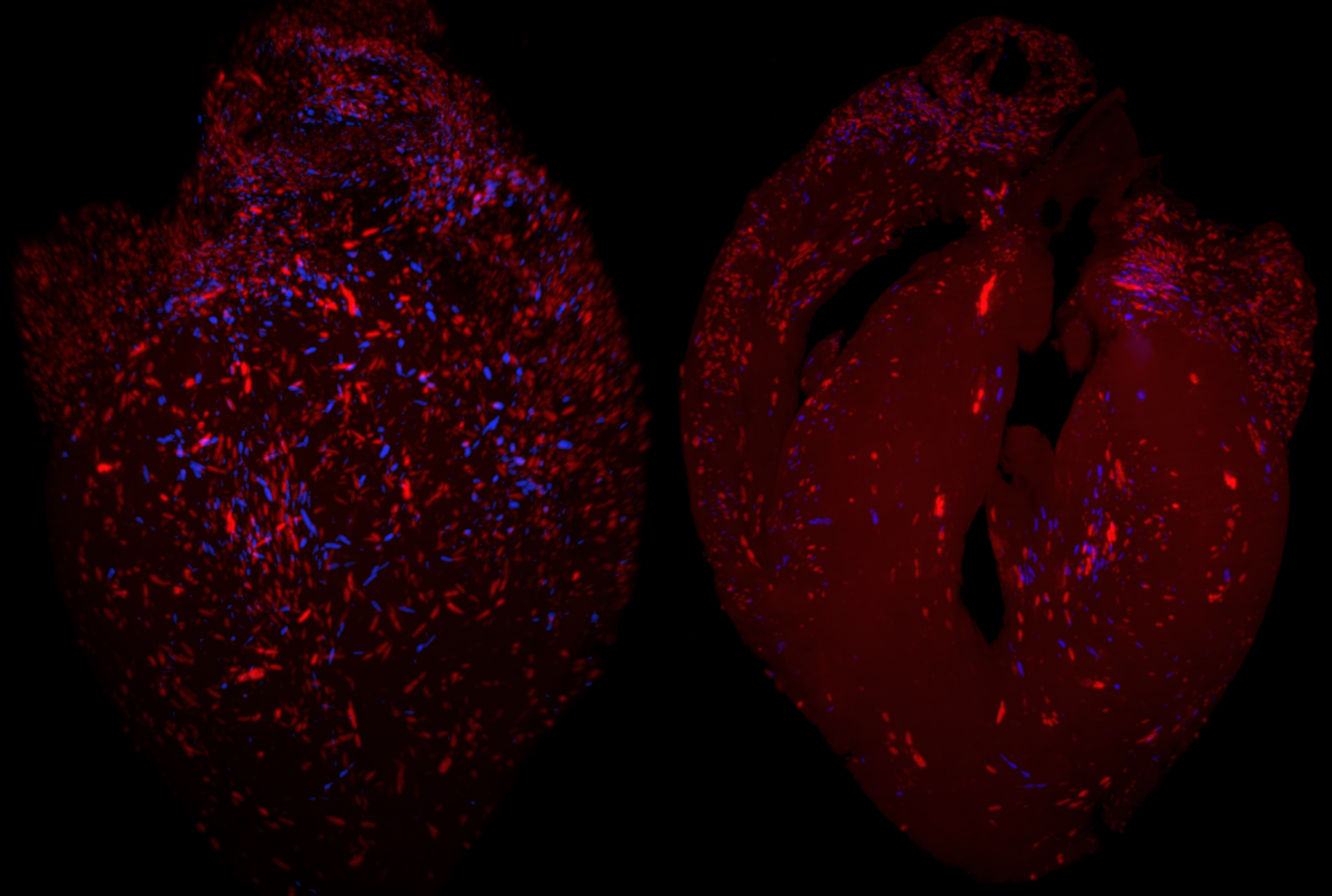
3D (left) and single slice (right) light sheet microscopy imaging of the heart of a mouse infected with two strains (red and blue) of Trypanosoma cruzi. (Image credit: Fernando Sanchez-Valdez) Research shows stronger but less frequent drug doses could be key Researchers in the University of Georgia’s Center for Tropical and Emerging Global Diseases have found …

A modified drug regimen clears active and dormant trypanosomes in mouse models of Chagas disease

A major contributor to treatment failure in Chagas disease, caused by infection with the protozoan parasite Trypanosoma cruzi, is that current treatment regimens do not address the drug insensitivity of transiently dormant T. cruzi amastigotes. Here, we demonstrated that use of a currently available drug in a modified treatment regimen of higher individual doses, given less frequently over …

New Scheme of Intermittent Benznidazole Administration in Patients Chronically Infected With Trypanosoma cruzi: Clinical, Parasitological and Serological Assessment After Three Years of Follow-Up

Introduction. In a pilot study, we showed that intermittent administration of benznidazole in chronic Chagas disease patients resulted in a low rate of treatment suspension and therapeutic failure, as assessed by qPCR at the end of treatment. Herein, a three-year post-treatment follow-up study of the same cohort of patients is presented. Methods. The treatment scheme consisted …

CRISPR/Cas9 Technology Applied to the Study of Proteins Involved in Calcium Signaling in Trypanosoma cruzi

Chagas disease is a vector-borne tropical disease affecting millions of people worldwide, for which there is no vaccine or satisfactory treatment available. It is caused by the protozoan parasite Trypanosoma cruzi and considered endemic from North to South America. This parasite has unique metabolic and structural characteristics that make it an attractive organism for basic research. The …

Visiting Scholar Fellow: Fernando Sanchez-Valdéz

Dr. Fernando Sanchez-Valdéz, from Salta, Argentina, completed a Ph.D. in Molecular Biology at the Faculty of Pharmacy and Biochemistry at the University of Buenos Aires, Argentina in 2014. After his Ph.D., he completed a postdoctoral fellowship in Dr. Rick Tarleton´s laboratory at University of Georgia. In 2018, he obtained a Research Scientist position in the …

Study reveals key cause of treatment failure in Chagas disease

Researchers at the University of Georgia have discovered that dormancy of the parasite Trypanosoma cruzi prevents effective drug treatment for Chagas disease, which kills more than 50,000 people each year in Central and South America and is a growing threat in the United States and Europe. The disease infects an estimated 6 million to 7 million …