Generic selectors
Exact matches only
Search in title
Search in content
Post Type Selectors

Tag: Chagas disease

Effective drug discovery in Chagas disease

The Chagas field has gone >50 years without tangible progress toward new therapies. My colleagues and I have recently reported on a benzoxaborole compound that achieves consistent parasitological cure in experimentally infected mice and in naturally infected non-human primates (NHPs). While these results do not assure success in human clinical trials, they significantly de-risk this …

B cell responses in chronic Chagas disease: Waning of Trypanosoma cruzi-specific antibody-secreting cells following successful etiological treatment

Background: A drawback in the treatment of chronic Chagas disease (American trypanosomiasis) is the long time required to achieve complete loss of serological reactivity, the standard for determining treatment efficacy. Methods: Antibody-secreting and memory B cells specific for Trypanosoma cruzi and their degree of differentiation were evaluated in adult and pediatric subjects with chronic Chagas disease prior …

Researchers discover potential treatment for Chagas disease

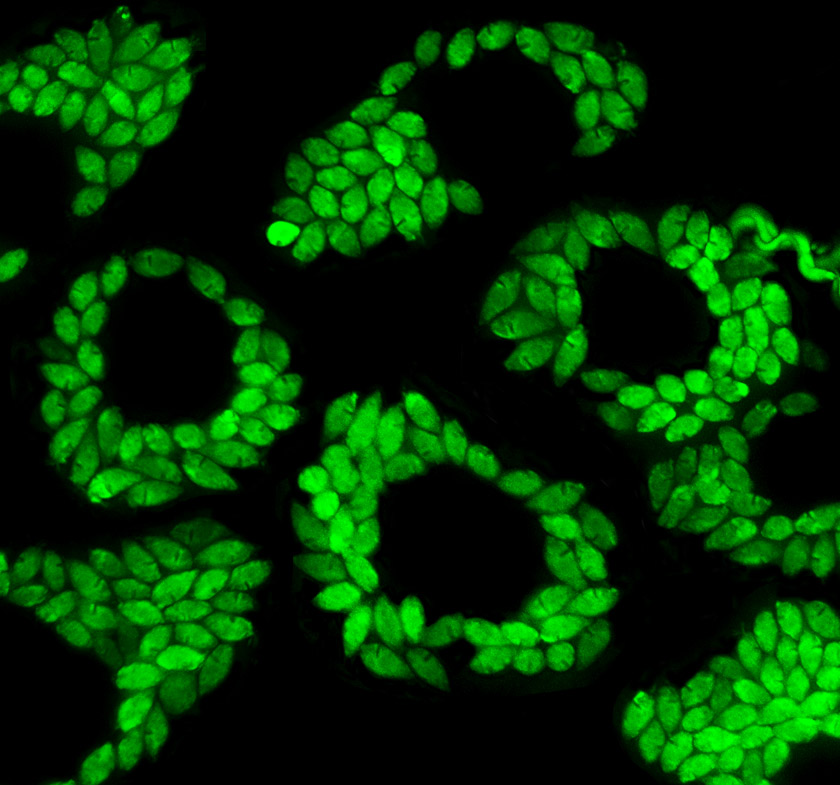
The skeletal muscle of a mouse infected with Trypanosoma cruzi is shown under a microscope. (Submitted by Fernando Sanchez) The condition affects tens of millions across the Americas but lacks effective treatments Researchers from the University of Georgia have discovered a potential treatment for Chagas disease, marking the first medication with promise to successfully and …

In the News: New study from the Tarleton Research Group

Rick Tarleton and colleagues recently published their new study, "Discovery of an orally active benzoxaborole prodrug effective in the treatment of Chagas disease in non-human primates" in Nature Microbiology. Check out these news stories about the study. Behind the paper: New Hope for Treatment of a Very Neglected, Neglected Tropical Disease (Nature Microbiology) Possible new …

Discovery of an orally active benzoxaborole prodrug effective in the treatment of Chagas disease in non-human primates

Trypanosoma cruzi, the agent of Chagas disease, probably infects tens of millions of people, primarily in Latin America, causing morbidity and mortality. The options for treatment and prevention of Chagas disease are limited and underutilized. Here we describe the discovery of a series of benzoxaborole compounds with nanomolar activity against extra- and intracellular stages of T. …

Trypanosoma cruzi Letm1 is involved in mitochondrial Ca 2+ transport, and is essential for replication, differentiation, and host cell invasion

Leucine zipper-EF-hand containing transmembrane protein 1 (Letm1) is a mitochondrial inner membrane protein involved in Ca2+ and K+ homeostasis in mammalian cells. Here, we demonstrate that the Letm1 orthologue of Trypanosoma cruzi, the etiologic agent of Chagas disease, is important for mitochondrial Ca2+ uptake and release. The results show that both mitochondrial Ca2+ influx and efflux are reduced in …

Immune exhaustion in chronic Chagas disease: Pro-inflammatory and immunomodulatory action of IL-27 in vitro

In chronic Chagas disease, Trypanosoma cruzi-specific T-cell function decreases over time, and alterations in the homeostatic IL-7/IL-7R axis are evident, consistent with a process of immune exhaustion. IL-27 is an important immunoregulatory cytokine that shares T-cell signaling with IL-7 and other cytokines of the IL-12 family and might be involved in the transcriptional regulation of …

High variation in immune responses and parasite phenotypes in naturally acquired Trypanosoma cruzi infection in a captive non-human primate breeding colony in Texas, USA

Trypanosoma cruzi, the causative agent of human Chagas disease, is endemic to the southern region of the United States where it routinely infects many host species. The indoor/outdoor housing configuration used in many non-human primate research and breeding facilities in the southern of the USA provides the opportunity for infection by T. cruzi and thus …

Deletion of a Golgi protein in Trypanosoma cruzi reveals a critical role for Mn2+ in protein glycosylation needed for host cell invasion and intracellular replication

Trypanosoma cruzi is a protist parasite and the causative agent of American trypanosomiasis or Chagas disease. The parasite life cycle in its mammalian host includes an intracellular stage, and glycosylated proteins play a key role in host-parasite interaction facilitating adhesion, invasion and immune evasion. Here, we report that a Golgi-localized Mn2+-Ca2+/H+ exchanger of T. cruzi …