
Generic selectors
Exact matches only
Search in title
Search in content
Post Type Selectors

Category: publications

The transcriptome of Balamuthia mandrillaris trophozoites for structure-guided drug design

Balamuthia mandrillaris, a pathogenic free-living amoeba, causes cutaneous skin lesions as well as granulomatous amoebic encephalitis, a 'brain-eating' disease. As with the other known pathogenic free-living amoebas (Naegleria fowleri and Acanthamoeba species), drug discovery efforts to combat Balamuthia infections of the central nervous system are sparse; few targets have been validated or characterized at the …

The Histidine Ammonia Lyase of Trypanosoma cruzi Is Involved in Acidocalcisome Alkalinization and Is Essential for Survival under Starvation Conditions

Trypanosoma cruzi, the agent of Chagas disease, accumulates polyphosphate (polyP) and Ca2+ inside acidocalcisomes. The alkalinization of this organelle stimulates polyP hydrolysis and Ca2+ release. Here, we report that histidine ammonia lyase (HAL), an enzyme that catalyzes histidine deamination with production of ammonia (NH3) and urocanate, is responsible for acidocalcisome alkalinization. Histidine addition to live parasites expressing …

Expeditious recruitment of circulating memory CD8 T cells to the liver facilitates control of malaria

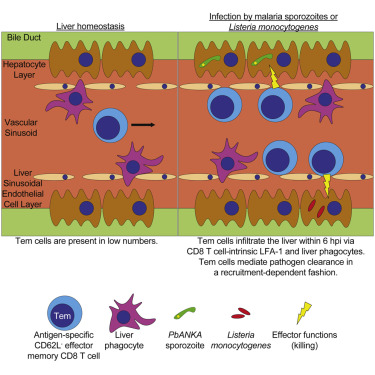
Circulating memory CD8 T cell trafficking and protective capacity during liver-stage malaria infection remains undefined. We find that effector memory CD8 T cells (Tem) infiltrate the liver within 6 hours after malarial or bacterial infections and mediate pathogen clearance. Tem recruitment coincides with rapid transcriptional upregulation of inflammatory genes in Plasmodium-infected livers. Recruitment requires CD8 …

VEuPathDB: the eukaryotic pathogen, vector and host bioinformatics resource center

The Eukaryotic Pathogen, Vector and Host Informatics Resource (VEuPathDB, https://veupathdb.org) represents the 2019 merger of VectorBase with the EuPathDB projects. As a Bioinformatics Resource Center funded by the National Institutes of Health, with additional support from the Welllcome Trust, VEuPathDB supports >500 organisms comprising invertebrate vectors, eukaryotic pathogens (protists and fungi) and relevant free-living or …

Control and elimination of lymphatic filariasis in Oceania: Prevalence, geographical distribution, mass drug administration, and surveillance in Samoa, 1998-2017

Lymphatic filariasis (LF) is a major public health problem globally and in the Pacific Region. The Global Programme to Eliminate LF has made great progress but LF is persistent and resurgent in some Pacific countries and territories. Samoa remains endemic for LF despite elimination efforts through multiple two-drug mass drug administrations (MDA) since 1965, including …

Application of SARS-CoV-2 serology to address public health priorities

Background: Antibodies against SARS-CoV-2 can be detected by various testing platforms, but a detailed understanding of assay performance is critical. Methods: We developed and validated a simple enzyme-linked immunosorbent assay (ELISA) to detect IgG binding to the receptor-binding domain (RBD) of SARS-CoV-2, which was then applied for surveillance. ELISA results were compared to a set …

Probing the distinct chemosensitivity of Plasmodium vivax liver stage parasites and demonstration of 8-aminoquinoline radical cure activity in vitro

Improved control of Plasmodium vivax malaria can be achieved with the discovery of new antimalarials with radical cure efficacy, including prevention of relapse caused by hypnozoites residing in the liver of patients. We screened several compound libraries against P. vivax liver stages, including 1565 compounds against mature hypnozoites, resulting in one drug-like and several probe-like …

A plastid two-pore channel essential for inter-organelle communication and growth of Toxoplasma gondii

Two-pore channels (TPCs) are a ubiquitous family of cation channels that localize to acidic organelles in animals and plants to regulate numerous Ca2+-dependent events. Little is known about TPCs in unicellular organisms despite their ancient origins. Here, we characterize a TPC from Toxoplasma gondii, the causative agent of toxoplasmosis. TgTPC is a member of a …

Drug Target Validation of the Protein Kinase AEK1, Essential for Proliferation, Host Cell Invasion, and Intracellular Replication of the Human Pathogen Trypanosoma cruzi

Protein phosphorylation is involved in several key biological roles in the complex life cycle of Trypanosoma cruzi, the etiological agent of Chagas disease, and protein kinases are potential drug targets. Here, we report that the AGC essential kinase 1 (TcAEK1) exhibits a cytosolic localization and a higher level of expression in the replicative stages of …

Calcium signaling in intracellular protist parasites

Calcium ion (Ca2+) signaling is one of the most frequently employed mechanisms of signal transduction by eukaryotic cells, and starts with either Ca2+ release from intracellular stores or Ca2+ entry through the plasma membrane. In intracellular protist parasites Ca2+ signaling initiates a sequence of events that may facilitate their invasion of host cells, respond to environmental changes within …