It is spring in Athens and that is always an exciting time for the Center for Tropical and Emerging Global Diseases! We always look forward to our annual signature event, the Molecular Parasitology & Vector Biology Symposium. This year will mark the 28th edition of the meeting that brings together students, staff, postdocs, and research scientists from around the southeastern US to focus on the neglected tropical diseases caused by eukaryotic pathogens. This year the symposium will be held on April 26th at the Georgia Center for Continuing Education and will feature talks by students and postdocs from CTEGD and visitors from other universities. In particular, we are excited that Dr. Patricia Johnson, Professor of Microbiology, Immunology & Molecular Genetics at UCLA will
present the Keynote Address. Dr. Johnson’s research focuses on the molecular and cellular biology of Trichomonas vaginalis, the cause of the most prevalent, non-viral, sexually transmitted infection worldwide. Please make plans to join us in Athens for the symposium.
As you will see in this edition of the CTEGD Newsletter, we have an exciting array of published studies, significant awards, and new grant funding that demonstrate the culture of excellence and scientific productivity by our center’s faculty, staff and students. In addition to multiple awards and recognitions for faculty and their research teams, I’m particularly proud of the spotlight focused on our pre-doctoral and post-doctoral trainees in this edition of the newsletter. Each of these trainees has exciting projects that they lead under the direction of our world-class faculty. Importantly, the CTEGD provides the robust scientific environment that is the venue for training this next generation of leaders in the fight against neglected tropical diseases caused by parasites.
We also have exciting news that our two core activities, the Biomedical Microscopy Core and the Cytometry Shared Resource Laboratory, are adding new instruments and capabilities that will support CTEGD as well as the broader UGA scientific community. We will highlight these new additions in our next newsletter once the instruments are installed. We thank Provost Pamela Whitten and Vice President for Research David Lee for supporting these core facilities with the new instrumentation.
Last but not least I want to thank the donors that provided support for CTEGD activities. All donations, no matter how small or large, help the CTEGD to achieve our mission of “Global Health Through Research.”
Trisha Dalapati, an undergraduate studying in Julie Moore’s laboratory, is among 211 students from across the nation to be recognized as Barry Goldwater Scholars, earning the highest undergraduate award of its type for the fields of the natural sciences, mathematics and engineering.
Georgia institutions had a total of six Goldwater Scholars. UGA had the highest number with three and was joined by Berry College, Emory University and Spelman College, which had one scholar each. Guy Eroh and Stephan George are the other two UGA undergraduates receiving this honor.
Dalapati, a junior from Roswell, is majoring in anthropology and biochemistry and molecular biology and working toward a master’s degree in comparative biomedical sciences. Sheplans to obtain an M.D./Ph.D. in infectious diseases after graduating from UGA. As a translational medicine researcher, she intends to investigate disease pathogenesis to create diagnostic tools for vulnerable groups such as pregnant women and children.
She currently conducts cell and tissue culture work with Julie Moore, a professor of infectious disease and associate vice president for research, in Moore’s placental malaria lab. She also analyzes data remotely with Moses Batwala of the University of Oxford Nuffield Department of Women’s & Reproductive Health.
In addition to her research, Dalapati is a Foundation Fellow, director of the Lunchbox Garden Project, a committee chair for the Model United Nations and a member of the Honors Program Student Council, Palladia Women’s Honor Society and Omicron Delta Kappa. Dalapati received the best poster award at the Emory STEM Symposium and is an Indian classical dancer.
“The university congratulates Trisha, Guy and Stephan on this outstanding achievement,” said UGA President Jere W. Morehead. “Our newest Goldwater Scholars reflect the tremendous strength of our students as well as the commitment of exceptional faculty mentors who guide and teach them. I look forward to all that these amazing students will accomplish in the coming years.”
Since 1995, 56 UGA students have received the Goldwater Scholarship, all of whom have been members of the Honors Program.
The scholarship recognizes exceptional sophomores and juniors across the nation. This year, awardees were selected from a field of 1,280 undergraduates and were nominated by campus representatives from among 2,000 colleges and universities nationwide. They will receive up to $7,500 toward the cost of tuition, fees, books and room and board.
Of this year’s Goldwater Scholars, 29 are mathematics and computer science majors, 142 are majoring in the natural sciences, and 40 are majoring in engineering. Many are majoring in a combination of mathematics, science, engineering and computer science.
“I am so thrilled for each of these students,” said David S. Williams, associate provost and director of the Honors Program, who serves as the UGA campus faculty representative for the Goldwater Scholarship. “All of them richly deserve recognition by the Goldwater Foundation for their hard work and research excellence. I think it speaks volumes that they came to UGA from across the country because they knew about the quality of our undergraduate research program and the strong support that faculty members provide to our students.”
The scholarship honoring Sen. Barry Goldwater was designed to encourage outstanding students to pursue careers in the fields of mathematics, natural sciences and engineering. Since its first award in 1989, the Foundation has bestowed 8,132 scholarships worth approximately $65 million.
Researchers at the University of Georgia have discovered that dormancy of the parasite Trypanosoma cruzi prevents effective drug treatment for Chagas disease, which kills more than 50,000 people each year in Central and South America and is a growing threat in the United States and Europe.
The disease infects an estimated 6 million to 7 million people, according to the World Health Organization, although some scientists estimate the number could be as high as 20 million. Chagas disease causing irreparable damage to the heart and digestive system, and effective prevention and treatment methods are virtually nonexistent.
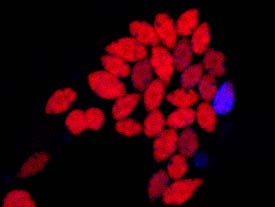
Proliferating Tdtomato expressing Trypanosoma cruzi amastigotes dilute the violet dye staining while non-replicating dormant parasite in the same host cell retains the violet signal.
In a new study published in eLife, Rick Tarleton and his research team at the Center for Tropical and Emerging Global Diseases sought to determine why drug treatments such as benzimidazole frequently fail.
“Benzimidazole has been shown to be particularly effective in reducing parasite infection,” said Tarleton, Regents’ Professor in the department of cellular biology. “A single dose can eliminate nearly 90 percent of parasites within 48 hours, but we didn’t know why it didn’t kill 100 percent of the parasites.”
For the first time, they show that a small proportion of T. cruzi parasites halt replication within 24 hours of invading the host cell. These dormant parasites are resistant to extended drug treatment and can resume replication after treatment ends, thus re-establishing a growing infection.
The researchers don’t know why some of the parasites exhibit this behavior, but they are hopeful that future studies into this mechanism will shed more light on the way T. cruzi evades the host’s immune response.
“This isn’t drug resistance in the classical way we think of resistance,” said Tarleton. “The parasites aren’t dormant because of the presence of the drug.”
In fact, while treatment continued they saw some of the dormant parasites “wake up” and then become susceptible to the treatment. The team believes the key to effective treatment will be to catch the parasite as they resume replication, continuing medication until no parasites remain in the host.
“This discovery really offers a solution for current drugs to be used in a more effective way,” said Tarleton. “A longer, less concentrated dosing schedule could lead to a cure.”
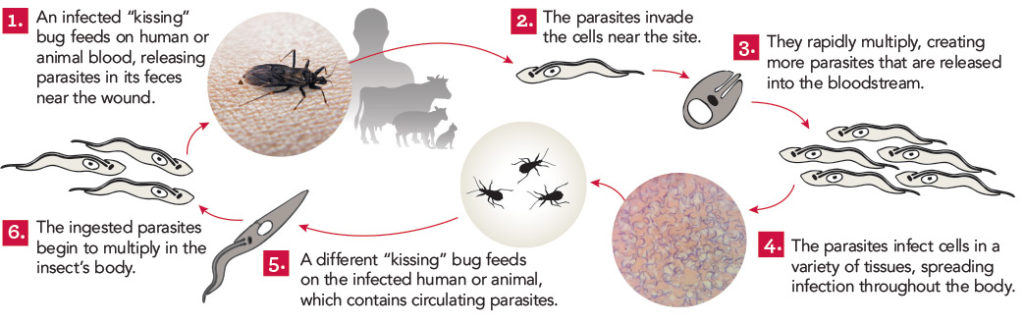
Life cycle of Trypanosoma cruzi, the cause of Chagas disease (graphic by Lindsay Robinson
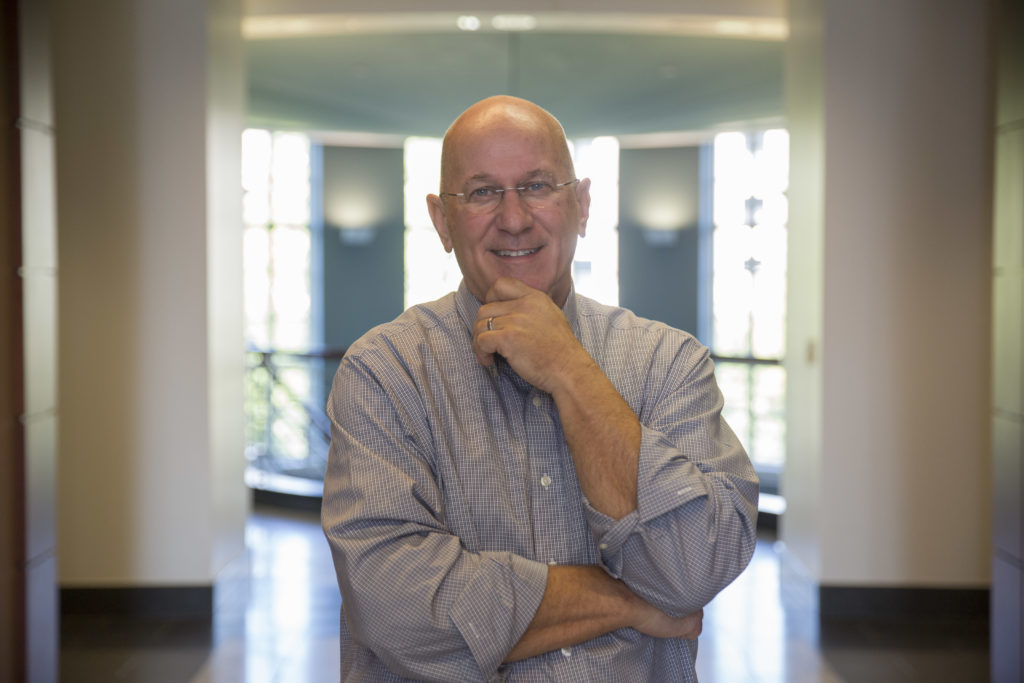
Center for Tropical and Emerging Global Diseases Director Dennis Kyle’s lab currently focuses on malaria, one of the world’s most prolific parasitic diseases, and the diseases caused by free-living amoebae. (Photo by Andrew Davis Tucker/UGA)
A UGA center takes on a public health problem that includes more than a dozen diseases of poverty.
Lymphatic filariasis. Schistosomiasis. Cryptosporidiosis. They’re some of the world’s most widespread parasitic diseases, but many people have never heard of them.
Those who live in Western nations are lucky—these diseases don’t really have to be on their radar. But for more than 2 billion people across the globe, the risk of contracting a disfiguring or potentially deadly parasitic disease is constant.
Rick Tarleton, founder of the Center for Tropical and Emerging Diseases, stands in front of the Coverdell Center where much of the center is housed. (Photo by Peter Frey/UGA)
Founded 20 years ago by Regents Professor of Cellular Biology Rick Tarleton, CTEGD consolidates UGA’s extensive, campus-wide tropical disease knowledge and drug discovery expertise into an interdisciplinary research unit that focuses on finding solutions for parasitic diseases. The center has garnered more than $135 million in research funding, and its 25 faculty, spanning eight departments across four colleges and schools, focus on more than a dozen diseases commonly associated with poverty.
Parasite-caused illnesses ravage developing nations across Africa, Asia, and Latin America, especially in areas already afflicted by inadequate housing, poor sanitation and unsafe water supplies, and stagnant or failing economies. In addition to a significant death toll, neglected disease means billions of dollars in lost productivity—the kind of economic hit that can upheave governments.
“These diseases cause poverty. Poverty breeds unrest. Unrest breeds political difficulties,” says Daniel Colley, professor of microbiology and the center’s former director. “If you can provide people with good health, you can take away a tremendous amount of angst in people’s lives.”
But governments often don’t have the ability or the resources to fix the problem. And, while several pharmaceutical companies donate existing drugs for some neglected diseases, there’s little incentive for pharmaceutical companies to develop new treatments for many of them, says Kojo Mensa-Wilmot, head of the Department of Cellular Biology and CTEGD member.
“If a large pharmaceutical company goes to its shareholders and tells them it’s going to invest $300 million to find a drug to treat a disease for people who have it but cannot pay for medication, no board member will vote for that project, and I cannot blame them,” he says. “That’s why we need people in academic institutions who are going to spend their time to try and help prevent or mitigate these very important global diseases.”
Kojo Mensa-Wilmot, department head, cellular biology
With infectious disease expert and cellular biologist Dennis Kyle now at the helm, the center’s diverse group of scientists, which includes entomologists, food safety researchers, geneticists, and more, are united in their commitment to vanquishing global diseases of poverty while training the next generation of scientists.
“It is a point of pride for UGA that we have this world-class assembly of scientists working on parasitic and neglected tropical diseases,” says David Lee, vice president for research. “Their work is so impressive and impactful because it is multidimensional, encompassing numerous disciplines from molecular and cellular biology to immunology and vaccinology, and extending from laboratory-based investigations to field work in Africa, South America, and elsewhere.”
For Kyle, Georgia Research Alliance Eminent Scholar in Antiparasitic Drug Discovery, the scope of the problem really hit home when he moved to Thailand in the early 1990s.
“I saw people suffering and dying of malaria,” Kyle says. “Most don’t realize how many people are affected by parasitic diseases like malaria, and the effort to try to eliminate those diseases is just not what it should be.”
Children very vulnerable
People infected with malaria present with symptoms similar to many viral illnesses: fever, chills, and headaches. The difference is that, left untreated, malaria intensifies after the first 24 hours, ultimately leading to respiratory distress and multi-organ failure. There are more than 200 million clinical cases of malaria every year, with almost half a million people dying from the disease. Of those, three out of four are children.
“It sounds like a great decrease from the 2 to 3 million people who died annually from malaria in past decades, but it still means that basically one child under the age of 5 is dying every minute,” Kyle says. “We still have lot of people who are suffering, and we have to come up with better drugs to fight the disease.”
In partnership with the Bill & Melinda Gates Foundation and Medicines for Malaria Venture, Kyle developed a drug-testing device in his lab and is using it to test thousands of potential treatments in the hopes of finding the next wonder drug. But it’s an uphill battle, as the disease quickly grows resistant to the drugs intended to vanquish it.
“The malaria parasite has adapted to infect us, yet we have to fight it off somehow,” Kyle says. “Resistance is a big problem, and that’s one of the reasons we study it. We’ve identified new ways the parasite avoids the current drugs on the market, and we’re building on that knowledge to create better drug candidates going forward.”
Jessica Kissinger, Distinguished Research Professor of Genetics. (Photo by Peter Frey/UGA)
What’s going on at the University of Georgia? That’s the question Distinguished Research Professor of Genetics Jessica Kissinger hears at parasitic disease conferences across the nation.
“CTEGD put Georgia on the map for tropical disease research,” says Kissinger, who was one of the first faculty to be recruited by the center. “Researchers and graduate students want to come to Georgia because we have CTEGD.”
Kissinger is a principal investigator on a National Institutes of Health-funded project known as EuPathDB, short for Bioinformatics Resource Center for Eukaryotic Pathogens. The online resource consolidates genomic information from thousands of datasets on more than 280 disease-causing organisms, enabling researchers to look up others’ lab results to test hypotheses rather than having to do basic, preliminary experiments themselves. This saves both time and resources. The database, which attracts about 50,000 users per month from countries across the globe, has revolutionized how research on parasites is conducted.
“It’s taken for granted if you want to plan a trip that there are lots of online databases you can use, and within seconds, you can find flights from competing companies, what seats are free, and hotel and rental car information,” says Kissinger, director of UGA’s Institute of Bioinformatics. “They’ve made your life easier by linking together diverse things. Our EuPathDB database is basically the Expedia or Trivago for research on an important class of human pathogens.”
It wasn’t Briana Flaherty’s PhD ’15 first trip abroad when she went with Colley’s research group to Kenya. It wasn’t even her first trip to a developing nation. But it was the first time she spoke with people who had experienced firsthand the effects of living in areas where the threat of infection with any number of parasitic diseases was constant.
“Tropical diseases are so prevalent in Kenya that it’s almost like the common cold.” — Briana Flaherty
A doctoral candidate in CTEGD member David Peterson’s malaria lab at the time, Flaherty worked with Colley’s team to explore the effects of worm-transmitted parasites on immune responses to standard vaccinations.
“Tropical diseases are so prevalent in Kenya that it’s almost like the common cold,” says Flaherty, now a postdoctoral fellow at the Centers for Disease Control and Prevention. “Everyone has had one, and everyone knows someone whose life has been taken by one. It’s why the work of CTEGD is so important.”
Colley’s work in Kenya is part of a larger global collaboration he founded almost 10 years ago called SCORE, short for Schistosomiasis Consortium for Operational Research and Evaluation. Funded by a grant from the Gates Foundation, SCORE’s mission is to control and eventually eliminate schistosomiasis, a disease caused by worms that leads to anemia and stunted growth and affects at least 240 million people. Another 700 million people are at risk of contracting the parasite, making schistosomiasis one of the major parasitic diseases in the world.
It’s not particularly deadly, at least not when compared to malaria, but the adult worms live inside people’s veins, laying eggs that ultimately embed and can cause severe damage to surrounding tissues.
“Schistosomiasis contributes to anemia, wasting, and stunting in childhood,” Colley says. “Tropical diseases like schistosomiasis keep children from going to school to learn. They keep people from getting good jobs.
“These are important diseases that are vastly understudied. CTEGD is turning that around.”
SUPPORT OUR RESEARCH
Give to the Center Tropical & Emerging Global Diseases General Fund
Kerri Miazowicz is a 3rd year Ph.D. trainee in Courtney Murdock‘s laboratory. She grew up in southern Michigan where she received a B.S. in microbiology from Michigan State University in 2012. After graduation, she spent more than two years as a Postbaccalaureate IRTA Fellow at the Rocky Mountain Laboratories, NIH/NIAID in Montana with the Virus Ecology Unit within the Laboratory of Virology.
Choosing the University of Georgia
Kerri chose the University of Georgia for her graduate training because she wanted to conduct interdisciplinary research related to disease ecology and vector-borne disease transmission.
“UGA hosts many experts across several scientific disciplines allowing me to link molecular biology and individual level phenotypes to population-level dynamics,” said Kerri. ” UGA is also home to the Center for Tropical and Emerging Global Diseases and the Center for Ecology of Infectious Diseases (CEID), which both provide valuable research resources and expertise.”
Research Focus
Kerri’s research focuses on environmental drivers of mosquito-borne disease transmission. Mainly, understanding how the environment affects the mosquito vector and modeling the consequences of these interactions on transmission dynamics.
“My current project revolves around temperature effects on Anopheles stephensi [the primary mosquito that transmits malaria in Asia] trait performance (longevity, biting frequency, and population growth), and mathematically exploring the implications these effects have on transmission.”
She will also investigate how Plasmodium, the parasite that causes malaria, exposure and infection modify these mosquito traits which are critical in transmission events.
“I find vector-borne diseases interesting due to the immense complexity that these systems contain,” said Kerri. “I also find it interesting to think about ‘scaling-up’ the outcome of molecular interactions and individual phenotypes to the context of population-level dynamics.”
Kerri has been able to conduct fieldwork within the Athens area to study how microclimate across an urban area can influence mosquito development along with adult mosquito traits with are important for mosquito-borne disease transmission.
“If I was able to travel for research purpose, it would be to India or Africa, where malaria is endemic, to study local mosquito populations.”
Trainee Earns Accolades
Kerri has received a number of awards recognizing her academic and research achievements. In 2009, she was named a 2008-2009 Regional Semifinalist for the Young Epidemiology Scholars (YES) Program. In 2010, Kerri was named a National Institutes of Health Undergraduate Scholar.
In 2014, she received an OITE Travel Award to attend the NIH Graduate and Professional School Fair, which allows NIH interns and postbacs to explore where the next step in their training will be.
Since coming to UGA, she has received an American Society of Virology Travel Award (2016) and a National Science Foundation Graduate Research Fellowship that funds 3 years of research training. In 2017, she received a travel award to attend the annual meeting of the Vector Behavior Ecology Research Coordination Network (VectorBITE RCN) at Imperial College in London.
What’s Next
While Kerri has a few more years of training at UGA, she hopes to continue conducting scientific research related to disease ecology and transmission dynamics in either an academic or government setting.
Your financial gift to CTEGD funds the Training Innovations in Parasitologic Studies (TIPS) Fellowships which allows trainees like Kerri Miazowicz to travel to international field sites for research. Give Today!
Beatrice Colon, an Illinois native, is a Ph.D. trainee in Dennis Kyle’s laboratory. She holds a Bachelor of Science degree from the University of Illinois at Urbana-Champaign and a Master of Science degree from the University of South Florida (USF). She began her Ph.D. at USF as well.
Beatrice moved to the University of Georgia in January 2017 with the Kyle Lab.
“I decided to transfer universities because of the excellent infectious disease department,” said Beatrice.
Research and Training
“My favorite thing about the CTEGD is the openness for collaborations; the center is also very focused on training a new generation of scientists. “
Beatrice is currently working on a drug discovery project for the brain-eating amoeba, Naegleria fowleri. The disease was the major factor that drew her to the project. Primary amoebic meningoencephalitis is nearly always fatal and affects young healthy children. Moreover, there is not an effective drug treatment for people that do get infected with the amoeba.
In her short time at UGA, Beatrice has won first place for a poster presentation at the graduate student and postdoc symposium. She was also selected for the Biology of Parasitism course at Woods Hole, MA this past summer.
“This course was definitely a career-changing experience – I was able to work with a variety of infectious diseases and learn techniques that were not available for the parasite I work on.”
What’s Next
Beatrice is interested in staying in drug discovery for infectious diseases and currently looking at positions in both academia and industry.