
Generic selectors
Exact matches only
Search in title
Search in content
Post Type Selectors

Tag: vaccine

Use of the Slow-Delivery Platform, VacSIM, Shapes the Host Immune Response to Increase Protection Against Influenza Infection
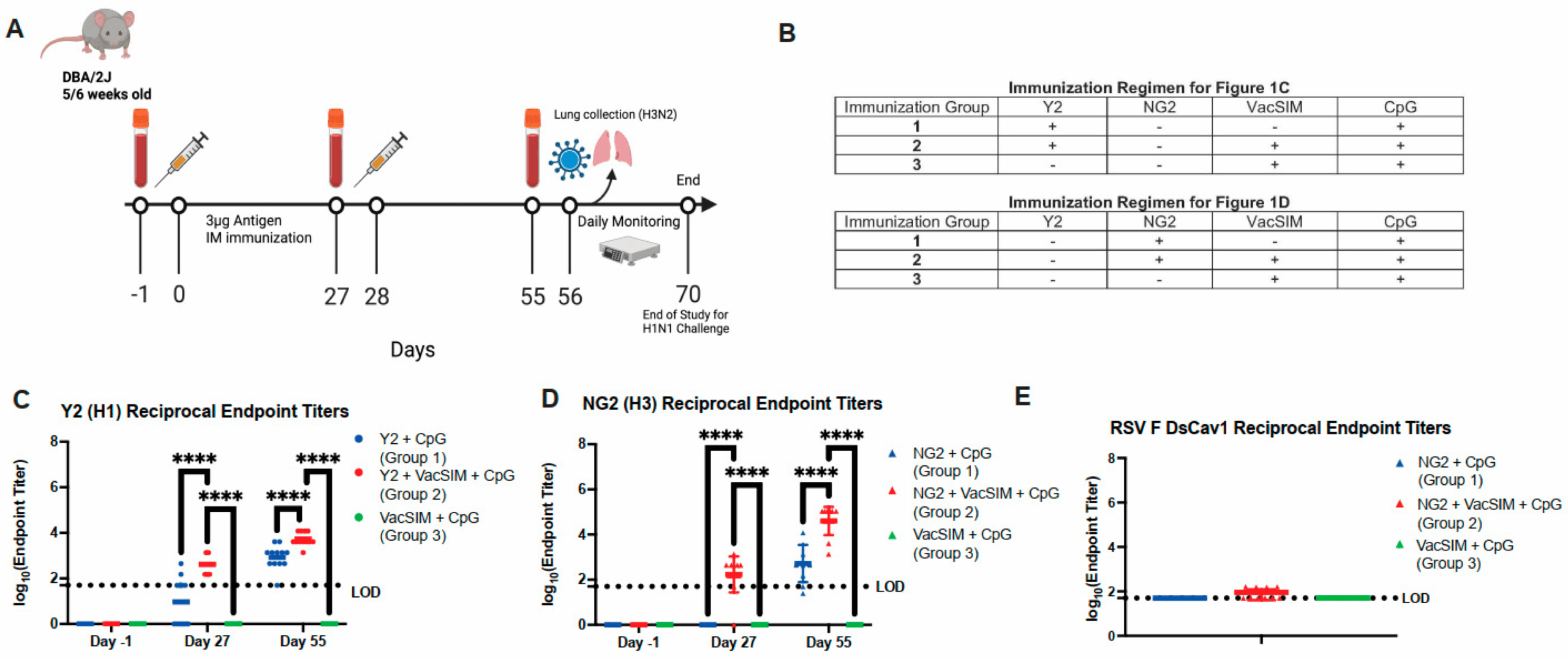
Antigen-specific serum antibody titers of immunized mice at Days −1, 27, and 55.

Influenza virus is a leading cause of global morbidity and mortality due to acute lower respiratory infection, even with the widespread use of multiple licensed influenza vaccines. However, antigenic drift during influenza replication can cause vaccine-induced antibodies to poorly neutralize influenza virus, thereby reducing vaccine effectiveness. To help overcome this problem, we leveraged a hydrogel platform with influenza hemagglutinin (HA) protein to induce prolonged antigen exposure. The hydrogel platform, Vaccine Self-Assembling Immune Matrix (VacSIM®), in combination with recombinant influenza H1 or H3 HA protein antigens, increased antigen-specific antibody titers in vaccinated mice, which led to decreased disease severity after H1N1 infection for H1 HA-vaccinated mice and decreased lung viral titers after H3N2 challenge for H3 HA-vaccinated mice. Sera collected from mice immunized with VacSIM and HA also showed broader HAI activity, increasing by 1–3 log against a panel of influenza viruses. These results were consistent with the use of cocktail immunization, containing both an H1 and H3 HA, where mice immunized with VacSIM had an increase in antigen-specific antibody titers and decreased disease severity and lung viral titers against H1N1 and H3N2 influenza challenges, respectively. Finally, it was determined that a single immunization with VacSIM and H1 HA could provide protection against lethal H1N1 challenge compared to a group without VacSIM. In summary, we demonstrate that use of the slow-release platform VacSIM can improve the host immune response to vaccination and increase protection against influenza infection.

Anna L. McCormick, Ted M. Ross, Donald A. Harn and Jarrod J. Mousa. 2025. Viruses 17, no. 9: 1190. https://doi.org/10.3390/v17091190


Chet Joyner receives $1.1 million grant to study malaria vaccine

RESEARCH WILL BE IN COLLABORATION WITH YALE UNIVERSITY

Chet Joyner, PhD, a faculty member in the Center for Vaccines and Immunology and the Center for Tropical and Emerging Diseases in the College of Veterinary Medicine (CVM) at the University of Georgia, is the recipient of a $1.1 million grant from Open Philanthropy to perform preclinical testing of a vaccine designed to prevent reinfection from malaria.

“A vaccine that lessens the impact of this disease will have incalculable value in terms of lives saved and the quality of life of those in the affected areas,” said Lisa K. Nolan, DVM, PhD, dean of the CVM. “We are proud of Dr. Joyner’s work and that he has chosen to do it in the College of Veterinary Medicine at the University of Georgia.”

Joyner is collaborating with Dr. Richard Bucala, MD, PhD, of Yale University to test the vaccine that targets Plasmodium-encoded Macrophage Migration Inhibitory Factor (pMIF), a protein secreted by Plasmodium falciparum, a pathogen that causes malaria.

The science team for Open Philanthropy, which recommended grants to Joyner and Bucala for the three-year study, believes that vaccinating against pMIF may provide an important boost to the efficacy of existing malaria vaccines, according to a statement on its website, openphilanthropy.org.

Open Philanthropy is a Silicon Valley-based nonprofit which aims to use its resources to help others as much as possible. They fund work in many areas, including global health.

Joyner, who was recruited from Emory University to join the CVM in January of 2020, said the college is uniquely positioned to test the efficacy of the vaccine developed by Bucala at Yale.

“We are a strong malaria group with unique infrastructure and facilities that can support this necessary research within the CVM,” Joyner said.

Immunity to malaria is acquired naturally after exposure, but the disease can be fatal to children younger than five and debilitating up to age 10 because malaria parasites disrupt the immune system’s response with their own proteins that mimic the human Macrophage Migration Inhibitory Factor (MIF).

Not only does the resulting illness cause children to miss school, but it also leads to long-term cognitive decline due to nutritional deficiencies. Parents miss work to care for children and the economic impacts compound.

According to the World Health Organization’s 2022 World Malaria report, an estimated 247 million cases of malaria occurred worldwide in 2021 and 619,000 people died, mostly children under the age of five in sub-Saharan Africa.

This story was originally published at https://vet.uga.edu/cvm-researcher-wins-1-1-million-grant-to-study-malaria-vaccine/

New method patented to provide increased vaccine efficacy

Rick Tarleton

by Donna Huber

Vaccines can be an efficient and cost-effective method of preventing and treating pathogen-induced illnesses. As new pathogens appear and old pathogens re-emerge, improved vaccines are needed. For one emerging global disease, Chagas Disease, effective vaccine development has long been elusive. Now, Rick Tarleton, Regents’ Professor in the department of cellular biology, and former graduate student Sam Kurup have received a patent for a vaccine method that improves efficacy. Even more promising, it can be used to develop vaccines for a variety of pathogens.

Chagas Disease, caused by the parasite Trypanosoma cruzi and spread by blood-feeding insects commonly known as “kissing bugs”, is endemic to the Americas, including the U.S. The infection can result in irreparable damage to the heart and digestive system, and in Central and South America, it kills more than 50,000 people each year.

Tarleton and Kurup found that vaccines consisting of parasites that have been genetically modified to produce stronger pathogen-associated molecular patterns, or PAMPs, increase the immune response of the host. PAMPs are molecules associated with the pathogen that are recognized by the immune system. T. cruzi does not naturally produce strong PAMPs.

In mice vaccinated with transgenic T. cruzi expressing potent bacterial PAMPs, they saw a superior immune response and a more rapid and persistently stronger acquired immune response. Furthermore, in chronically infected mice, they also saw a boost in immune response and a reduction in parasite load. This is good news as presently available treatments are not completely effective and often have severe side effects.

The inability of classical adjuvants to induce innate immunity and to generate a long-lasting T-cell response in T. cruzi infection has been a hurdle in the development of T-cell-based vaccines. Using PAMPs-modified attenuated vaccines may be an ingredient for preventing and treating this and other pathogenic illnesses.