Generic selectors
Exact matches only
Search in title
Search in content
Post Type Selectors

Tag: Trypanosoma

Protein phosphatase PP1 regulation of RNA polymerase II transcription termination and allelic exclusion of VSG genes in trypanosomes

The genomes of Leishmania and trypanosomes are organized into polycistronic transcription units flanked by a modified DNA base J involved in promoting RNA polymerase II (Pol II) termination. We recently characterized a Leishmania complex containing a J-binding protein, PP1 protein phosphatase 1, and PP1 regulatory protein (PNUTS) that controls transcription termination potentially via dephosphorylation of …


Pseudokinase NRP1 facilitates endocytosis of transferrin in the African trypanosome

Trypanosoma brucei causes human African trypanosomiasis (HAT) and nagana in cattle. During infection of a vertebrate, endocytosis of host transferrin (Tf) is important for viability of the parasite. The majority of proteins involved in trypanosome endocytosis of Tf are unknown. Here we identify pseudokinase NRP1 (Tb427tmp.160.4770) as a regulator of Tf endocytosis. Genetic knockdown of …

In Vivo Efficacy of SQ109 against Leishmania donovani, Trypanosoma spp. and Toxoplasma gondii and In Vitro Activity of SQ109 Metabolites

SQ109 is an anti-tubercular drug candidate that has completed Phase IIb/III clinical trials for tuberculosis and has also been shown to exhibit potent in vitro efficacy against protozoan parasites including Leishmania and Trypanosoma cruzi spp. However, its in vivo efficacy against protozoa has not been reported. Here, we evaluated the activity of SQ109 in mouse models of Leishmania, Trypanosoma spp. as …

New insights into the role of acidocalcisomes in trypanosomatids

Acidocalcisomes are electron-dense organelles rich in polyphosphate and inorganic and organic cations that are acidified by proton pumps, and possess several channels, pumps and transporters. They are present in bacteria and eukaryotes and have been studied in greater detail in trypanosomatids. Biogenesis studies of trypanosomatid acidocalcisomes found that they share properties with lysosome-related organelles of …

Design, Synthesis, and Evaluation of Novel Anti-Trypanosomal Compounds

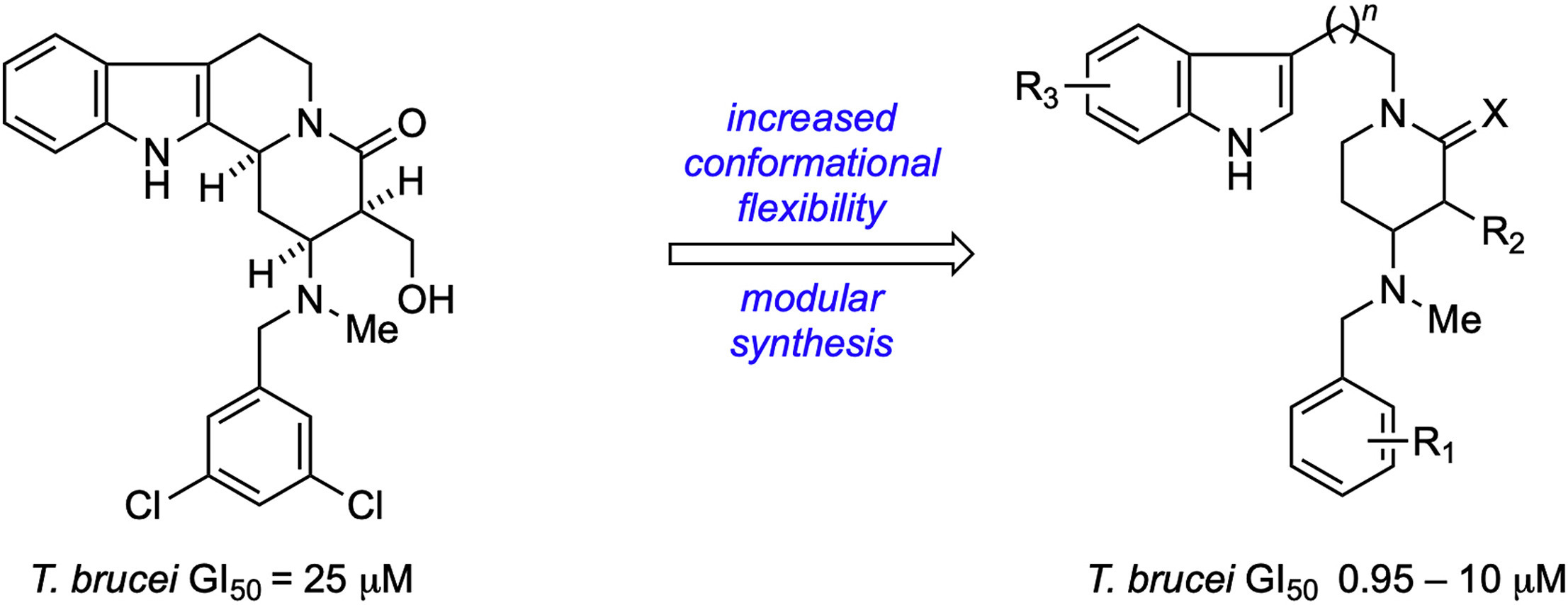
Human African trypanosomiasis (HAT) is a deadly neglected tropical disease caused by the protozoan parasite Trypanosoma brucei. During the course of screening a collection of diverse nitrogenous heterocycles, we discovered two novel compounds that contain the tetracyclic core of the Yohimbine and Corynanthe alkaloids, were potent inhibitors of T. brucei proliferation and T. brucei methionyl-tRNA synthetase (TbMetRS) activity. Inspired by these key …

Isolation and Characterization of Acidocalcisomes from Trypanosomatids

Acidocalcisomes are membrane-bounded, electron-dense, acidic organelles, rich in calcium and polyphosphate. These organelles were first described in trypanosomatids and later found from bacteria to human cells. Some of the functions of the acidocalcisome are the storage of cations and phosphorus, participation in pyrophosphate (PPi) and polyphosphate (polyP) metabolism, calcium signaling, maintenance of intracellular pH homeostasis, …

The Mitochondrial Calcium Uniporter Interacts with Subunit c of the ATP Synthase of Trypanosomes and Humans

Mitochondrial Ca2+ transport mediated by the uniporter complex (MCUC) plays a key role in the regulation of cell bioenergetics in both trypanosomes and mammals. Here we report that Trypanosoma brucei MCU (TbMCU) subunits interact with subunit c of the mitochondrial ATP synthase (ATPc), as determined by coimmunoprecipitation and split-ubiquitin membrane-based yeast two-hybrid (MYTH) assays. Mutagenesis analysis in combination …

Lexis and Grammar of Mitochondrial RNA Processing in Trypanosomes

Trypanosoma brucei spp. cause African human and animal trypanosomiasis, a burden on health and economy in Africa. These hemoflagellates are distinguished by a kinetoplast nucleoid containing mitochondrial DNAs of two kinds: maxicircles encoding ribosomal RNAs (rRNAs) and proteins and minicircles bearing guide RNAs (gRNAs) for mRNA editing. All RNAs are produced by a phage-type RNA …

Kinetoplast Division Factors in a Trypanosome

  Highlights   Kinetoplasts (mitochondrial genome nucleoids) are important in bloodstream trypanosomes for the establishment of mitochondrial membrane potential.   Many proteins involved in segregation of kinetoplasts have been identified.   A region between a kinetoplast and basal bodies is described as a tripartite attachment complex (TAC).   A set of TAC-associated proteins (TACAPs) has …

Anilinoquinoline based inhibitors of trypanosomatid proliferation

Abstract We recently reported the medicinal chemistry re-optimization of a series of compounds derived from the human tyrosine kinase inhibitor, lapatinib, for activity against Plasmodium falciparum. From this same library of compounds, we now report potent compounds against Trypanosoma brucei brucei (which causes human African trypanosomiasis), T. cruzi (the pathogen that causes Chagas disease), and Leishmania spp. (which cause leishmaniasis). In addition, sub-micromolar …