Generic selectors
Exact matches only
Search in title
Search in content
Post Type Selectors

Tag: Mark Brown

Protocol for detecting peptide hormones in mosquito tissues

Peptide hormones in insects are primarily expressed in specialized brain, ventral nerve chord, and midgut cells. When released, peptide hormones play crucial roles in regulating physiology, reproduction, and behavior. Here, we present a protocol for detecting peptide hormones in mosquito tissues such as the brain, midgut, and hemolymph. We describe steps for tissue preparation, immunocytochemistry, …

Reciprocal interactions between neuropeptide F and RYamide regulate host attraction in the mosquito Aedes aegypti

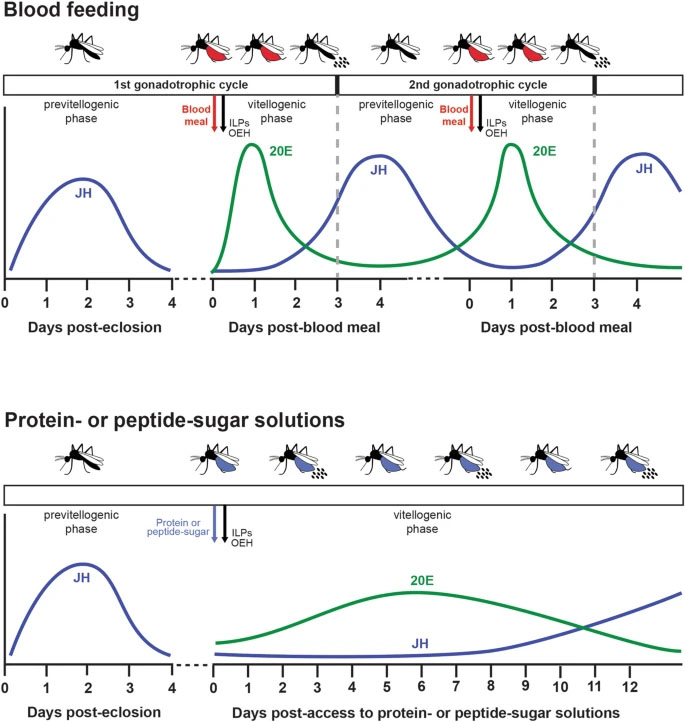
Female mosquitoes produce eggs in gonadotrophic cycles that are divided between a previtellogenic and vitellogenic phase. Previtellogenic females consume water and sugar sources like nectar while also being attracted to hosts for blood feeding. Consumption of a blood meal activates the vitellogenic phase, which produces mature eggs and suppresses host attraction. In this study, we …

The mosquito Aedes aegypti requires a gut microbiota for normal fecundity, longevity and vector competence

Mosquitoes shift from detritus-feeding larvae to blood-feeding adults that can vector pathogens to humans and other vertebrates. The sugar and blood meals adults consume are rich in carbohydrates and protein but are deficient in other nutrients including B vitamins. Facultatively hematophagous insects like mosquitoes have been hypothesized to avoid B vitamin deficiencies by carryover of …

Insulin-like peptides and ovary ecdysteroidogenic hormone differentially stimulate physiological processes regulating egg formation in the mosquito Aedes aegypti

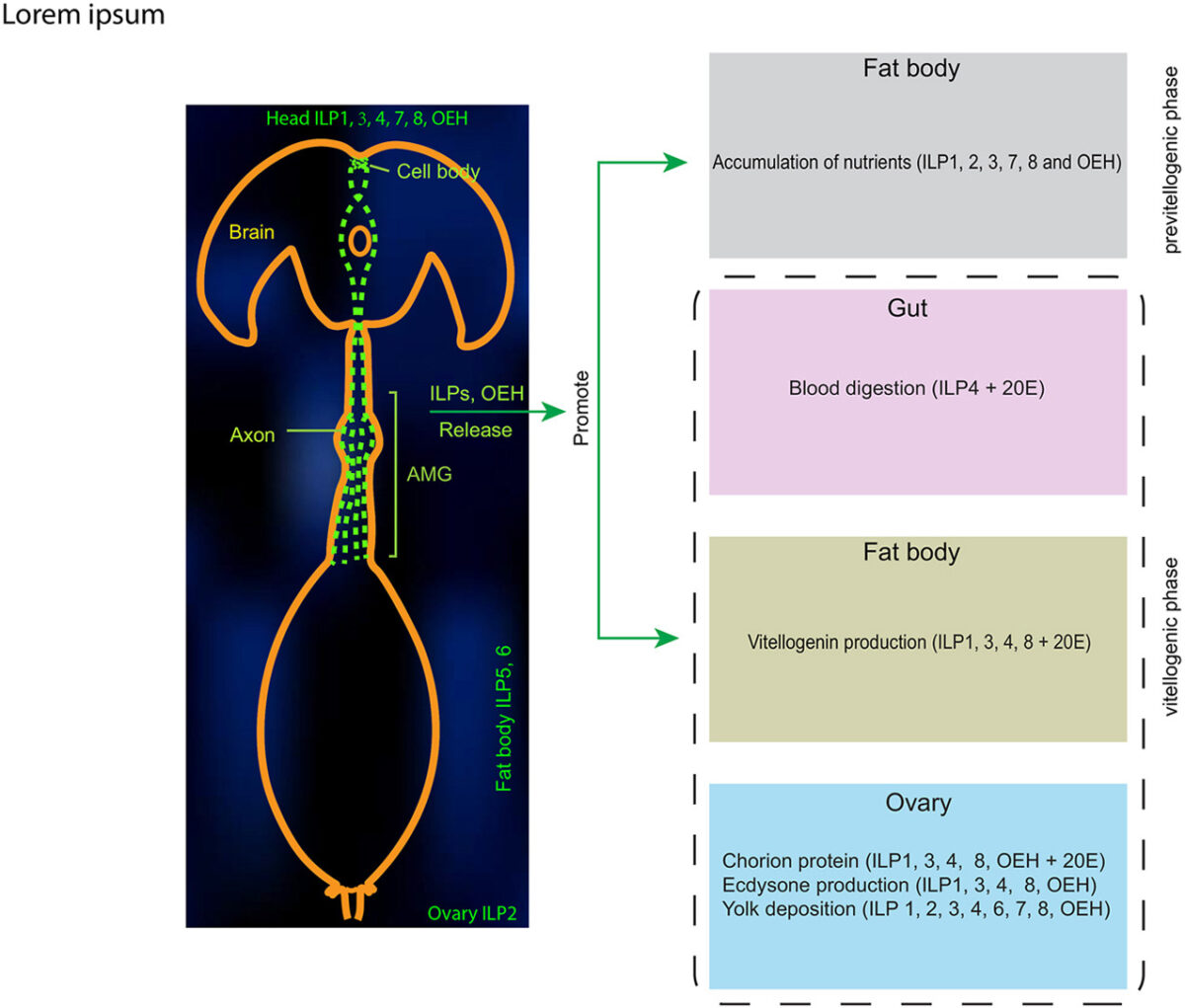
Mosquitoes including Aedes aegypti are human disease vectors because females must blood feed to produce and lay eggs. Blood feeding triggers insulin-insulin growth factor signaling (IIS) which regulates several physiological processes required for egg development. A. aegypti encodes 8 insulin-like peptides (ILPs) and one insulin-like receptor (IR) plus ovary ecdysteroidogenic hormone (OEH) that also activates …

Multiple endocrine factors regulate nutrient mobilization and storage in Aedes aegypti during a gonadotrophic cycle

Anautogenous mosquitoes must blood feed on a vertebrate host to produce eggs. Each gonadotrophic cycle is subdivided into a sugar-feeding previtellogenic phase that produces primary follicles and a blood meal-activated vitellogenic phase in which large numbers of eggs synchronously mature and are laid. Multiple endocrine factors including juvenile hormone (JH), insulin-like peptides (ILPs), ovary ecdysteroidogenic …

Ad libitum consumption of protein- or peptide-sucrose solutions stimulates egg formation by prolonging the vitellogenic phase of oogenesis in anautogenous mosquitoes

Background: Anautogenous mosquitoes commonly consume nectars and other solutions containing sugar but are thought to only produce eggs in discrete gonadotrophic cycles after blood-feeding on a vertebrate host. However, some anautogenous species are known to produce eggs if amino acids in the form of protein are added to a sugar solution. Unclear is how different sources …

Insulin-like peptide 3 stimulates hemocytes to proliferate in anautogenous and facultatively autogenous mosquitoes

Most mosquito species are anautogenous, which means they must blood feed on a vertebrate host to produce eggs, while a few are autogenous and can produce eggs without blood feeding. Egg formation is best understood in the anautogenous mosquito Aedes aegypti, where insulin-like peptides (ILPs), ovary ecdysteroidogenic hormone (OEH) and 20-hydroxyecdysone (20E) interact to regulate …

The Peptide Hormone CNMa Influences Egg Production in the Mosquito Aedes aegypti

Mosquito reproduction is regulated by a suite of hormones, many acting through membrane-bound receptor proteins. The Aedes aegypti G protein-coupled receptors AAEL024199 (AeCNMaR-1a) and AAEL018316 (AeCNMaR-1b) were identified as orthologs of the Drosophila melanogaster CNMa receptor (DmCNMaR). The receptor was duplicated early in the evolution of insects, and subsequently in Culicidae, into what we refer to as CNMaR-1a and …

Insulin-like peptide 3 stimulates hemocytes to proliferate in anautogenous and facultatively autogenous mosquitoes

Most mosquito species are anautogenous, which means they must blood feed on a vertebrate host to produce eggs, while a few are autogenous and can produce eggs without blood feeding. Egg formation is best understood in the anautogenous mosquito Aedes aegypti where insulin-like peptides (ILPs), ovary ecdysteroidogenic hormone (OEH) and 20-hydroxyecdysone (20E) interact to regulate …

Riboflavin instability is a key factor underlying the requirement of a gut microbiota for mosquito development

We previously determined that several diets used to rear Aedes aegypti and other mosquito species support the development of larvae with a gut microbiota but do not support the development of axenic larvae. In contrast, axenic larvae have been shown to develop when fed other diets. To understand the mechanisms underlying this dichotomy, we developed a defined …