Generic selectors
Exact matches only
Search in title
Search in content
Post Type Selectors

Tag: Glycosylation

Glycoregulation of E3(SCF) ubiquitin ligases in unicellular eukaryotes

Skp1 is an essential adaptor within the Skp1/Cul1/F-box (SCF) class of E3 polyubiquitin ligases that regulate protein degradation in all eukaryotes. Skp1 is also a target of a 5-enzyme glycosylation pathway in parasites and other unicellular eukaryotes. Glycosylation of Skp1 is contingent upon oxygen-dependent hydroxylation of a critical Pro residue by a homolog of the HIFα PHD2 oxygen sensor of animals. The resulting hydroxyproline is modified by a series of soluble, cytoplasmic, sugar nucleotide-dependent glycosyltransferases that vary among branches of protist evolution, and are evolutionarily related to counterparts in the Golgi and the cytoplasm of prokaryotes. Pair-wise gene fusions of the six enzymes occur in various protists, suggesting processing efficiency. The terminal glycosyltransferases exhibit a second site interaction with Skp1 that may modulate its function irrespective of glycosylation status. The pentasaccharide adopts a constrained fold that in turn promotes Skp1 conformations that inhibit sequestration by homodimerization and encourage binding to select F-box protein substrate receptors with varied effects on their expression levels. The occurrence of a second Skp1 copy in some protists that is resistant to modification indicates a mechanism to bypass glycoregulation. This review details evidence from the social amoeba Dictyostelium discoideum and the pathogens Toxoplasma gondii and Pythium ultimum for the specificity of the enzymes for Skp1 and their regulation, as support for a role in regulating protein turnover via E3(SCF) ubiquitin ligases, and in turn sensing oxygen at the cellular level.

Donovan A Cantrell, Hanke van der Wel, Christopher M West. Glycobiology. 2025 Dec 17;36(1):cwaf078. doi: 10.1093/glycob/cwaf078.

UGA biochemists create new tool to study biological process in parasites

Click on image below to view photo gallery with captions.

Researchers in the University of Georgia’s West Laboratory are interested in how unicellular parasites thrive in their environments. Focusing on post-translational modifications of proteins, particularly a crucial process called glycosylation, researchers are gaining insights into how this basic life process in parasites can lead to better treatments for diseases.

Christopher West
Chris West

Led by Distinguished Research Professor Christopher West, the team focuses on Toxoplasma gondii, a parasite that causes a chronic infection known as toxoplasmosis, and Dictyostelium discoideum, a soil-dwelling social amoeba commonly known as a cellular slime mold. Dictyostelium is an unrelated non-pathogenic model organism with a relatively simple life cycle, making it ideal for laboratory research.

Their colleagues at Boston University, Giulia Bandini and John Samuelson, discovered that dozens of nuclear and cytoplasmic proteins in Toxoplasma are unusually modified by a single sugar called fucose. There were potential parallels with a similar modification of host cell proteins with the key difference being the sugar involved-called GlcNAc, which is important for mediating host cell stress responses.

“This unprecedented finding raised new questions after we found that a similar process occurred in Dictyostelium,” said West, Distinguished Research Professor in Franklin College of Arts and Science’s Department of Biochemistry and Molecular Biology.

When the West lab identified the gene responsible for attaching O-fucose, the door was opened to study its function when it was knocked out in Toxoplasma and Dictyostelium.

“Though the cells still lived, both grew more slowly,” said West, a member of the Center for Tropical and Emerging Global Diseases. “The evidence indicated that several important proteins were less abundant, which consequently compromised their activity in cells.”

O-fucose is difficult to detect through traditional methods, which impedes learning more about its roles. To address this need, Megna Tiwari, a recently graduated biochemistry Ph.D. student in the West Lab, got together with Ron Orlando at the Complex Carbohydrate Research Center and GlycoScientific LLC to generate antibodies that only bind O-fucose on proteins. Her recent study published in mSphere illustrates the power of these antibodies to find and isolate O-fucose in the cell.

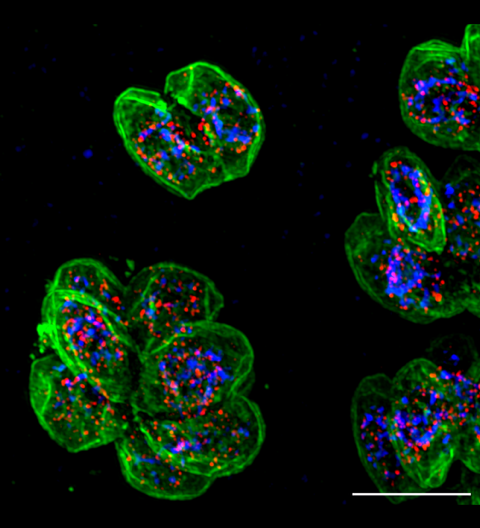
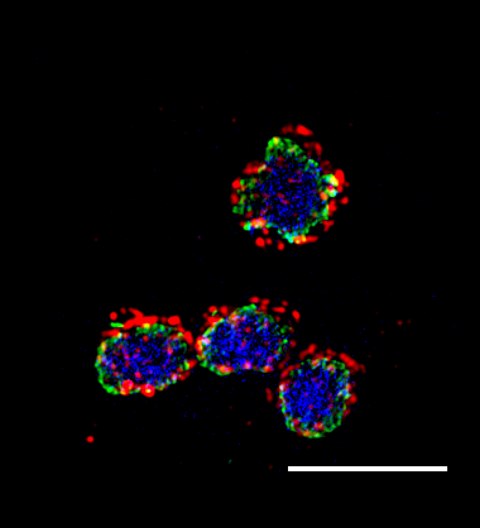
“Remarkably, dozens of new proteins were found to bear O-fucose and the images indicate that majority of them appear to be enriched at the nuclear periphery, inviting new ideas for O-fucose at this location,” West said.

This story was originally published at UGA Research https://research.uga.edu/news/uga-biochemists-create-new-tool-to-study-biological-process-in-parasites/

Oxygen-dependent regulation of F-box proteins in Toxoplasma gondii is mediated by Skp1 glycosylation

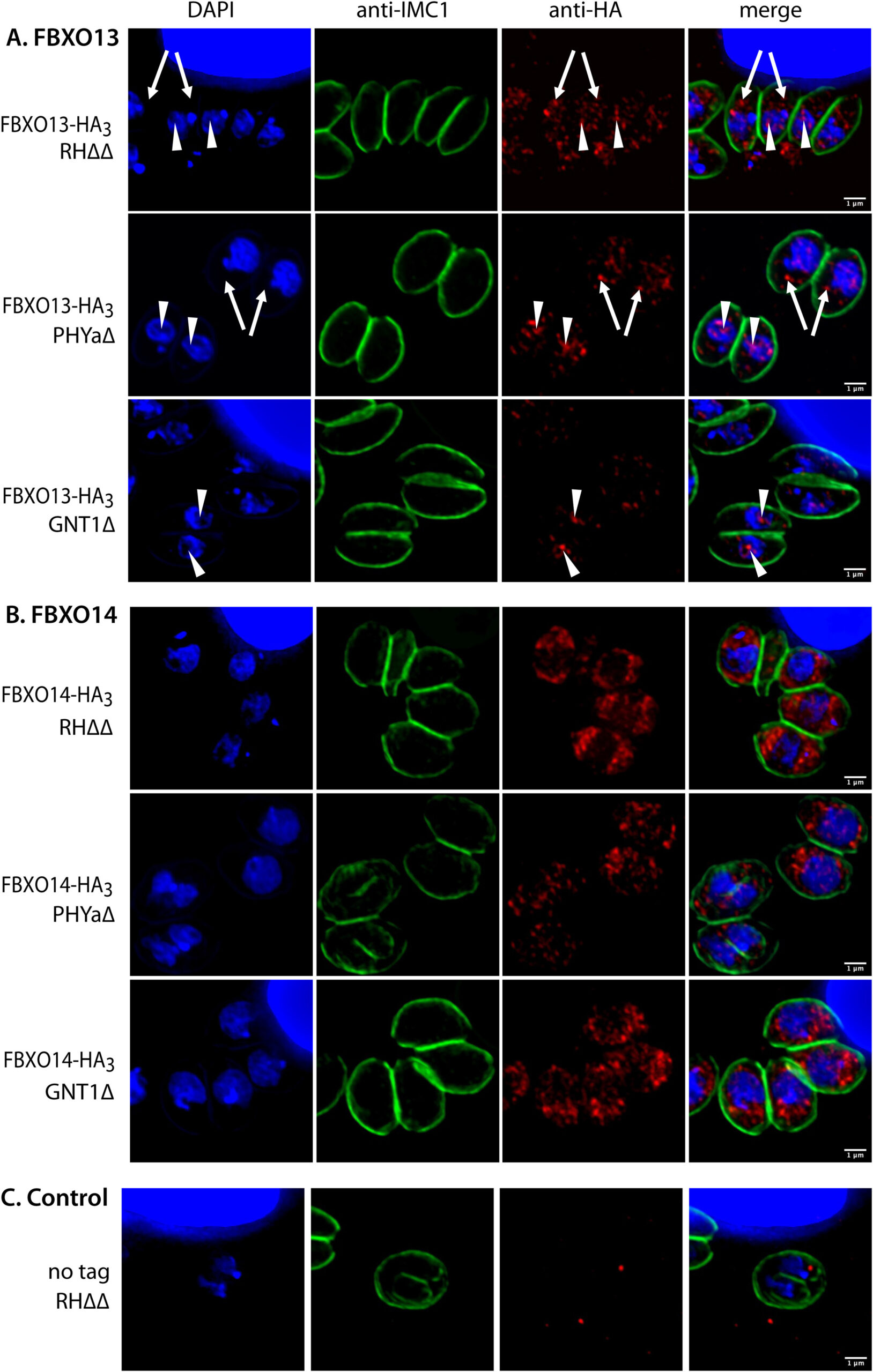
Figure 8. Immunolocalization of FBXO13-HA3 and FBXO14-HA3.


A dynamic proteome is required for cellular adaption to changing environments including levels of O2, and the SKP1/CULLIN-1/F-box protein/RBX1 (SCF) family of E3 ubiquitin ligases contributes importantly to proteasome-mediated degradation. We examine, in the apicomplexan parasite Toxoplasma gondii, the influence on the interactome of SKP1 by its novel glycan attached to a hydroxyproline generated by PHYa, the likely ortholog of the HIFα PHD2 oxygen-sensor of human host cells. Strikingly, the representation of several putative F-box proteins (FBPs) is substantially reduced in PHYaΔ parasites grown in fibroblasts. One, FBXO13, is a predicted lysyl hydroxylase related to the human JmjD6 oncogene except for its F-box domain. The abundance of FBXO13, epitope-tagged at its genetic locus, was reduced in PHYaΔ parasites thus explaining its diminished presence in the SKP1 interactome. A similar effect was observed for FBXO14, a cytoplasmic protein of unknown function that may have co-evolved with PHYa in apicomplexans. Similar findings in glycosylation-mutant cells, rescue by proteasomal inhibitors, and unchanged transcript levels, suggested the involvement of the SCF in their degradation. The effect was selective, because FBXO1 was not affected by loss of PHYa. These findings are physiologically significant because the effects were phenocopied in parasites reared at 0.5% O2. Modest impact on steady-state SKP1 modification levels suggests that effects are mediated during a lag phase in hydroxylation of nascent SKP1. The dependence of FBP abundance on O2-dependent SKP1 modification likely contributes to the reduced virulence of PHYaΔ parasites owing to impaired ability to sense O2 as an environmental signal.

Msano N Mandalasi, Elisabet Gas-Pascual, Carlos Gustavo Baptista, Bowen Deng, Hanke van der Wel, John A W Kruijtzer, Geert-Jan Boons, Ira J Blader, Christopher M West. J Biol Chem. 2024 Sep 20:107801. doi: 10.1016/j.jbc.2024.107801.

Glycomics, Glycoproteomics and Glycogenomics: an Inter-Taxa Evolutionary Perspective

Glycosylation is a highly diverse set of co- and post-translational modification of proteins. For mammalian glycoproteins, glycosylation is often site-, tissue- and species-specific, and diversified by microheterogeneity. Multitudinous biochemical, cellular, physiological and organismic effects of their glycans have been revealed, either intrinsic to the carrier proteins or mediated by endogenous reader proteins with carbohydrate recognition domains. Furthermore, glycans frequently form the first line of access by or defense from foreign invaders, and new roles for nucleocytoplasmic glycosylation are blossoming. We now know enough to conclude that the same general principles apply in invertebrate animals and unicellular eukaryotes – different branches of which spawned the plants or fungi and animals. The two major driving forces for exploring the glycomes of invertebrates and protists are (i) to understand the biochemical basis of glycan-driven biology in these organisms, especially of pathogens, and (ii) to uncover the evolutionary relationships between glycans, their biosynthetic enzyme genes, and biological functions for new glycobiological insights. With an emphasis on emerging areas of protist glycobiology, here we offer an overview of glycan diversity and evolution, to promote future access to this treasure trove of glycobiological processes.

Christopher M West, Daniel Malzl, Alba Hykollari, Iain B H Wilson. Mol Cell Proteomics. 2020 Sep 29;mcp.R120.002263. doi: 10.1074/mcp.R120.002263.