
Symposium
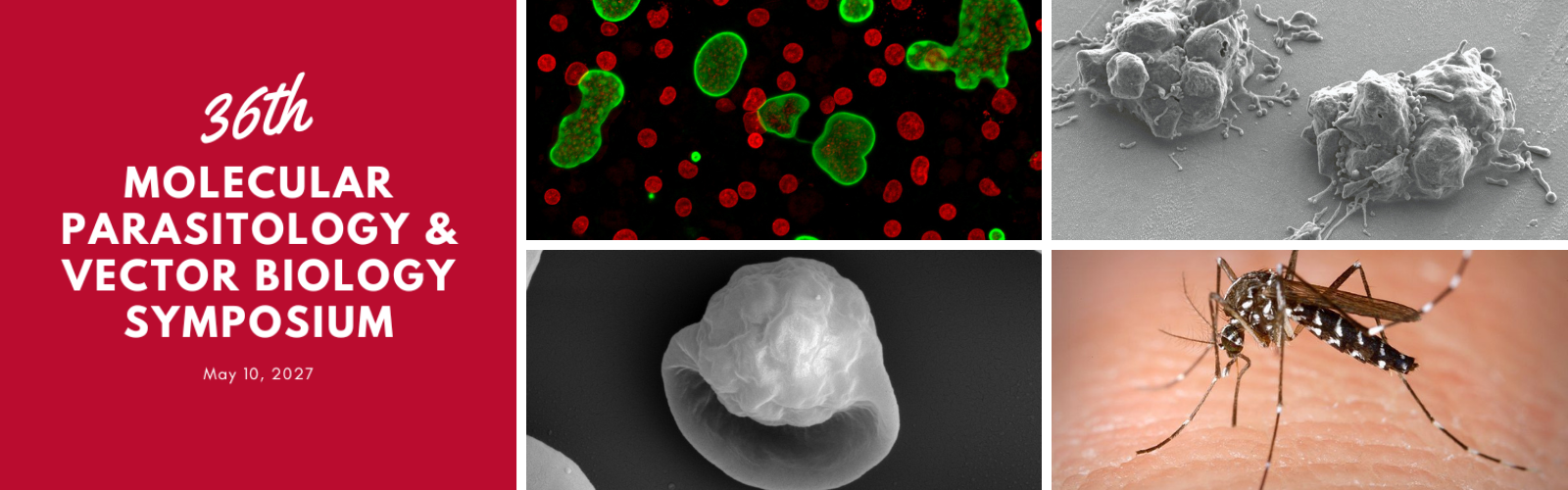
Save the Date! The 36th Molecular Parasitology & Vector Biology Symposium will be held on Monday, May 10, 2027 at the Georgia Center for Continuing Education.
About
Each spring, CTEGD hosts a day-long interactive conference on parasites and host/parasite interactions. This regional symposium routinely draws 200+ attendees from many departments in at least four different colleges or schools at UGA, and colleagues from other institutions in Georgia, Alabama, South Carolina, Florida, and Tennessee.
The Molecular Parasitology/Vector Biology Symposium includes talks from graduate students, postdoctoral fellows, and leading researchers and concludes with a keynote address by an internationally acclaimed investigator in the field of parasitology or vector biology. Poster sessions and a full-catered lunch are also on the schedule for this free event held at the Georgia Center for Continuing Education on the University of Georgia campus in Athens, GA.
To receive email updates about the symposium, please join our mailing list.
Download the Abstract Book 2026
The Symposium is made possible in part due to the generous financial support of friends and alumni. Please consider giving a tax-deductible gift today.
General Symposium Information
Poster setup: Poster setup begins at 8:30 am. Each poster will have an assigned number to indicate where the poster should be hung. Posters are allowed a maximum width of 48 inches. All posters should be displayed by the first poster viewing session. All posters should be taken down by 5:00 pm.
Oral presentations: If you are presenting a talk, a link will be sent for you to upload your presentation prior to May 10. Each speaker will have 10 minutes for the presentation and 5 minutes for questions. If you have any questions or concerns, please contact David Peterson at dspete [at] uga.edu
Parking: There is a pay deck next to the Georgia Center that visitors may use. If the South Campus Deck is full, you may also park in the Carlton Street Deck that is about a 5-minute walk from the Georgia Center. See more information about visitor parking on campus.
Room temperature: You may wish to bring a sweater or light jacket as the meeting room is often on the cooler side.
Wi-Fi access: The Georgia Center is equipped with eduroam access for those coming from universities participating in that program. You would use your university login credentials to access the “eduroam” network (this includes UGA faculty, staff, and students using their MyId). All other visitors should use the “UGA” network and follow the login instructions to accept the terms of use.
Hotel rooms: For those wishing to stay overnight, reservations can be made at The Georgia Center Hotel. Please reserve your room by Friday, April 10, as our courtesy block of rooms will be released back into general inventory after that.
Booking Link: Georgia Center Hotel Group Booking Link
Group Code: #94974
There are also several hotels downtown.
Registration and Abstract Submission
Registration is now closed.
If you would like to present a talk or poster at the symposium, when registering, be sure to check ‘yes’ to poster or speak at the symposium. You will be able to upload your abstract during registration. Abstracts are due by TBA.
Abstract Submission Guidelines
- All abstracts must be submitted online by TBA.
- Abstracts should include Title, Author(s), and Affiliation(s). Please follow the format below.
- This is the title of a presentation abstract
Donna Huber1 and David Peterson1, 2
1CTEGD, UGA, Athens, GA 2Dept. of Infectious Diseases, CVM, UGA, Athens, GA
- This is the title of a presentation abstract
- Limit your submission to 22 lines inclusive of Title, Author(s), Affiliation(s), and Abstract (using Calibri 11 for the font).
- Please label your Word document file with LAST NAME and Presentation Type (Oral or Poster), i.e. Huber_Poster
- Notification of acceptance will be emailed to you after the April 24 submission deadline.
2026 Invited Speakers
Robyn Kent, Ph.D. is an assistant professor in the Department of Microbiology and Immunology in the College of Medicine at The University of Oklahoma Health Sciences Center. Learn more about her research interests.
David Horn, FRSE, FMedSci is the Chair of Parasite Molecular Biology, Biological Chemistry and Drug Discovery, School of Life Sciences at the University of Dundee. Learn more about his research interests.
Past Symposium Books
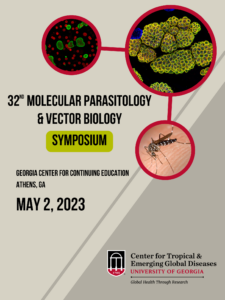
Click on the cover to view that year’s abstract book.

Past Keynote Speakers
| 2025 | Fernanda Novais, Dept. of Microbial Infection and Immunity, The Ohio State University, College of Medicine | HYPOXIA AND CD8 T CELLS IN CUTANEOUS LEISHMANIASIS |
| 2025 | Terri Taylor, Dept. of Osteopathic Medical Specialities, Michigan State University | THE PATHOGENESIS OF PEDIATRIC CEREBRAL MALARIA: MORE PIECES OF THE PUZZLE |
| 2024 | Astra Bryant, Dept. of Physiology & Biophysics, University of Washington, Seattle | THE THERMOSENSORY SPECIALIZATIONS OF A SKIN-PENETRATING HUMAN-PARASITIC NEMATODE |
| 2024 | David Sibley, Institute for Public Health, Washington University in St. Louis | CRYPTOSPORIDIOSIS: MICROBIAL INTERACTIONS IN THE GUT |
| 2023 | Sabrina Absalon, Dept. of Pharmacology & Toxicology, Indiana University School of Medicine | DECODING NEW PLAYERS IN PLASMODIUM NUCLEAR BIOLOGY USING EXPANSION MICROSCOPY |
| 2023 | Robert Seder, Cellular Immunology Section, National Institutes of Health | SCIENTIFIC AND CLINICAL DEVELOPMENT OF MONOCLONAL ANTIBODIES TO PREVENT AND ELIMINATE MALARIA |
| 2022 | Filipa Rijo-Ferreira, University of California, Berkeley School of Public Health | CIRCADIAN RHYTHMS IN PARASITIC DISEASES |
| 2022 | Philippe Bastin, Trypansome Cell Biology Unit, Institut Pasteur | SINGLE CELL RNA SEQUENCING REVEALS TRYPANSOME DEVELOPMENT IN THE SALIVARY GLANDS OF THE TSETSE FLY |
| 2021 | Emily R. Derbyshire, Duke University | INTERDISCIPLINARY APPROACHES TO REVEAL PLASMODIUM PARASITE VULNERABILITIES |
| 2021 | Daniel Goldberg, Washington University School of Medicine in St. Louis | MALARIA PARASITE PLASMEPSINS: NOT JUST PLAIN OLD DEGRADATIVE PEPSINS |
| 2019 | Matthew Collins, Emory University | EPITOPE TARGETS OF THE HUMAN ANTIBODY RESPONSE TO ZIKA VIRUS INFECTION |
| 2019 | James Morris, Clemson University | POUR SOME SUGAR ON ME: GLUCOSE, DEVELOPMENT, DRUG DISCOVERY, AND THE AFRICAN TRYPANOSOME |
| 2019 | Tiffany Weinkoff, University of Arkansas for Medical Sciences | THE ROLE OF MYELOID CELLS IN VASCULAR REMODELING DURING LEISHMANIA MAJOR INFECTION |
| 2019 | Marc-Jan Gubbels, Boston College | OF THE TOXOPLASMA GONDII BASAL COMPLEX PROTEOME: CELL DIVISION, APICAL ANNULI AND BEYOND |
| 2018 | Patricia J. Johnson, UCLA Molecular Biology Institute | TRICHOMONAS VAGINALIS: HUMAN HOST AND PARASITE INTERACTIONS |
| 2017 | Rick Fairhurst, M.D., Ph.D., NIAID Malaria Pathogenesis and Human Immunity Unit | PIPERAQUINE RESISTANCE AND DIHYDROARTEMISININ-PIPERAQUINE TREATMENT FAILURE IN CAMBODIA |
| 2016 | John Boothroyd, professor, Dept. of Microbiology and Immunology, Stanford School of Medicine | COMMUNICATING OUTSIDE THE BUBBLE: HOW THE INTRACELLULAR PARASITE, TOXOPLASMA GONDII, MOVES PROTEINS ACROSS THE PARASITOPHOROUS VACUOLE |
| 2015 | Takafumi Tsuboi, M.D., Ph.D., director of the Proteo-Science Center at Ehime University, Japan | WGCFS: AN INNOVATIVE TECHNOLOGY FOR POST-GENOME MALARIA VACCINE RESEARCH |
| 2015 | James KazurJames Kazuraa, M.D., professor of international health, medicine and pathology at Case Western Reserve University School of Medicine | PARADOXES ON THE ROAD TO MALARIA ELIMINATION |
| 2014 | Steve Reed, President and Chief Scientific Officer, IDRI | VACCINES FOR INTRACELLULAR PATHOGENS; LESSONS FROM LEISHMANIASIS AND TUBERCULOSIS |
| 2013 | Yasmine Belkaid, Chief, Mucosal Immunology Section, NIAID, Laboratory of Parasitic Diseases | |
| 2012 | Upinder Singh, Division Chief, Infectious Diseases and Geographic Medicine | |
| 2011 | Manuel Llinas, Department of Molecular Biology, Princeton University | |
| 2010 | William Petri, University of Virginia School of Medicine | MALNUTRITION AND INFECTION: LEPTIN AS A MEDIATOR OF MUCOSAL IMMUNITY TO AMEBIASIS |
| 2009 | Margaret Phillips, Department of Pharmacology, University of Texas Southwestern Graduate School of Biomedical Sciences | TARGETING MALARIA DIHYDROOROTATE DEHYDROGENASE |
| 2008 | CTEGD's 10th Anniversary | |
| 2007 | Karen Day, Department of Medical Parasitology, NYU Medical Center | THE EPIDEMIOLOGY OF MALARIA - A GENETICIST’S VIEW |
| 2006 | Stefan Kappe, Seattle Biomedical Research Institute | MALARIA LIVER STAGES: FROM BIOLOGY TO VACCINES |
| 2005 | David Sacks, Laboratory of Parasitic Disease, NIH | MOLECULAR ASPECTS OF LEISHMANIA – SAND FLY INTERACTIONS |
| 2004 | Jim McKerrow, Department of Pathology, University of California - San Francisco | MEETING THE CHALLENGE OF ANTIPARASITIC DRUG DESIGN |
| 2003 | Joseph Urban, Jr., Nutrient Requirements & Functions Laboratory, Beltsville Human Nutrition Research Center, Agricultural Research Service, USDA | CYTOKINE REGULATION OF IMMUNE AND PHYSIOLOGICAL FUNCTION DURING THE RESPONSE TO GASTROINTESTINAL PARASITES: LESSONS LEARNED FROM MICE AND PIGS |
| 2002 | Scott Landfear, Department of Molecular Microbiology and Immunology, Oregon Health and Sciences University | MOLECULAR STRATEGIES FOR NUTRIENT ACQUISITION BY LEISHMANIA AND TRYPANOSOMES |
| 2001 | Marilyn Parsons, Seattle Biomedical Research Institute and Department of Pathobiology, University of Washington | BUILDING A PROTEIN INTERACTION NETWORK IN THE TRYPANOSOMA BRUCEI NUCLEOLUS |
| 2000 | David Roos, Department of Biology, Computational Biology Training Programs, University of Pennsylvania | TOXOPLASMA AS A MODEL PARASITE: BIOCHEMISTERY, CELL BIOLOGY, MOLECULAR GENETICS, GENOMICS... AND BEYOND! |